The most consequential conversations in international politics are often those conducted behind closed doors. Diplomatic visits may be announced in the language of partnership, regional stability, and strategic cooperation; yet their implications can extend far beyond the official agenda.
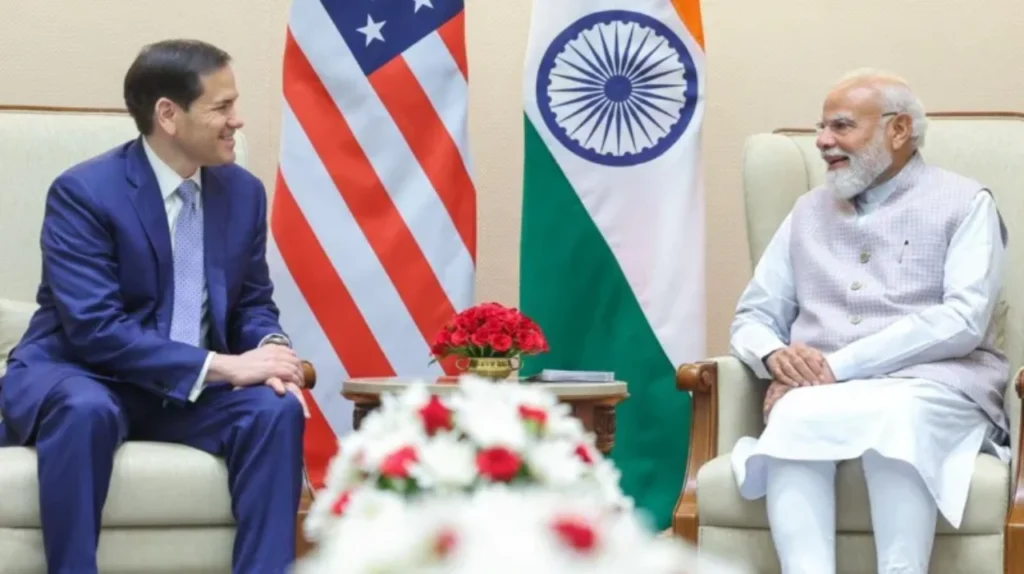
When American Secretary of State Marco Rubio recent visits India, Bangladesh has compelling reasons to watch closely—not with panic or speculation, but with clear-eyed attention to the strategic calculations of two influential powers.
Is Bangladesh merely a neighbouring concern, or could it become a significant question in the wider American–Indian strategic dialogue?
That is the question demanding serious examination.
Washington and New Delhi share important interests in the Indo-Pacific, regional security, trade, technology, and their respective approaches to an increasingly contested international order.
Their relationship, however, is not without contradictions. Each government pursues its own national interests, and cooperation in one domain does not guarantee agreement in another.
Bangladesh, positioned at the crossroads of South and Southeast Asia and overlooking the strategically significant Bay of Bengal, occupies a geography that neither capital can afford to ignore.
Its political direction, economic resilience, and external partnerships therefore carry implications extending beyond its borders.
Bangladesh: More than a footnote
For India, Bangladesh is inseparable from questions of border security, connectivity, trade, water sharing, and the security of India’s northeastern states.
For the United States, Bangladesh matters through its strategic location, commercial opportunities, maritime significance, democratic institutions, and relationships with regional and global powers.
These overlapping interests create ample grounds for diplomatic discussion. They do not, however, establish that Bangladesh may necessarily the central subject of Rubio’s conversations with Indian leaders.
Nevertheless, the possibility of Bangladesh featuring in broader discussions deserves attention. Regional diplomacy rarely occurs in isolated compartments. Developments in one country can influence calculations concerning security, economic access, migration, maritime routes, and the regional balance of power.
The pertinent question is not simply whether Washington and New Delhi discuss Bangladesh. It is what principles guide their approach, whose interests they prioritise, and how their decisions might affect the sovereignty and democratic aspirations of the Bangladeshi people.
Sovereignty must not become a bargaining chip
Bangladesh earned its independence through an extraordinary struggle in 1971. Millions endured suffering, and countless lives were sacrificed in the pursuit of national freedom.
That history imposes a profound responsibility upon every government, domestic or foreign, to respect the country’s sovereignty and the dignity of its people.
No strategic partnership should become a licence to dictate Bangladesh’s political future. Nor should Dhaka’s internal affairs be treated as negotiable assets in a contest between larger powers.
The principle applies universally. Neither Washington nor New Delhi should presume that Bangladesh’s national interests can be determined without the participation of Bangladeshis themselves.
Equally, Bangladesh’s own political leaders bear the responsibility of ensuring that foreign relationships strengthen national independence rather than compromise it.
A country’s sovereignty is not preserved by rhetoric alone. It requires credible institutions, accountable government, economic resilience, public confidence, and a foreign policy capable of engaging powerful states without surrendering independent judgment.
The Sheikh Hasina and Awami League question
Bangladesh’s political future, including the position of Sheikh Hasina and the Awami League, may attract international attention because domestic political developments can affect regional stability and bilateral relations. Yet the significance of these questions must evidence of a particular diplomatic bargain.
Any assessment of Washington’s or New Delhi’s position should rest on verifiable statements, documented policy decisions, and demonstrable actions—not conjecture about secret understandings.
Bangladesh’s political future ultimately depends upon the country’s constitutional arrangements, the legitimacy of its institutions, the protection of fundamental rights, and the meaningful participation of its citizens. Foreign governments can influence the surrounding environment, but they cannot substitute for a credible domestic political settlement.
The decisive issue is whether Bangladesh can secure a political order in which sovereignty, accountability, pluralism, and the rule of law reinforce one another.
The Bay of Bengal and the new geopolitical contest
The Bay of Bengal is not merely a body of water separating coastlines. It is a strategic corridor connecting South Asia with Southeast Asia and the wider Indo-Pacific. Maritime security, port access, commercial routes, infrastructure, and regional connectivity can all shape the calculations of major powers.
Bangladesh must therefore resist the temptation to view international diplomacy through the narrow lens of immediate political advantage. Its long-term interests require balanced engagement with India, the United States, China, and other partners, without becoming captive to any single power’s strategic priorities.
Diplomatic independence does not mean diplomatic isolation. It means maintaining the freedom to cooperate without surrendering the right to disagree.
The questions Dhaka must answer
If Bangladesh features in American–Indian discussions, what should Dhaka demand of its own leadership? Transparency in national decision-making. Consistency in foreign policy. Protection of strategic assets. Respect for constitutional principles. And, above all, an unwavering commitment to the national interest.
Bangladesh must also develop the diplomatic capacity to articulate its priorities convincingly. A country that cannot define its interests clearly risks allowing others to define them on its behalf.
The responsibility extends beyond whichever political administration happens to occupy the corridors of power. National sovereignty belongs to the people, not to a government, a political party, or a foreign patron.
Rubio’s visit should consequently prompt a broader debate about Bangladesh’s place in the emerging regional order. What kind of relationship does the country seek with Washington? How should it manage its complex relationship with New Delhi? How can it maintain constructive engagement with Beijing while safeguarding its own strategic autonomy?
History is watching
Bangladesh did not emerge in 1971 to become a pawn on another nation’s geopolitical chessboard. Its independence was won through sacrifice, and its future must be shaped by the aspirations of its own people.
Whether Washington and New Delhi discuss Bangladesh in their diplomatic exchanges remains a question to be answered clear-cut. What is beyond dispute is that Bangladesh’s strategic location makes it relevant to the region’s wider calculations.
The challenge for Dhaka is to transform that geographical significance into diplomatic strength.
Bangladesh must be a partner, never a pawn; a sovereign voice, never an echo; a nation that engages the world without surrendering its destiny.
The blood of 1971 demands nothing less.