In the quiet pottery workshops of Larnai and among the towering stone monoliths of Nartiang, Union Finance Minister Nirmala Sitharaman found herself at the heart of Meghalaya’s living heritage on Sunday, engaging with artisans, farmers and local communities who continue to preserve traditions passed down through generations.
During the second day of her visit to the state, the Finance Minister experienced first-hand some of the cultural practices, historical landmarks and indigenous products that have come to define the identity of the Jaintia Hills. Along the way, she reflected on the importance of safeguarding traditional knowledge while ensuring that local communities are able to translate their heritage into sustainable economic opportunities.
The visit brought together several strands of Meghalaya’s story — its craftsmanship, agriculture, spirituality and history — illustrating how culture and livelihood remain closely connected across the region.
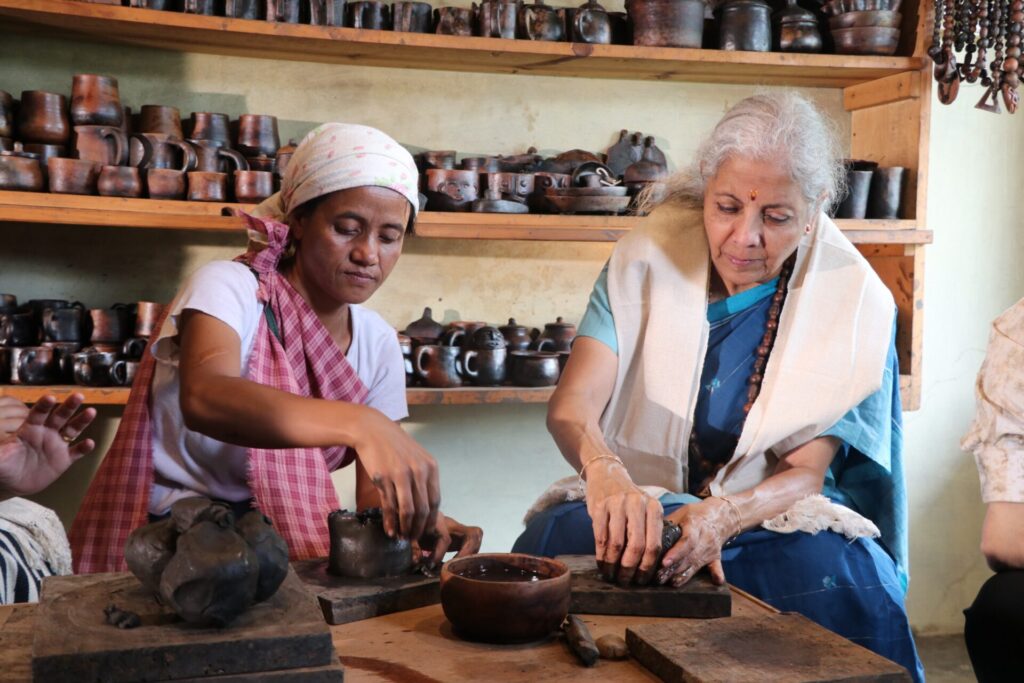
A key highlight of the visit was Larnai village, renowned for its centuries-old tradition of black clay pottery. Recently awarded a Geographical Indication (GI) tag, Larnai’s distinctive pottery is known for its dark finish and entirely handcrafted production process, making it one of Meghalaya’s most unique cultural products.
For the people of Larnai, the craft is not merely a symbol of cultural identity but also the foundation of their local economy.
During a live demonstration, Sitharaman observed every stage of the pottery-making process — from preparing the clay and hand-moulding the vessels to the intricate engraving work that gives each piece its character.
Joining the artisans, she also tried moulding clay herself under their guidance, drawing smiles from villagers and craftspeople gathered around the demonstration area.
Impressed by the skill, patience and dedication involved, the Finance Minister praised the artisans for preserving and passing on their ancestral knowledge to younger generations.
She also interacted with members of the community on ways to improve market access and expand the reach of their products beyond the region, noting that traditional crafts can create meaningful livelihood opportunities when connected to wider markets.
The focus on Meghalaya’s unique cultural and economic assets continued at the historic Nartiang Monoliths, one of the Northeast’s most significant megalithic heritage sites.
Surrounded by the towering stone monuments erected during the height of the Jaintia Kingdom, Sitharaman visited a special exhibition showcasing Meghalaya’s growing portfolio of GI-tagged products.
The exhibition featured some of the state’s most celebrated products, including Khasi Mandarin, Memong Narang, Lakadong Turmeric, Garo Textiles, Larnai Black Clay Pottery and the traditional beverage Meghalaya Chubitchi.
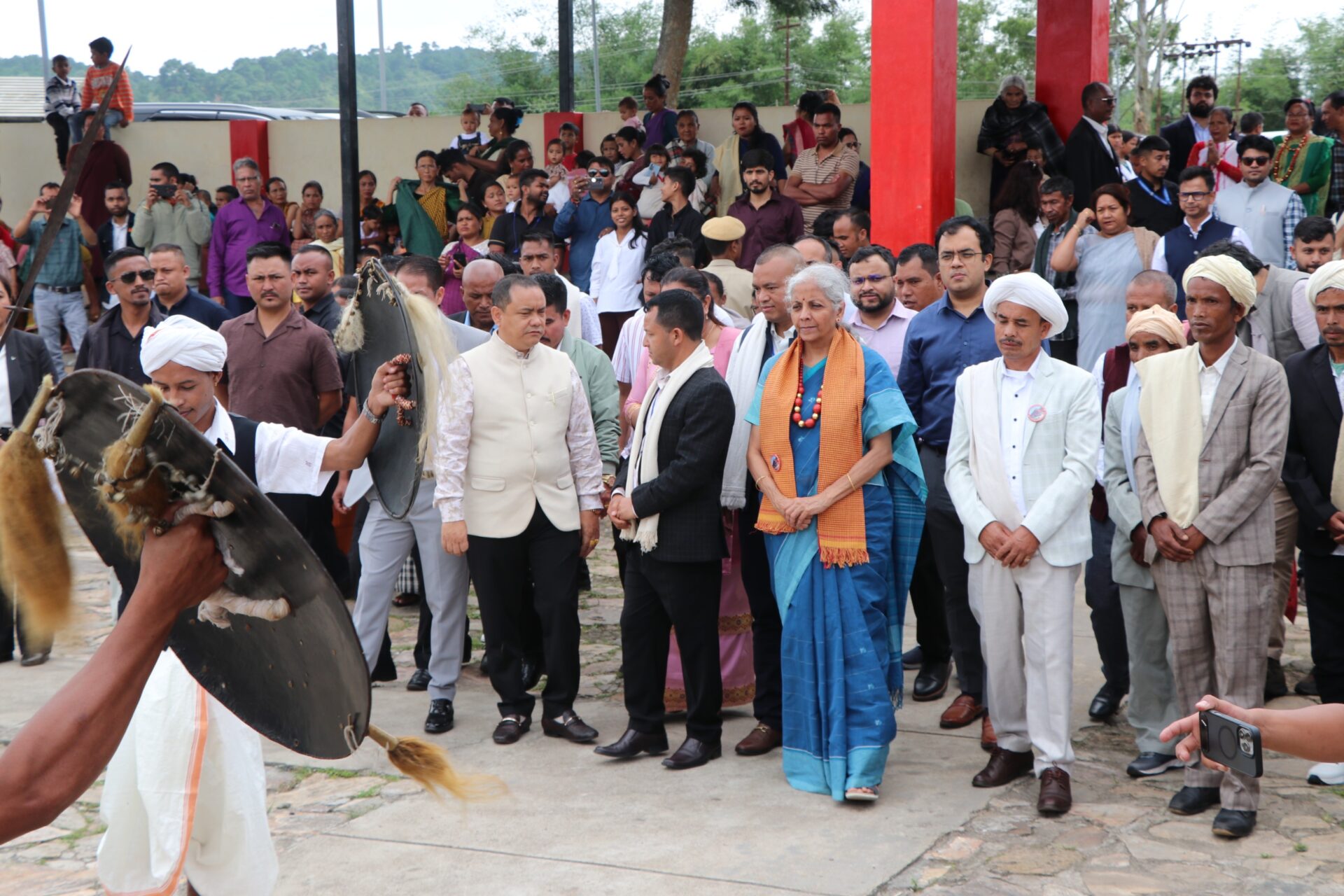
The display highlighted both the diversity of Meghalaya’s indigenous knowledge systems and the economic potential of locally produced goods.
Interacting with farmers, weavers, artisans and producer groups, Sitharaman learned about their traditional production methods and discussed opportunities to access larger markets.
She commended their entrepreneurial spirit and observed that the successful blending of heritage and commerce can help create resilient local economies while preserving cultural traditions.
Beyond economics and craftsmanship, the visit also reflected the deep historical and spiritual roots of the region.
Earlier in the day, the Finance Minister offered prayers at the revered Shri Maa Jayantee Temple. Believed to be more than 600 years old and widely regarded as one of the 51 sacred Shakti Peethas, the temple remains an important spiritual landmark that attracts devotees from across the country.
The visit offered a glimpse into the rich cultural landscape of the Jaintia Hills, where sacred sites, traditional livelihoods and historical landmarks continue to shape community life.
By connecting the spiritual legacy of the region, the historic significance of the Nartiang Monoliths and the growing recognition of Meghalaya’s GI-tagged products, Sitharaman’s engagements highlighted how heritage can also serve as a driver of economic opportunity.
Her interactions across Larnai, Nartiang and other heritage sites reinforced the importance of preserving cultural assets while ensuring that local communities benefit from their growing visibility and value.
The visit also included a focus on infrastructure and youth development.
On Saturday, Sitharaman inaugurated the Jowai–Nartiang–Kdiap–Khanduli (JNKK) Road and inspected the Wahiajer Football Stadium in West Jaintia Hills. Together, the projects represent an investment of more than ₹124 crore.
Constructed with financial support from the New Development Bank (NDB) at a cost exceeding ₹59 crore, the JNKK Road is expected to significantly improve connectivity across the region.
Addressing a gathering at the Wahiajer Football Stadium, the Finance Minister emphasised that quality infrastructure remains essential for ensuring that the benefits of development reach even the most remote parts of the country.
Local residents have welcomed the road project, which is expected to improve access to markets, educational institutions and healthcare facilities.
By easing transportation challenges, the upgraded route is projected to reduce travel time, lower transport costs for agricultural produce and support economic activity across surrounding tribal communities.
At the stadium, Sitharaman also interacted with students from Kiang Nangbah Government College, Jowai.
Established in 1967 and named after the legendary freedom fighter U Kiang Nangbah, the institution has long served as a centre of higher education for the Jaintia Hills region.
During an interactive session, students raised questions on employment, entrepreneurship, financial literacy, technology and nation-building.
Encouraging them to remain adaptable in a rapidly changing world, the Finance Minister urged young people to stay curious and continuously upgrade their skills.
She also spoke about the challenges of the digital age, observing that while smartphones provide instant access to information, the overwhelming volume of online content can often create confusion and distraction.
Sitharaman advised students to exercise critical thinking, practise self-restraint and seek guidance from teachers, elders and family members before forming opinions based solely on information encountered online.
The Wahiajer Football Stadium itself emerged as a major symbol of the government’s investment in sports infrastructure.
Built at a cost of over ₹65 crore on a 16-acre site, the facility was funded under the Ministry of Finance’s Special Assistance to States for Capital Investment (SASCI) scheme, which provides states with 50-year interest-free loans for critical capital projects.
Designed according to international sporting standards, the complex includes a synthetic football turf integrated within an eight-lane, 400-metre World Athletics-certified synthetic track.
Built to meet both FIFA and World Athletics requirements, the stadium also features facilities for long jump, triple jump, pole vault, steeplechase, javelin throw, shot put and discus throw, along with a 100-metre straight athletics track and spectator seating for more than 6,000 people.
Interacting with schoolchildren and athletes, Sitharaman expressed satisfaction with the quality of the facility and described it as a valuable public asset that can serve generations of young sportspersons.
Noting that the stadium has already begun hosting local events, she encouraged authorities and local communities to ensure its full utilisation so that it can develop into a premier hub for sports and community engagement in the wider Northeast.
Officials said the road and sports infrastructure projects align with Prime Minister Narendra Modi’s broader emphasis on capital expenditure-led development aimed at creating jobs, improving rural livelihoods and providing world-class opportunities for India’s youth.