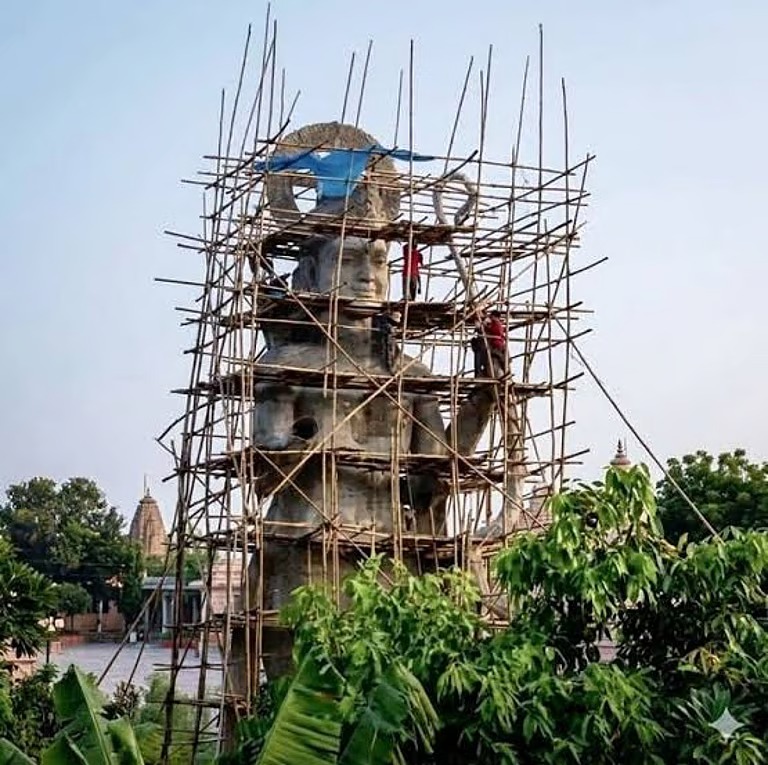
On the edge of the Dhaka–Rangpur highway, an unfinished concrete figure rises above the paddy fields of Gaibandha. Steel bars jut from its crown. The planned 81-foot statue of Ram—about 80 percent complete—stands on the grounds of the Shri Shri Radha Gobinda and Kali Temple in Palashbari and has remained untouched since June 13.
For many local Hindus, that frozen construction site has come to represent something larger than an interrupted building project. It has become a measure of how far Bangladesh’s constitutional promise of religious freedom extends when organised opposition pushes back.
The temple committee says it suspended construction in the interest of communal harmony.
“We have not come under political or administrative pressure,” committee adviser Shyamal Kumar Mohanta told reporters at the time.
Few within Bangladesh’s minority community accepted that explanation at face value.
What halted the construction was not a court order. There was no official notice, nor any formal government directive. What stopped it, according to those involved, was fear.
Sources familiar with discussions between local officials and temple representatives told local media that authorities had quietly encouraged the committee to halt construction before tensions escalated further. No written order was ever issued. No government agency has publicly acknowledged those conversations.
That absence of any formal directive is precisely the problem: it leaves the statue’s legal status in limbo while providing the government with plausible deniability should its actions be challenged.
From temple project to national controversy
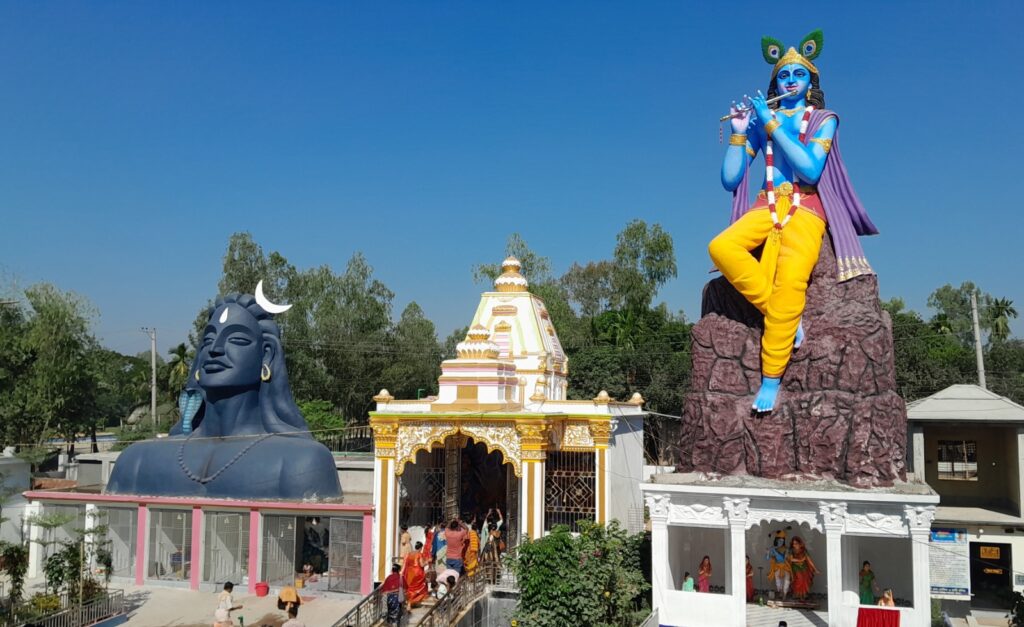
The temple complex is not new, and controversy is not its natural state. A 52-foot Krishna statue has stood on the same grounds for years. So has a Shiva idol. Neither attracted significant attention.
Ram was different. When details of the project spread on social media—organisers had initially described it as potentially the largest Ram statue in Asia—religious organisations mobilised quickly. The Imam Olama Parishad submitted a memorandum to district authorities demanding an investigation into the project’s funding and an immediate halt to construction. Demonstrations were organised across Gaibandha.
Videos circulated online showing speakers threatening to take direct action against the statue if the government failed to intervene. Borderlens has not independently verified each clip, but several widely shared videos appeared to significantly heighten public tensions.
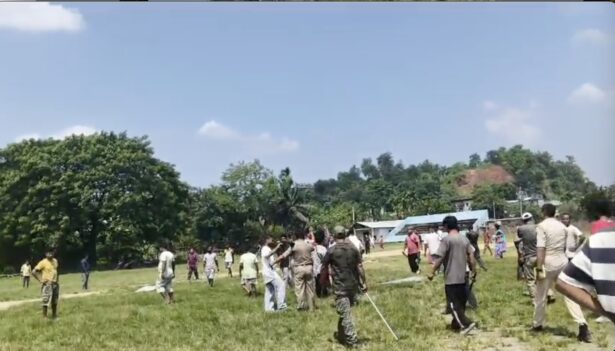
Days after construction stopped, hundreds gathered at Palashbari’s Charmatha intersection. Religious leaders, local Jamaat activists, and figures associated with Hefazat took turns addressing the crowd. Police were deployed in large numbers.
The man at the centre of the dispute
Haridash Chandra Tarani Das, chairman of the temple committee and the driving force behind the project, has spent recent weeks fending off what he describes as a coordinated disinformation campaign.
Social media accounts have accused him of being a Muslim convert named Touhid Islam, of fraud, and of having a Christian background. He has publicly rejected all such allegations, stating that he has never changed his religion and noting that a 2022 fraud case against him ended without prosecution after two weeks.
Borderlens has not independently verified the various accusations circulating online.
What is verifiable is that the temple complex operates a gurukul school and an old-age home, and is working toward establishing a small medical facility. According to Haridash, most of the roughly 150 shops adjacent to the temple are operated by Muslim traders.
His assessment of the situation is blunt.
“There is no problem with Muslims here. The problems are coming from outside.”
He has also made his position on the statue clear. He will not demolish it himself. If the government wants it removed, it should do so officially.
Constitutional rights versus political reality
Bangladesh’s Constitution guarantees citizens the right to profess, practise, and propagate their religion. The land on which the statue stands is Debottar property—a Hindu religious trust. No court has declared the construction illegal. No government agency has publicly stated that the project violates any law.
What has occurred instead is something quieter and more difficult to challenge.
Legal experts note that governments sometimes pursue negotiated outcomes in sensitive religious disputes rather than issuing formal orders that could later face judicial scrutiny. Critics argue that such an approach effectively achieves a desired outcome while avoiding accountability.
Supporters of the temple project say that anyone who publicly backs the statue risks online harassment, intimidation, and coordinated social media attacks.
A wider debate on minority rights
The Palashbari dispute has unfolded against a broader backdrop that gives it significance beyond the local context.
Minority advocacy groups, including the Bangladesh Hindu Buddhist Christian Unity Council, have documented hundreds of incidents targeting minority communities since the political transition that followed the fall of Sheikh Hasina’s government in August 2024.
Government officials have pushed back against those characterisations, arguing that many incidents categorised as communal violence were primarily political rather than religious in nature.
That dispute over interpretation has itself become a source of friction. International human rights organisations have repeatedly called for impartial investigations and stronger legal protections, regardless of motive.
An early test for Tarique Rahman’s government
Following his election victory in February, Prime Minister Tarique Rahman pledged to build “a safe land for every citizen—Muslims, Hindus, Buddhists, Christians—regardless of party, opinion, religion or ethnicity.”
The temple committee, in seeking permission to resume construction, quoted the Prime Minister’s own words back to the government: “religion belongs to the individual, but the state belongs to all.”
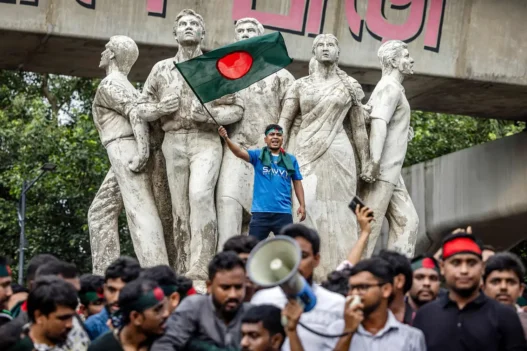
In Dhaka, students from Jagannath Hall marched to Shahbagh, blocked traffic, and demanded two things: that construction be allowed to resume and that those who desecrated images of Ram during earlier protests face legal consequences.
For many who joined the demonstrations, the unfinished statue had already ceased to be solely a religious issue. It had become a political one.
What happens next?
The structure stands where it has stood since June. Completing it requires political approval that no one has publicly offered. Demolishing it requires an official decision that no one has publicly accepted responsibility for making.
That gap—between the Constitution’s guarantee and the government’s silence—is exactly what Bangladesh’s Hindu community is watching.
Whether the statue is eventually completed, permanently frozen, or quietly removed will say much about how the Rahman government intends to navigate the tension between majority sentiment and minority rights.
The concrete has already been poured. The answer is still pending.