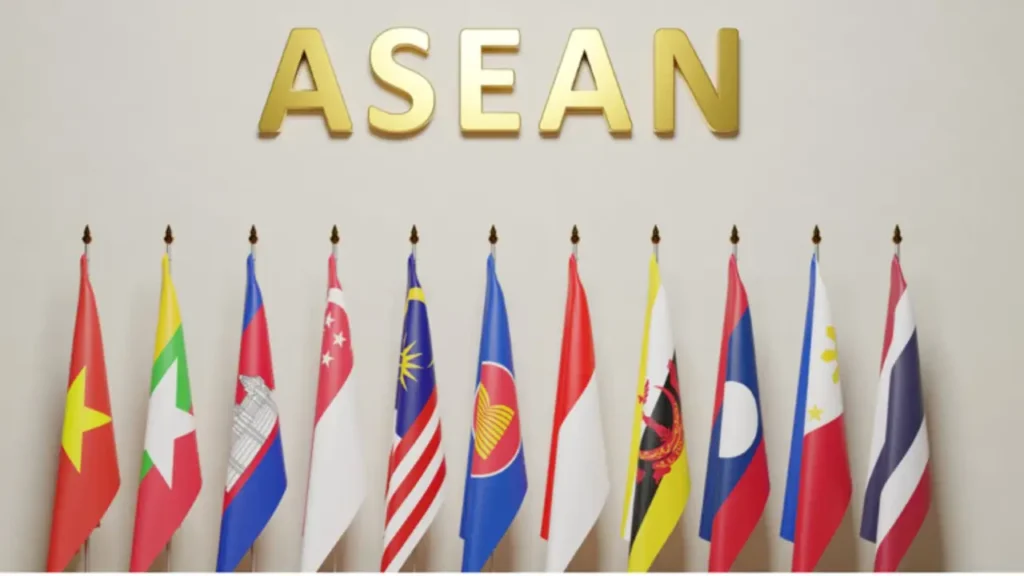
Myanmar’s military-led government appears to be slowly rebuilding diplomatic engagement with the Association of Southeast Asian Nations (ASEAN), signalling a cautious thaw in relations after years of isolation following the 2021 military takeover. Yet, despite signs of renewed contact, ASEAN continues to insist that any meaningful progress depends on dialogue involving all parties to Myanmar’s conflict and concrete movement on its long-standing Five-Point Consensus.
The latest indication of this gradual re-engagement comes as Myanmar’s President Min Aung Hlaing is expected to undertake his first official visit to Thailand in early August since assuming the presidency in April. The visit would be his second official trip to an ASEAN member state after travelling to Laos earlier this month, reflecting a noticeable increase in diplomatic outreach by the Naypyidaw administration.
The expected visit follows a series of high-level regional interactions. Earlier this month, Myanmar’s Foreign Minister Tin Maung Swe attended an informal gathering of ASEAN foreign ministers in Bangkok—the first in-person participation by a representative of Myanmar’s military administration at such a meeting since ASEAN suspended the country’s political leadership from its high-level summits after the 2021 coup.
Ahead of that meeting, Tin Maung Swe also held bilateral discussions with Thailand’s Foreign Minister Sihasak Phuangketkeow, where the two sides exchanged views on cross-border security, trade, environmental cooperation and other bilateral concerns. Thai officials reportedly reiterated the importance of advancing ASEAN’s Five-Point Consensus, the regional framework intended to facilitate dialogue and reduce violence in Myanmar.
At the same time, ASEAN has made it clear that renewed engagement with Myanmar’s authorities will not come at the expense of broader political inclusion. The Philippines, which currently chairs ASEAN, has emphasised that the bloc’s diplomatic efforts will continue to include conversations with all stakeholders involved in Myanmar’s conflict, including ethnic armed organisations, resistance groups and representatives of the National Unity Government (NUG).
Philippine Foreign Secretary Ma. Theresa P. Lazaro, who also serves as ASEAN’s Special Envoy on Myanmar, has reportedly held separate discussions with representatives of the NUG, ethnic armed organisations and other actors in recent days. According to Philippine officials, these consultations are intended to ensure that ASEAN’s understanding of the crisis reflects perspectives from across Myanmar’s deeply fragmented political landscape.
Officials in Manila described the discussions as constructive and reaffirmed that ASEAN’s engagement remains open to every stakeholder willing to participate in dialogue. Philippine government spokesperson Dominic Xavier Imperial said the regional bloc is not restricting its consultations to any single group, arguing that a durable political solution requires broad participation from all sides.
According to informed sources The National Unity Government (NUG) has likewise urged ASEAN to maintain an inclusive approach. In a recent statement, the NUG argued that the principal obstacle to peace is not a lack of diplomatic initiatives but the military administration’s continued failure to implement the Five-Point Consensus, which Senior General Min Aung Hlaing accepted shortly after the military seized power in February 2021.
Sources also said that the opposition administration also called on ASEAN to ensure that future political engagement includes all relevant actors rather than focusing solely on the military authorities, stressing that an inclusive process remains essential for any credible pathway towards peace.
According to a report by Reuters Myanmar is expected to feature prominently during the upcoming ASEAN Foreign Ministers’ Meeting in Manila next week, where regional diplomats will review developments in the country alongside broader strategic issues, including negotiations on the proposed ASEAN–China Code of Conduct for the South China Sea, rising geopolitical competition across the Indo-Pacific and the wider economic consequences of recent conflicts in the Middle East. The meeting will also bring together senior diplomats from ASEAN and several major international partners, including the United States, China, Russia, Japan, Australia, Canada and the United Kingdom, underscoring the growing international attention on both Myanmar’s political crisis and Southeast Asia’s evolving strategic landscape.
Although Myanmar’s renewed diplomatic engagements suggest that its years of relative isolation within ASEAN may be gradually easing, the regional bloc has remained consistent in linking deeper political re-engagement to tangible progress on its Five-Point Consensus. By continuing to engage not only the military authorities but also the National Unity Government, ethnic armed organisations and other stakeholders, ASEAN appears to be signalling that any sustainable resolution to Myanmar’s conflict will depend on an inclusive political process rather than engagement with a single actor alone.