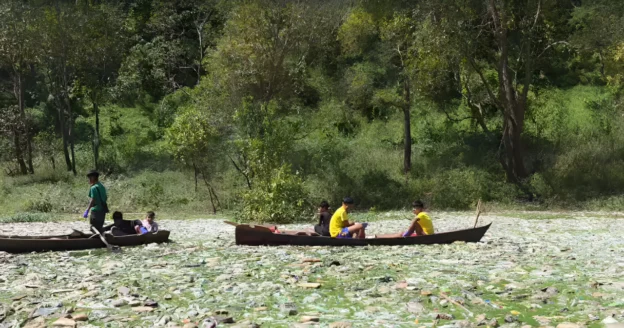
The gunfire that echoed through the Behali Reserve Forest in Assam’s Biswanath district on July 16 was more than an isolated law-and-order incident. When alleged armed miscreants from Arunachal Pradesh fired around 50 rounds at Assam Forest Department personnel attempting to stop fresh encroachment inside the reserve, the incident exposed a much deeper crisis. It revealed how an unresolved inter-state boundary dispute has gradually transformed one of Northeast India’s ecologically richest landscapes into a contested frontier where forests, governance and national security increasingly intersect.
Assam Forest Minister Jayanta Mallabaruah’s unusually strong response—authorising stringent action against encroachers, ordering an inquiry into possible collusion by forest officials, and declaring that security personnel need not hesitate to use force when necessary—reflects the seriousness with which the Assam government now views the situation. His observation that nearly 400 hectares of forest visible in satellite imagery six months ago have already been partially destroyed should alarm policymakers far beyond Assam.
Yet the Behali episode should not be viewed merely as a dispute over trees or administrative jurisdiction. It is the latest manifestation of a decades-old border conflict whose consequences now extend to biodiversity conservation, organised timber smuggling, illegal land conversion, insurgency and India’s strategic security along its sensitive eastern Himalayan frontier.
A boundary drawn without consent
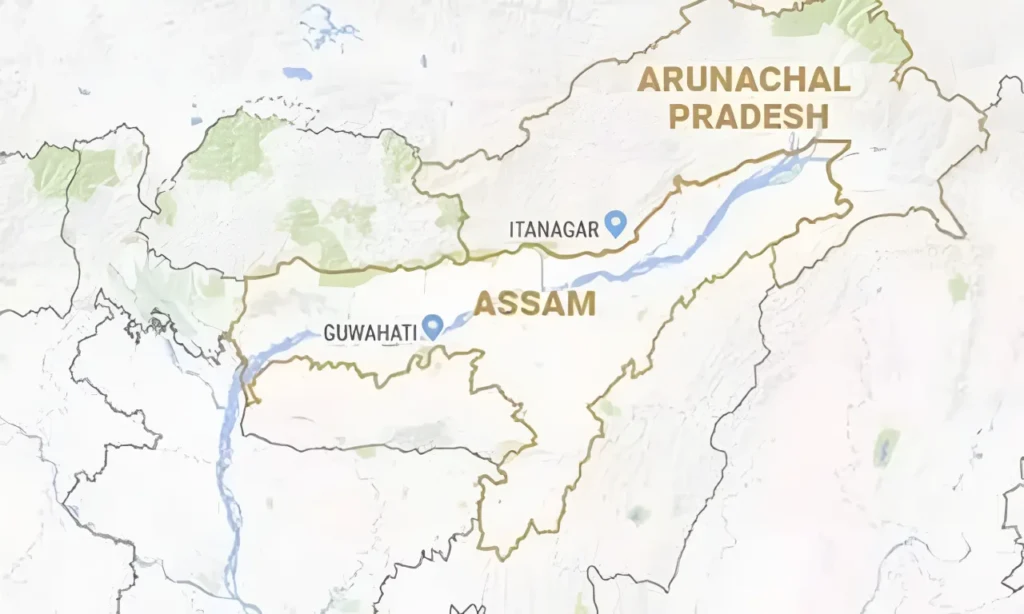
The Assam-Arunachal Pradesh border dispute has its roots in colonial cartography. The present boundary largely follows the “Inner Line” notified under the Bengal Eastern Frontier Regulation of 1873 and later the recommendations of the 1951 Bordoloi Committee, which transferred vast tracts of forest and foothill areas from Assam to the then North-East Frontier Agency (NEFA).
Assam has consistently questioned several of these transfers, arguing that traditional administrative boundaries and revenue records were ignored. Arunachal Pradesh, however, considers the existing constitutional boundary final. The disagreement affects numerous sectors across districts such as Biswanath, Sonitpur, Lakhimpur, Dhemaji, and Tinsukia.
Although the Supreme Court-appointed Justice V.S. Srinivasan Commission submitted recommendations in 2014, neither state fully accepted the findings. In 2022, the two BJP-led governments initiated a fresh process through regional committees to resolve 123 disputed villages. While progress has been reported in several sectors, many ecologically sensitive forest areas remain unresolved.
The events in Behali demonstrate that administrative negotiations alone have not translated into effective protection on the ground.
Forests paying the highest price
The foothill forests along the Assam-Arunachal border form one of India’s most significant ecological corridors. Behali Reserve Forest connects the forests of Nameri National Park, Pakke Tiger Reserve and the larger Eastern Himalayan landscape. These forests support elephants, tigers, clouded leopards, hornbills and numerous endemic species.
However, satellite assessments by the Forest Survey of India indicate that parts of the Assam-Arunachal foothills have experienced increasing fragmentation due to encroachment, road expansion, shifting cultivation, illegal logging and agricultural conversion. While both Assam and Arunachal continue to retain substantial overall forest cover, localised losses in border forests have become particularly severe. The minister’s reference to approximately 400 hectares of recent degradation in Behali underscores the scale of destruction in a relatively short period.
What makes the current crisis particularly disturbing is the apparent shift from opportunistic logging to organised land conversion. Officials suspect that portions of the cleared forests are being prepared for commercial plantations, including oil palm cultivation. Such conversion permanently alters forest ecosystems and weakens one of the most critical wildlife corridors in the eastern Himalayas.
The smuggling economy behind the conflict
Border disputes often create governance vacuums, and governance vacuums create illegal economies.
For years, environmental groups and local communities have alleged that unresolved jurisdictional issues enable timber smugglers to exploit enforcement ambiguities. Valuable hardwood species can be felled in remote forests and transported across poorly monitored boundaries before enforcement agencies determine administrative responsibility.
The problem extends beyond timber. Once forests are cleared, illegal occupation gradually follows, eventually converting public forests into private agricultural land. Such encroachments become increasingly difficult to reverse, especially when competing jurisdictional claims exist.
Minister Mallabaruah’s decision to investigate possible involvement of forest officials acknowledges another uncomfortable reality: illegal forest economies rarely survive without institutional complicity. Whether through negligence, corruption, or political protection, organised forest crimes often involve actors on both sides of administrative boundaries.
The national security dimension
The Assam-Arunachal frontier carries significance beyond environmental governance.
Arunachal Pradesh shares a nearly 1,100-kilometre international boundary with China, making it one of India’s most strategically sensitive regions. For decades, the dense forests and rugged mountains along the Assam-Arunachal border have provided temporary shelter and transit routes for insurgent groups operating in Northeast India, including factions of the United Liberation Front of Asom (ULFA). Security agencies have repeatedly documented how difficult terrain, sparse population and limited state presence enabled insurgent movement through these forested corridors, although the operational capacities of such groups have significantly declined in recent years.
In this context, weakening forest governance acquires broader security implications. Illegal settlements, uncontrolled land occupation and criminal networks operating in border forests complicate surveillance and reduce the state’s ability to monitor sensitive frontier regions.
Environmental degradation, therefore, cannot be viewed separately from strategic security.
A political opportunity
Ironically, the current political situation offers perhaps the best opportunity in decades to address the issue comprehensively.
Both Assam and Arunachal Pradesh are governed by the Bharatiya Janata Party. The absence of partisan confrontation should, in theory, allow faster administrative coordination and political consensus. Chief Ministers Himanta Biswa Sarma and Pema Khandu have already demonstrated willingness to negotiate several disputed sectors.
However, Behali shows that negotiations alone are insufficient unless accompanied by joint enforcement.
Rather than allowing competing claims to become excuses for administrative paralysis, both governments should establish permanent joint forest protection mechanisms in disputed landscapes. Shared satellite monitoring, coordinated anti-smuggling operations, integrated forest patrols and common restoration programmes could protect forests without prejudicing either state’s legal claims.
Equally important is ensuring that local communities are not drawn into illegal land conversion driven by commercial interests.
Beyond borders
Minister Jayanta Mallabaruah made an important distinction when he observed that “a border dispute cannot become a reason to destroy forests.”
That statement deserves to become the guiding principle for both governments.
The forests along the Assam-Arunachal boundary are older than the states themselves. They regulate rivers flowing into the Brahmaputra, sustain biodiversity recognized globally, support indigenous livelihoods and form part of India’s strategic environmental infrastructure.
If these forests continue disappearing while governments debate jurisdiction, the eventual settlement may resolve a boundary that no longer possesses the ecological wealth it was meant to protect.