
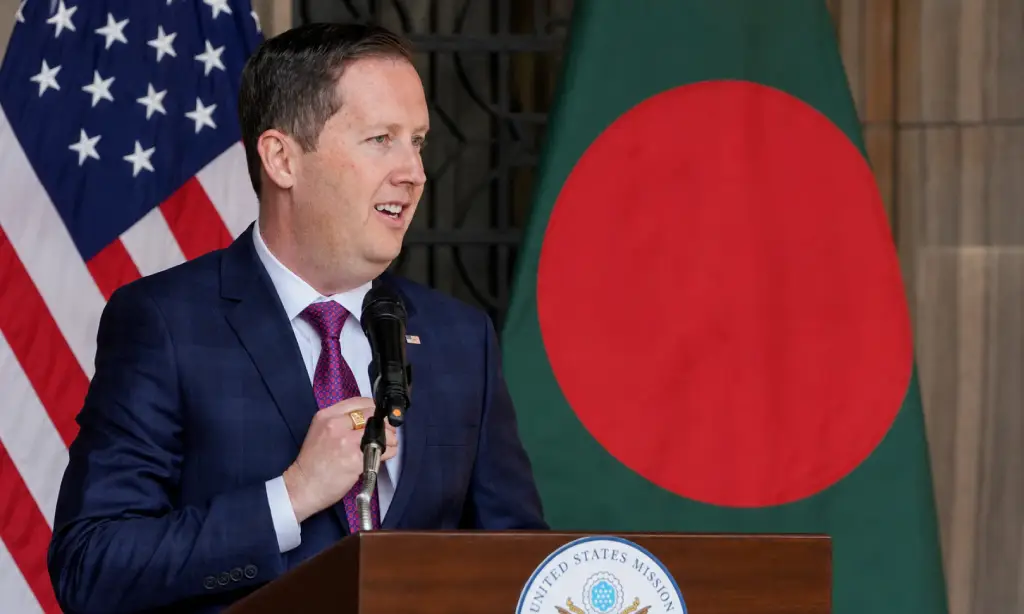
The impending visit of Sergio Gor, one of U.S. President Donald Trump’s closest confidants and Special Envoy for South and Central Asian Affairs, has generated intense political and diplomatic speculation across Bangladesh.
Arriving only five months after the formation of the Tarique Rahman government, his visit is widely viewed as carrying strategic significance that extends well beyond the ceremonial boundaries of bilateral diplomacy.
South Asia today stands at the epicentre of an increasingly competitive geopolitical landscape.
Bangladesh, situated at the confluence of the Bay of Bengal, India’s northeastern gateway, and China’s expanding Indo-Pacific footprint, has inevitably become a nation of immense strategic value.
Consequently, every high-level diplomatic engagement is interpreted through the prism of regional security, economic influence, and great-power rivalry.
Among the issues expected to dominate discussions are Bangladesh’s evolving military and economic engagement with China, particularly the proposed “Two Plus Two” strategic dialogue, Beijing’s continuing interest in the Teesta River Comprehensive Management Project, possible Chinese involvement in Mongla Port, and reports concerning future defence procurement, including advanced combat aircraft.
These developments have naturally attracted close attention from Washington, New Delhi, and other regional stakeholders seeking to preserve strategic equilibrium in South Asia.
Equally significant is the widespread speculation surrounding Prime Minister Sheikh Hasina and the possibility of her eventual return to Bangladesh.
Her political future remains one of the country’s most closely watched issues, not only because of her enduring domestic influence but also because of the implications for regional stability and Bangladesh’s future democratic trajectory.
Should Sergio Gor’s discussions include Bangladesh’s internal political climate, constitutional governance, or prospects for political reconciliation, it would signal that Washington is reassessing its long-term engagement with Dhaka under the evolving regional strategic environment.
Such discussions would inevitably be interpreted as part of a broader recalibration rather than an isolated diplomatic exercise.
The Trump administration has consistently approached foreign policy through the lens of strategic realism.
National interest, regional stability, secure supply chains, maritime security, and balancing China’s growing influence remain central pillars of Washington’s global outlook.
Within this framework, Bangladesh occupies a position that is increasingly difficult for any major power to overlook.
The Bay of Bengal has become one of the world’s most strategically contested maritime theatres.
As China expands its Belt and Road Initiative and strengthens partnerships throughout the Indo-Pacific, the United States and its allies are simultaneously seeking to reinforce their own regional partnerships.
Bangladesh therefore finds itself navigating between competing strategic visions while attempting to preserve its sovereign decision-making and developmental aspirations.
For Dhaka, this balancing act demands exceptional diplomatic prudence.
Constructive relations with China have contributed significantly to infrastructure development and economic growth.
Simultaneously, strong partnerships with the United States remain indispensable in trade, investment, technology, defence cooperation, and access to global markets.
Bangladesh’s long-term national interest lies not in choosing sides but in maintaining strategic autonomy through balanced engagement with all major partners.
India’s perspective also carries considerable weight.
Given the shared border, interconnected security concerns, and extensive economic ties, New Delhi closely monitors any geopolitical shifts involving Bangladesh.
Consequently, Washington’s evolving assessment of Dhaka’s external partnerships will almost certainly take India’s strategic interests into account, particularly regarding regional connectivity, maritime security, and counterterrorism cooperation.
Whether Sergio Gor’s visit ultimately produces major policy shifts remains uncertain.
Diplomatic missions frequently serve as opportunities for candid exchanges rather than immediate announcements.
Nevertheless, the timing of this visit suggests that Washington is carefully evaluating Bangladesh’s strategic direction amid rapidly changing regional dynamics.
Speculation regarding American support for any particular domestic political outcome should therefore be approached with caution.
International diplomacy rarely operates through simplistic narratives. Instead, it is shaped by a complex interplay of security considerations, economic interests, institutional relationships, and long-term geopolitical calculations.
Bangladesh now stands at an important crossroads.
Decisions concerning foreign partnerships, defence cooperation, infrastructure investment, and constitutional governance will influence not only domestic politics but also the country’s standing within the broader Indo-Pacific architecture.
Responsible statecraft requires strategic clarity, diplomatic balance, and unwavering commitment to national sovereignty.
Ultimately, Sergio Gor’s Dhaka visit represents more than another diplomatic engagement.
It is a reminder that Bangladesh’s geopolitical relevance has never been greater.
How Dhaka manages its relationships with Washington, Beijing, New Delhi, and other international partners will profoundly shape its future security, economic prosperity, and international influence.
In an era defined by strategic competition, Bangladesh’s greatest strength will lie in pursuing an independent foreign policy rooted firmly in national interest, regional stability, and constructive engagement with all responsible global powers.