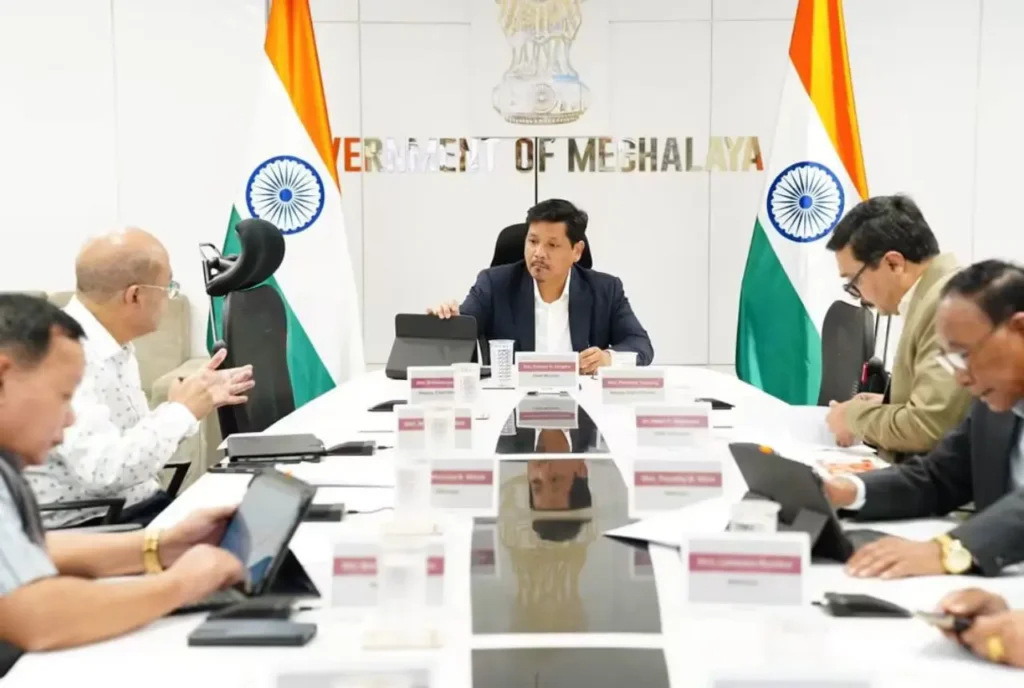
The Meghalaya State Cabinet has approved a series of significant administrative and policy decisions aimed at modernizing governance, enhancing public service delivery, and streamlining regulatory frameworks across the state. The decisions encompass a broad spectrum of sectors, including transportation infrastructure, civil aviation, water safety, social welfare, public finance, tourism promotion, judicial welfare, education, and labor regulation.
A primary decision focused on the state’s mobility sector with the official creation and approval of the Meghalaya Integrated Transport Society. Formed as a unified platform, the society is tasked with facilitating and harmonizing different public and private transportation services. It will manage and run an online integrated application designed for both residents and visiting tourists. This digital system will enable users to book tickets for buses, taxis, and helicopters on a single interface, with plans to gradually incorporate broader tourism-related ticketing services over time.
In tandem with land transportation efforts, the Cabinet approved the creation of a dedicated Civil Aviation Wing, or Cell, within the Transport Department to bolster the state’s institutional capacity. This decision comes as aviation infrastructure expands, driven by the extension of the runway at Umroi Airport to accommodate larger commercial aircraft, the planned activation of Baljek Airport under the management of the Airports Authority of India, and the rollout of new heliports and helicopter tourism initiatives across Meghalaya. The newly created wing will be staffed by dedicated officials to provide strong administrative oversight for the burgeoning aviation sector.
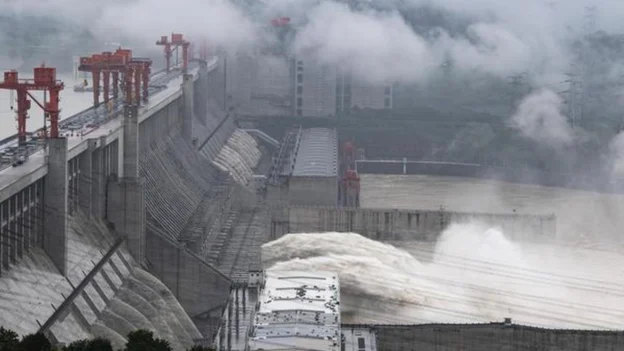
To address water infrastructure security, the Cabinet approved the establishment of an independent Dam Safety Organization. Following standard operating procedures issued by the Union Ministry of Jal Shakti, the state is mandated to maintain dedicated safety mechanisms for its roughly twelve to thirteen dams. Historically, safety checks were conducted internally by officials from the Meghalaya Energy Corporation Limited for power dams and the Public Health Engineering Department for drinking water reservoirs. To eliminate potential conflicts of interest inherent in operating entities evaluating their own facilities, the government established a standalone structure. Independent officers will now oversee safety inspections and strictly enforce established protocols.
In accordance with specific legal directives, the Cabinet authorized a one-time regularization of eleven female supervisors in the Social Welfare Department. This measure follows an order originating from the High Court, which was subsequently sustained through appeals before the Division Bench and ultimately upheld by the Supreme Court of India. The judgment explicitly clarifies that this regularization is an isolated, non-precedential action applicable strictly to the specified cases.
Addressing human resource requirements within developmental programs, the Cabinet sanctioned service engagements for several retired senior officials to serve as advisors and consultants. These re-engagements apply exclusively to externally aided projects, specific mission-mode programs, and autonomous state agencies funded by international or external agencies. Consequently, these positions operate outside the regular government promotion hierarchy and do not restrict career progression or block regular vacancies for serving junior officers. Among the approved engagements, K. Diengdoh, a retired Superintendent of the Public Works Department, was appointed as a PMGSY consultant for the Meghalaya State Rural Roads Development Agency. G. Kharmawphlang, a retired IAS officer, will serve as Executive Director (Technical) at the Meghalaya Basin Management Agency. B. Marak, a retired Chief Engineer, will act as an advisor for the Meghalaya Integrated Transport Project. Additional consultant and advisory roles within the Meghalaya Basin Management Agency and the Meghalaya Basin Development Authority were approved for M. Kharbani as General Manager, A. S. Suting as Assistant Project Director, D. Lamar, retired Director of Agriculture, as Advisor, and Aiban Swer as Additional Director.
Significant fiscal restructuring was approved for the state’s liquor taxation system through amendments to Rule 376 of the Meghalaya Excise Amendment Rules 2026 and Rule 41 of the Meghalaya Bonded Warehouse Rules 2026. Under the revised framework, the state reclassified categories of Indian-Made Foreign Liquor and unified the dual tax streams of Excise Duty and Value Added Tax into a single Ad Valorem tax managed entirely by the Excise Department. Merging the duties previously split between the Taxation and Excise departments streamlines revenue administration into a single point of collection. Furthermore, to address price disparities resulting from recent tax rate hikes in neighboring states like Assam and Arunachal Pradesh, Meghalaya adjusted its tax structure upward. This realignment is projected to generate an additional revenue surplus of approximately 150 crore rupees.
To further encourage local media production, the Cabinet approved specific amendments to the Meghalaya Film Tourism Policy 2025. While the original policy offered financial incentives of up to one crore rupees for regional film productions, the revised policy adds stricter eligibility requirements, mandating that eligible regional movies secure a release across at least one hundred commercial theaters or land a distribution deal on a national OTT platform. Revisions were also made to the incentives linked to the state-backed platform, Hello Meghalaya. The updated rule removes the original exclusivity clause that limited movies from being distributed elsewhere, allowing filmmakers to access a broader national audience provided the film is available on Hello Meghalaya and dubbed in both Khasi and Garo languages.
The Cabinet also approved modifications to the retired judges secretarial assistance and domestic help rules. Replacing the previous fragmented system of separate allowances for telephone, electricity, travel, and general retirement support, the state consolidated these provisions into a single lump-sum monthly payment, significantly reducing administrative paperwork for both the judiciary and the state government.
In the education sector, the Cabinet formally approved the CM Impact Plus scheme, a grant-in-aid initiative aimed at strengthening secondary and higher secondary education infrastructure. The initiative responds to a geographic imbalance where lower primary schools heavily outnumber secondary facilities, leaving seven developmental blocks without a single secondary school. The new program targets around 1,900 eligible secondary and higher secondary schools with direct institutional lump-sum grants rather than funding specific individual teacher salaries. The scheme is designed as an annual performance-based evaluation system, offering higher financial incentives and increased support to schools demonstrating measurable academic progress.
Finally, the Cabinet addressed service uniformities for casual and temporary workers by standardizing the age of accession or retirement for regular casual workers, casual laborers, and muster roll workers at sixty years, making consequential amendments to paragraph six of the Meghalaya Regular Casual Workers Scheme 1996. This change reconciles past policy discrepancies where muster roll workers retired at sixty-five while regular casual workers retired at fifty-eight. Standardizing the retirement age at sixty years accounts for the absence of pension benefits for non-regular employees. To ensure a smooth transition, the government established that ongoing cases involving older muster roll workers who previously opted out of regular casual status will be reviewed by the department on an individual basis.