In Bangladesh’s Victory Month—a period traditionally devoted to honoring the heroes of 1971—the brutal killing of a distinguished freedom fighter and his wife, along with a separate arson attack on a cemetery reserved for war veterans, has convulsed communities and rekindled anxieties about the growing vulnerability of the country’s Liberation War legacy.
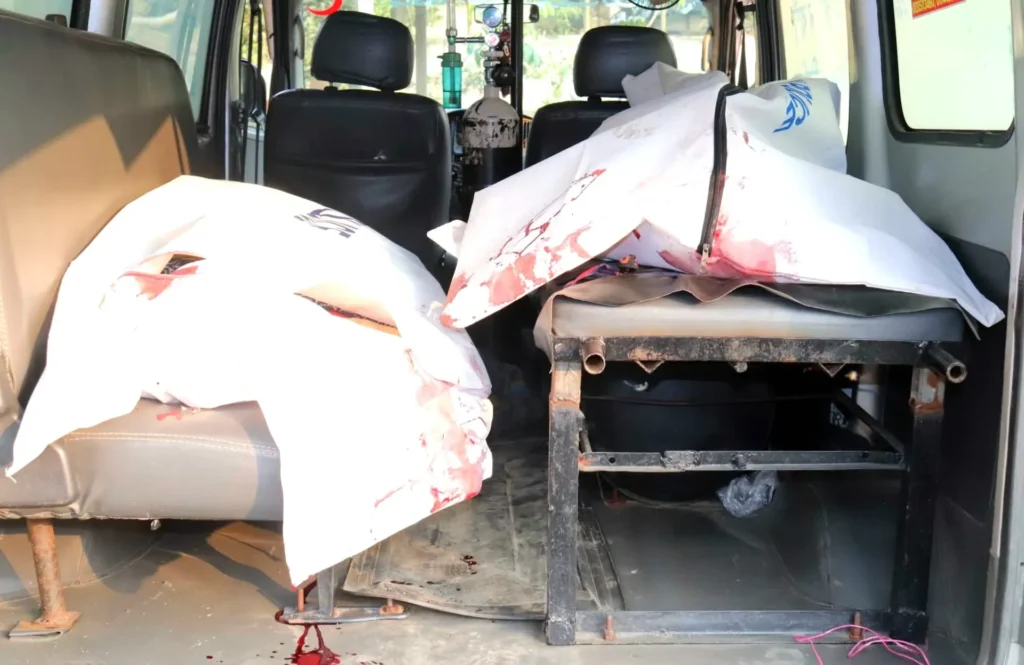
The bodies of Yogesh Chandra Ray, 75, a retired head teacher and 1971 freedom fighter, and his wife Suborna Ray, 60, were discovered early Sunday inside their home in northern Rangpur’s Taraganj sub-district. Villagers say the couple lived alone; their sons work in Joypurhat and Dhaka.
“It was unnervingly silent. They never missed their morning routine,” said Deepak Chandra Ray, a longtime caregiver and neighbor who first suspected something was wrong. “When we climbed in, we found Yogesh’s body in a pool of blood in the dining room. Suborna was lying lifeless in the kitchen. The house felt… gutted of life.”
Police collected forensic evidence but did not immediately disclose a motive.
Villagers, grieving and enraged, said the assault appeared premeditated. Several spoke on condition of anonymity, fearing reprisals.
“This was not a robbery. No door was broken. Whoever came knew exactly what they were doing,” said one resident.
“We are terrified,” whispered another. “If militants or extremists can slaughter a freedom fighter in his own house, what protection do we have?”
“Some radicals resent anyone tied to the Liberation War. We grew up hearing stories of his bravery. Now those same forces he fought in ’71 seem emboldened again.”
Many residents cited a broader climate of intimidation under the current interim administration led by Dr. Muhammad Yunus, arguing that law enforcement has failed to curb growing hostility toward liberation-era veterans.
“Look around,” said a villager in a hushed voice. “You say ‘Joy Bangla’ now and you get beaten. You cannot utter Bangabandhu’s name. This is not the Bangladesh we knew.”
Their concern echoed a viral statement by journalist Anis Alamgir, who wrote on Facebook:
“You cannot utter Bangabandhu’s name; if you say ‘Joy Bangla,’ you get beaten. There is no Awami League. In the month of victory, from December 1 to 16, the media used to carry stories of freedom fighters’ triumphs—but not anymore. Such an atmosphere has been created that it feels as if the country is now being ruled by the Razakars.”

Hours after news of the killings spread, another shock emerged from the southwest.
In Bahadurpur, Rajbari district, unknown assailants set fire to the fenced boundary of a cemetery reserved for freedom fighters early Sunday.
There is no electricity connection inside the cemetery, and locals assert the blaze was intentional.
“I saw flames today early hours ,” said Shahidul Islam, the caretaker. “There is no chance this was accidental. Someone came here with a purpose.”
Nurul Alam, a local teacher and cemetery committee secretary, said a general diary entry would be filed with police. “It is heartbreaking. Even their graves are not spared.”
Veteran fighters expressed simmering outrage.
“In ’71 we wagered our lives for this country,” said Md. Shamsher Ali, a retired soldier. “Now the defeated forces are burning our graves. They want to erase us.”
Nazrul Islam Khan Jahangir, a member-secretary of the local Freedom Fighters’ Command Council, warned of dire consequences if the perpetrators walk free.
“Those who lost in 1971 are carrying out sabotage again,” he said. “If this goes unpunished, the very existence of freedom fighters will vanish.”
Several villagers and veterans directly blamed what they described as “resurgent pro-Pakistan ideological networks,” including fringe elements allegedly aligned with or inspired by Jamaat-e-Islami—a party historically associated with the anti-independence militias of 1971, though Jamaat denies involvement in recent violence.
“There is a nexus of old collaborators, radical outfits, and opportunistic power-brokers,” said an elderly villager, requesting anonymity. “They feel protected now. They think no one will hold them accountable.”
These groups draw ideological legitimacy from Pakistan’s wartime history. They want to rewrite our history. By attacking freedom fighters, they send the message that the spirit of ’71 is under siege.”
Many Bangladeshis say the killings and arson strike at the psychological foundation of the nation—its victory over the Pakistan Army in 1971 and the moral authority of the men and women who fought.
“In December, the media used to be filled with liberation war stories,” said a schoolteacher in Taraganj. “Now everything is muted. It feels like someone wants the memory of the war to fade.”
A resident standing beside the charred cemetery fence put it more starkly:
“The defeated forces of 1971 believe this is their moment. They feel the state is distracted, fractured. And so they advance.”
Police said investigations were underway into both the double homicide and the cemetery arson, though no arrests had been made by Sunday evening.
Officials have promised to “leave no stone unturned,” but villagers remain skeptical.

“We do not need promises,” said a freedom fighter who has now moved out of his home at night out of fear. “We need protection. Because if a man who fought in 1971 can be killed like a brute, then no one is safe—not even the idea of Bangladesh itself.”
The 1971 Liberation War remains the defining chapter in Bangladesh’s history. Over a nine-month period, millions of citizens rose in armed resistance or provided critical support to the independence movement, confronting a Pakistani military crackdown that resulted in the deaths of hundreds of thousands and the displacement of millions.
The struggle was waged not only on the battlefield but also for fundamental human rights—the right to speak freely, to exist with dignity, and to assert national identity.
Freedom fighters, known as muktiyoddhas, risked their lives and livelihoods to secure Bangladesh’s independence, creating a nation whose moral and political foundations are rooted in their courage and sacrifice.