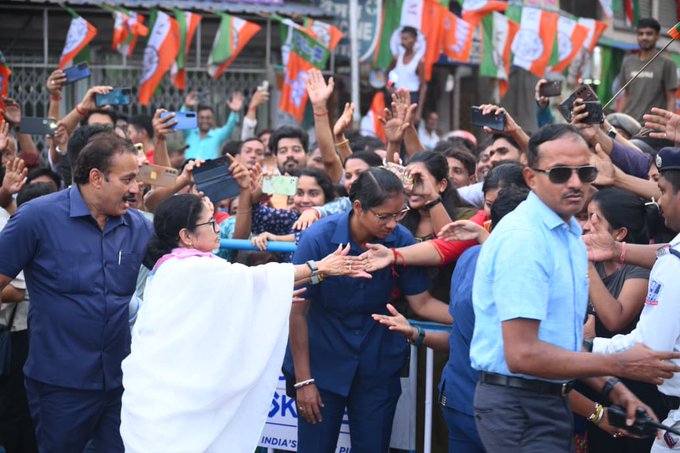
There is a peculiar quietness in Bengal’s politics today, unlike the election five years ago. In 2021, the All India Trinamool Congress operated with a siege mentality, perfectly captured by the slogan Khela Hobe. This time, the AITC appears far calmer — a calm that seems to stem from a game already understood. In most parts of India, when the opponent is the BJP, elections are approached like a war.
In West Bengal, however, they are beginning to resemble something else: an arrangement, almost architectural, where outcomes are shaped less by momentum and more by structure. Within this structure, Mamata Banerjee appears less like a combatant and more like a custodian of a system working exactly as intended.
It is not that the Trinamool Congress is overwhelmingly strong or perfectly organised to have engineered such a system. Rather, it is the very nature of the Bharatiya Janata Party, in its current form, that has paradoxically helped create it — a system in which, each time the BJP is the principal opponent, the AITC almost automatically gains advantage.
To understand this, one must step away from the noise of rallies and television debates and instead view Bengal as a political borderland, where identity, memory and material survival intersect in ways not easily legible to Delhi.
For decades, Bengal has resisted neat ideological packaging. It absorbed communism without becoming Soviet, embraced nationalism without becoming majoritarian, and sustained regional pride without rejecting the Union. This is not contradiction; it is a habit of political negotiation. And it is precisely this habit that the BJP struggles with. In its current form, the BJP is more comfortable in regions where identity narratives — particularly around caste and religion — are more easily structured: Bihar, Uttar Pradesh, Gujarat, Haryana. Bengal is the opposite.
If Bengal’s nature is complex, its arithmetic is equally decisive. At the heart of the Trinamool’s system lies a simple but powerful arithmetic — one that does not announce itself, yet quietly governs outcomes. A significant minority population, hovering around a third, does not merely vote; it aligns with the Trinamool for reasons of perceived security. Not out of passive loyalty, but from a cultivated sense of vulnerability. Narratives around citizenship, documentation and electoral revision are not abstract here; they travel as stories through villages, across borders, and into everyday conversations, eventually settling as anxiety.
And anxiety, in electoral politics, is adhesive. The more the BJP asserts itself, the more this anxiety consolidates. The more it consolidates, the narrower the BJP’s path becomes. This is not conventional polarisation; it is something more structural — a ceiling that lowers each time the BJP emerges as the primary challenger.
Yet Bengal does not move by arithmetic alone. There is also a cultural language — almost instinctive — through which politics is interpreted. Hindutva, the BJP’s primary political idiom, has been studied, dissected, and met with a counter-language. The Trinamool has, over time, learned to speak this counter-language with fluency. It does not simply oppose the BJP; it translates and reframes it, positioning it as something slightly out of place.
Unlike figures such as Rahul Gandhi, it does not declare Hindutva inherently hostile, but rather as not entirely belonging. Once this framing takes hold, BJP slogans become signals, symbols suggest intrusion, and even faith — when politicised — is read less as devotion and more as performance. In this subtle shift, from participation to performance, the BJP loses something intangible but critical: authenticity.
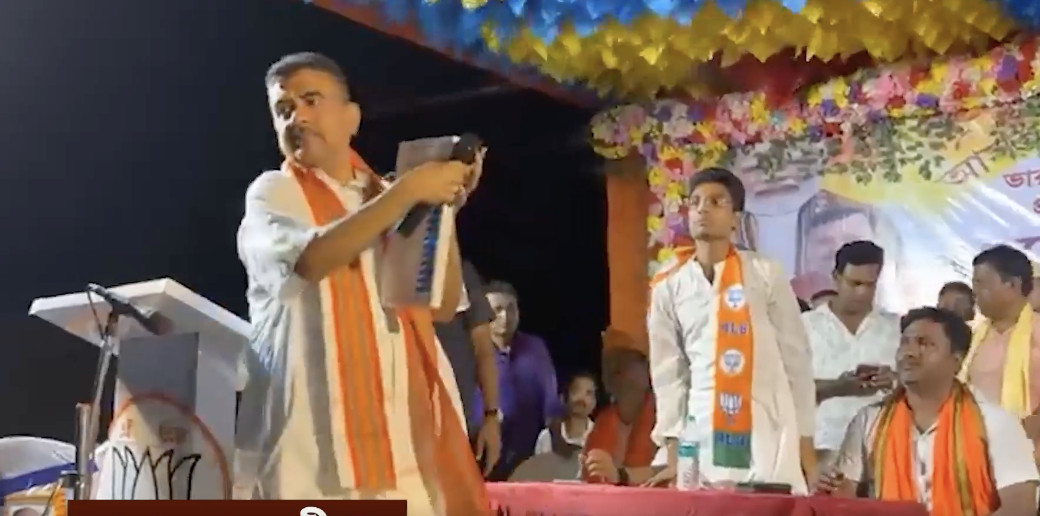
This may be described as Bengal’s cultural veto. It does not shout or mobilise visibly, but quietly filters the BJP’s strongest narratives, recasting them as imposed.
Then there is the most grounded layer — one that speaks not in ideology but in monthly rhythms. Across rural Bengal, in homes where politics was once distant, the state now arrives with predictability: a transfer of money, surprisingly well regulated; a small but consistent assurance. For many women, across caste and community, the Trinamool is no longer just a political party. It is a material presence.
Material politics has a different kind of memory. It is not easily erased by allegations or counter-narratives. It exists in kitchens, in school fees, in everyday financial continuity. The BJP, in contrast, offers scale, vision and national direction. But here, scale competes with immediacy — and more often than not, immediacy prevails.
What emerges, therefore, is not dominance in the conventional sense, but something more stable, and perhaps more difficult to disrupt: a system where demographic anxieties consolidate a base, cultural instincts filter the challenger, and welfare embeds loyalty into daily life. Each layer reinforces the other. Each move by the BJP, intended as expansion, feeds back into this structure.
This leads to an uncomfortable but necessary proposition: as long as the BJP remains the principal challenger, the Trinamool does not need to reinvent itself. It simply needs to endure.
This does not mean Bengal is without discontent. There are murmurs — of corruption, of stalled industry, of fatigue with long incumbency. But murmurs require a language to become movements, and movements require a vehicle that feels safe enough to carry them. At present, the BJP is not that vehicle for a significant section of Bengal. It is not seen as an alternative, but as a shift — and shifts, in a borderland society, are approached with caution.
The real question, then, is not about 2026. That election almost feels predetermined. The deeper question is whether a political force can emerge that breaks this binary — not by outshouting the Trinamool, nor by intensifying polarisation, but by quietly dissolving the fears that sustain it.
Until that happens, the game remains what it is: not a contest of equals, nor even of momentum, but a structure — patient, layered, and remarkably self-sustaining — where one party fights, and the other simply waits.