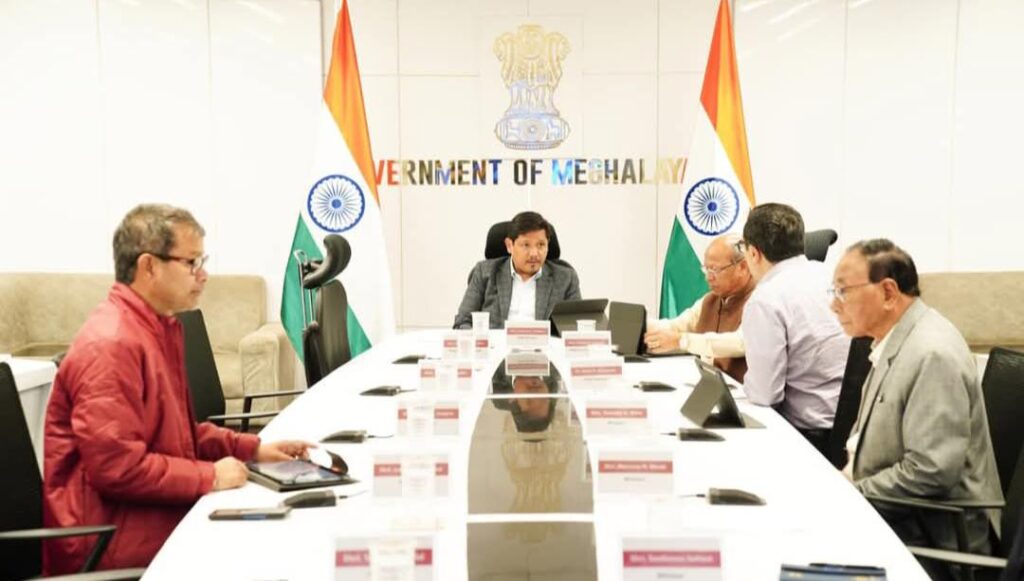
In what could prove to be a defining moment in Meghalaya’s policy landscape, the state cabinet has set in motion a series of reforms that reach far beyond routine governance. These decisions—touching language, administration, and urban management—signal a broader attempt to align governance with identity, efficiency, and the lived realities of a rapidly changing state.
At the heart of this shift lies a long-standing question: how does a state preserve its cultural soul while modernising its institutions?
The most consequential step in that direction is the introduction of the Meghalaya Official Languages Ordinance 2026. By repealing the 2005 language law, the government has moved to formally recognise Khasi and Garo alongside English as official languages of the state.
This is more than a legislative update. It reflects a deeper assertion—that language is not just a tool of communication, but a marker of identity, memory, and belonging. By institutionalising Khasi and Garo, Meghalaya is also strengthening its case for their inclusion in the Eighth Schedule of the Indian Constitution, placing its linguistic aspirations firmly on the national stage.
The rollout, however, is being approached with care. Rather than a sudden overhaul, the transition is designed to unfold in phases. In the Khasi Hills, English and Khasi will guide official work; in the Garo Hills, English and Garo will take precedence. At the state level, official notifications will now appear in all three languages, gradually reshaping how governance is seen and heard by its people.
Yet, the balancing act is evident. English will continue to serve as the bridge—linking districts, enabling administrative continuity, and ensuring that the machinery of governance does not stall even as it transforms. Behind the scenes, this shift will require new systems, translators, and rules—quiet but crucial work that will determine how smoothly policy translates into practice.
Running parallel to this cultural assertion is a quieter, more technical reform—one that speaks to consistency within the state’s administrative framework. The cabinet has amended the rules governing the Real Estate Regulatory Authority, replacing a fixed remuneration structure with a “last pay drawn minus pension” formula.
On the surface, it is a procedural change. But in essence, it reflects an effort to standardise how institutions function, bringing uniformity across boards and agencies. It is part of a larger attempt to make governance less fragmented and more coherent—an often overlooked but vital aspect of institutional reform.
If language speaks to identity and administrative reform to structure, the third decision turns to the everyday realities of urban life.
Shillong, expanding and evolving, has been grappling with the visible pressures of growth—none more pressing than waste management. Fragmented jurisdictions between municipal bodies, cantonment authorities, and traditional institutions have long complicated the issue, leaving gaps in coordination.
The creation of the Greater Shillong Waste Management Agency is an attempt to bridge those gaps. Envisioned as a coordinating body, it will operate across the wider planning area, bringing a measure of cohesion to a system that has remained scattered.
What sets this initiative apart is its approach. Rather than imposing a uniform system, it leans on consent. Communities will opt in, not be compelled—an acknowledgment of Meghalaya’s unique governance structure, where traditional institutions and local autonomy remain deeply significant.
This model reflects an understanding that urban solutions in Meghalaya cannot simply be transplanted from elsewhere. They must adapt to local realities, respecting both legal frameworks and community sentiment.
Taken together, these reforms reveal a government attempting to move on multiple fronts at once—asserting cultural identity, tightening administrative systems, and responding to the pressures of urbanisation.
There is an effort here to connect the past with the future: to ensure that as Meghalaya grows, it does not lose sight of what defines it. Whether in the language spoken in official corridors, the way institutions function, or how a city manages its waste, the underlying question remains the same—how to build forward without leaving behind.
The answers may not emerge overnight. But the direction is becoming clearer.