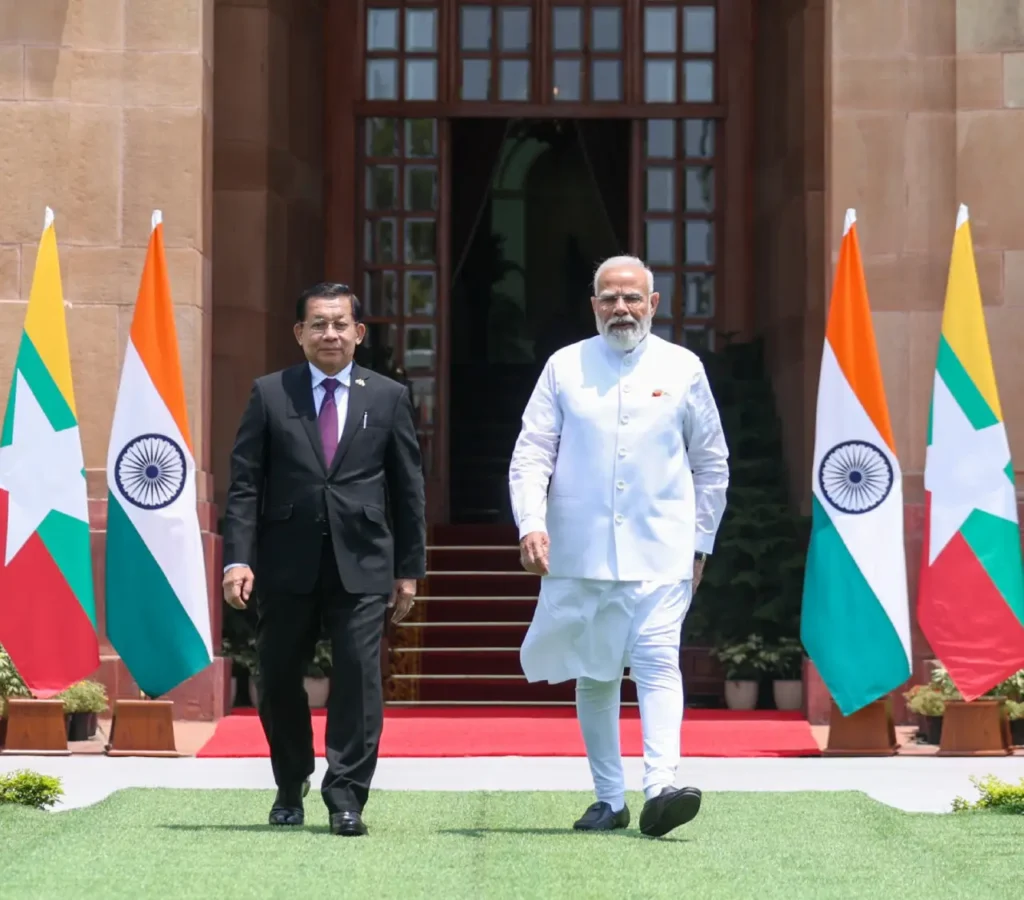
President U Min Aung Hlaing’s first official foreign visit as President to India is significant not merely because of protocol or symbolism. It underscores a strategic reality that has shaped Indian foreign policy for decades: Myanmar is indispensable to India’s security, connectivity ambitions, regional diplomacy and broader Indo-Pacific vision.
Prime Minister Narendra Modi’s description of Myanmar as “vital to India’s ‘Neighbourhood First’, ‘Act East’ and Indo-Pacific policies” was therefore not a diplomatic courtesy. It was a concise articulation of why the relationship occupies a unique place in India’s strategic thinking.
At a time when geopolitical competition is intensifying across Asia, the visit reaffirmed that India’s engagement with Myanmar is driven by a combination of geography, economics, security and civilisational ties. Few countries sit at the intersection of so many Indian interests.
The symbolism of President U Min Aung Hlaing beginning his visit in Bodh Gaya, paying homage at the Mahabodhi Temple and other revered Buddhist sites, highlighted the deep cultural and spiritual bonds between the two countries. These ties stretch back centuries and continue to serve as an important foundation for bilateral relations.
Yet while history binds India and Myanmar, geography makes the relationship strategically indispensable.
Myanmar is India’s only land bridge to Southeast Asia. It shares a border of more than 1,600 kilometres with India, touching the states of Arunachal Pradesh, Nagaland, Manipur and Mizoram. No discussion of India’s eastern outreach can therefore be separated from Myanmar.
For New Delhi, the success of the Act East policy depends substantially on the stability, connectivity and prosperity of Myanmar. Conceived as an evolution of the earlier Look East policy, Act East seeks not merely stronger diplomatic ties with ASEAN but deeper economic integration, physical connectivity and strategic engagement across the Indo-Pacific.
Myanmar is the gateway through which that vision must pass.
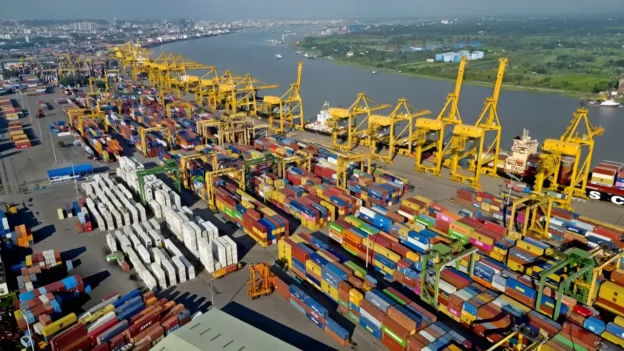
This explains why connectivity featured prominently during the discussions between the two leaders. Both sides reiterated the importance of advancing the Kaladan Multi-Modal Transit Transport Project and the India-Myanmar-Thailand Trilateral Highway, two flagship initiatives that have long been viewed as transformational for regional integration.
The Kaladan project will connect India’s eastern seaboard with Myanmar’s Rakhine State before linking to Mizoram through inland waterways and road networks. The Trilateral Highway, meanwhile, seeks to establish a seamless land corridor linking India with Myanmar and Thailand, creating new avenues for trade, tourism, investment and people-to-people exchanges.
These projects are often described as infrastructure initiatives, but their significance is much broader.
For India’s northeastern states, improved connectivity offers access to larger markets and opportunities for economic transformation. For Myanmar, it provides greater integration with regional supply chains and enhanced trade opportunities. For ASEAN, it strengthens links with South Asia. In strategic terms, these projects reduce the economic isolation of India’s Northeast while embedding the region more firmly within broader Asian growth networks.
Had a productive meeting with President U Min Aung Hlaing of Myanmar. We in India are honoured that he has chosen India for his first foreign visit as President. Equally gladdening is the fact that he began the visit from Bodh Gaya, with the blessings of Lord Buddha. We reviewed… pic.twitter.com/eL1sXgsrE6
— Narendra Modi (@narendramodi) June 1, 2026
Connectivity and security, however, are inseparable along India’s eastern frontier.
For decades, insurgent groups operating in India’s Northeast have exploited the difficult terrain and porous border areas between the two countries. Various militant organisations have historically used sanctuaries across the border to evade Indian security forces, establish camps and sustain operations. Consequently, cooperation with Myanmar has become a critical component of India’s internal security strategy.
The discussions between Prime Minister Modi and President U Min Aung Hlaing reflected this reality.
Both sides underscored the importance of preventing the misuse of their territories for activities inimical to each other’s security interests. The President reiterated Myanmar’s assurance that its territory would not be allowed to be used against India’s security interests, while India reaffirmed its commitment to deepening security cooperation.
These statements may appear routine in diplomatic language, but they carry considerable significance.
For India, ensuring that insurgent groups cannot operate from across the border remains a core objective. Stability in Manipur, Nagaland and Arunachal Pradesh is closely linked to the effectiveness of bilateral security coordination. New Delhi has long sought closer cooperation with Myanmar’s authorities to disrupt insurgent networks, improve border management and enhance intelligence sharing.
The importance of this cooperation has only increased in recent years. Instability in border regions can create opportunities for criminal networks, arms trafficking, narcotics smuggling and other transnational threats. Effective border management is therefore not only a bilateral concern but also a regional security imperative.
This security dimension extends beyond the land frontier.
The two sides also agreed to strengthen cooperation in maritime security and cyber security, reflecting the evolving nature of contemporary strategic challenges. Myanmar occupies a critical position along the Bay of Bengal, a region of growing economic and geopolitical importance. Enhanced maritime cooperation contributes to India’s broader vision of ensuring security and stability across the Indian Ocean and adjoining waters.
This is where Prime Minister Modi’s MAHASAGAR initiative assumes particular relevance.
By describing Myanmar as lying at the confluence of India’s Neighbourhood First, Act East and MAHASAGAR (Mutual and Holistic Advancement for Security and Growth Across Regions) policies, the Prime Minister signalled that India increasingly views connectivity, economic growth and security as interconnected objectives.
MAHASAGAR represents a vision in which regional prosperity is supported by secure sea lanes, resilient infrastructure, trusted partnerships and collective security arrangements. Myanmar’s strategic location makes it an essential participant in that vision.
Economic cooperation formed another important pillar of the discussions.
Both countries agreed to facilitate and enhance bilateral trade, including through the Rupee-Kyat settlement mechanism. Since its operationalisation in 2024, the mechanism has provided an alternative framework for trade settlements and reflects a broader effort to deepen economic engagement.
The agenda discussed during the visit extended well beyond conventional trade. Cooperation in rare earths, healthcare, energy, mining, agriculture, agro-processing, capacity building and technology featured prominently. Rare earths in particular have acquired increasing strategic significance as countries seek to diversify supply chains for critical minerals required in advanced technologies and clean-energy transitions.
The President’s participation in the India-Myanmar Business Conclave, alongside a delegation representing sectors ranging from banking and pharmaceuticals to logistics and information technology, highlighted the growing recognition that economic engagement must become a central pillar of the relationship.
Development cooperation also remains a cornerstone of India’s approach.
Prime Minister Modi’s announcement that Mekong Ganga ICCR scholarships for Myanmar students would increase from 36 to 100 annually reflects India’s long-standing emphasis on capacity building and human resource development. Such initiatives may not generate headlines comparable to major infrastructure projects, but they build enduring connections between societies and cultivate future generations of goodwill.
India’s support for Myanmar’s socio-economic development likewise reflects a broader philosophy that stability and prosperity reinforce one another. Development assistance, infrastructure projects, educational opportunities and institutional cooperation all contribute to strengthening bilateral ties in ways that extend beyond immediate political considerations.
Beyond the official agenda, however, the visit carries a wider strategic message for the region.
Neither side publicly framed the engagement in competitive geopolitical terms. Yet it would be difficult for observers to ignore the broader strategic context. Myanmar occupies a pivotal position between South Asia, Southeast Asia and the Bay of Bengal. It has long attracted the attention of major powers seeking influence through infrastructure investment, economic engagement and strategic partnerships.
Against this backdrop, the visit demonstrates India’s determination to remain a credible, committed and influential partner in its immediate neighbourhood.
The message is subtle but clear. India intends to deepen its engagement with countries that occupy critical positions in its security environment and regional architecture. By accelerating connectivity projects, expanding economic cooperation, enhancing maritime collaboration and strengthening border security coordination, New Delhi is signalling that its eastern neighbourhood remains central to its strategic priorities.
For regional observers, including those in Beijing, the visit serves as a reminder that Myanmar is not merely a peripheral state in India’s foreign policy calculations. It is a strategic partner whose stability, connectivity and security have direct implications for India’s national interests.
Ultimately, the significance of President U Min Aung Hlaing’s visit lies not only in the agreements discussed but in the vision it reaffirmed.
A stable Myanmar strengthens India’s Northeast. A connected Myanmar advances India’s Act East ambitions. A cooperative Myanmar contributes to regional security. And a prosperous Myanmar supports the broader goals of Neighbourhood First and MAHASAGAR.
In an era defined by strategic competition and shifting alignments, India and Myanmar have compelling reasons to deepen their partnership. Geography has made them neighbours. Shared interests increasingly make them indispensable partners.
The challenge now is to translate diplomatic momentum into concrete outcomes—from highways and trade corridors to security cooperation and cultural exchanges. If that happens, this visit may ultimately be remembered not merely as a successful diplomatic engagement, but as a reaffirmation of one of the most consequential partnerships on India’s eastern frontier.