The controversy surrounding the Dalai Lama’s birthday celebrations has presented the Balen-RSP government with its first major foreign policy test. While the Gen Z revolution transformed Nepal’s domestic political landscape, it did little to alter the country’s geopolitical realities. Situated between India and China, and increasingly courted by the United States, Nepal remains a strategically sensitive state where domestic political decisions often carry consequences far beyond its borders.
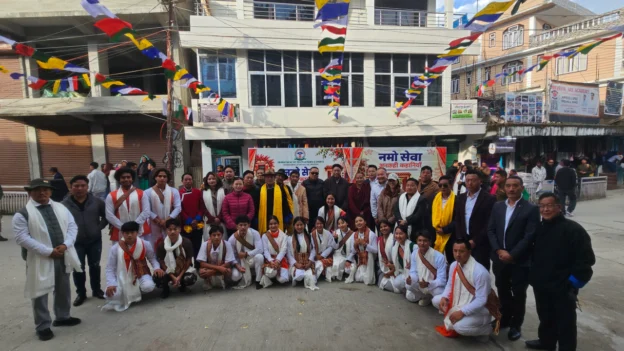
The Swayambhu gathering illustrates precisely this dilemma. What appeared to be a religious and cultural event quickly acquired diplomatic significance, exposing the competing expectations of Beijing, New Delhi and Western powers. For the Balen-RSP government, therefore, the episode is not simply about managing a domestic controversy but about demonstrating whether Nepal can pursue an independent foreign policy while carefully balancing the interests of major powers.
Beijing’s Core Red Lines: Tibet and the One-China Policy
The intensity of Beijing’s response to the Swayambhu gathering cannot be understood without appreciating China’s uncompromising position on issues it considers fundamental to its territorial sovereignty. For the Government of the People’s Republic of China (PRC), Tibet is an inalienable part of China, and the Dalai Lama is viewed not merely as a revered religious figure but as a political exile engaged in anti-China separatist activities. From Beijing’s perspective, therefore, even seemingly symbolic public events involving the Dalai Lama carry profound political significance.
This position is reinforced by the One-China Policy, under which Beijing expects all countries maintaining diplomatic relations with China to acknowledge its sovereignty over Tibet and Taiwan while actively discouraging political activities that challenge these claims. Consequently, the presence of Western diplomats at the Dalai Lama’s birthday celebration in Kathmandu was unlikely to be viewed as a routine diplomatic engagement. Instead, it could easily be interpreted as part of a broader effort by external powers to challenge Chinese influence within its immediate strategic neighbourhood.
The situation has become even more sensitive because of persistent speculation within Kathmandu’s political circles that the next successor to the Dalai Lama could one day be identified from within Nepal. Whether such speculation carries any practical basis is almost secondary. The rumours themselves have heightened Beijing’s security concerns and further complicated Nepal’s already delicate diplomatic balancing act. These sensitivities also extend beyond diplomacy, shaping China’s broader strategic engagement with Nepal through infrastructure, connectivity and economic cooperation.
Infrastructure and Strategic Competition
Nepal has increasingly become a key arena for competing infrastructure initiatives, each carrying distinct geopolitical interests. China, the United States and India all present themselves as partners in Nepal’s development, but each advances a different model of engagement, leaving Kathmandu to navigate an increasingly complex strategic landscape.
China’s Belt and Road Initiative (BRI) has centred on projects such as the Pokhara and Bhairahawa international airports, financed largely through commercial loans, while their full potential continues to be constrained by India’s refusal to provide additional air corridors. In contrast, the United States’ US$500 million Millennium Challenge Corporation (MCC) compact has focused on electricity transmission and road infrastructure through grant assistance, although its implementation required parliamentary ratification and became deeply politicised. India, meanwhile, has combined concessional Lines of Credit for major infrastructure with High Impact Community Development Projects, allowing it to maintain a strong developmental presence across Nepal.
Together, these competing approaches demonstrate that infrastructure in Nepal is no longer merely about development. It has become an important instrument through which regional and global powers seek to consolidate strategic influence.
The structural constraints
Infrastructure competition represents only one dimension of Nepal’s foreign policy challenges. Beneath these competing investment models lie deeper structural realities that continue to shape Kathmandu’s relations with both India and China.
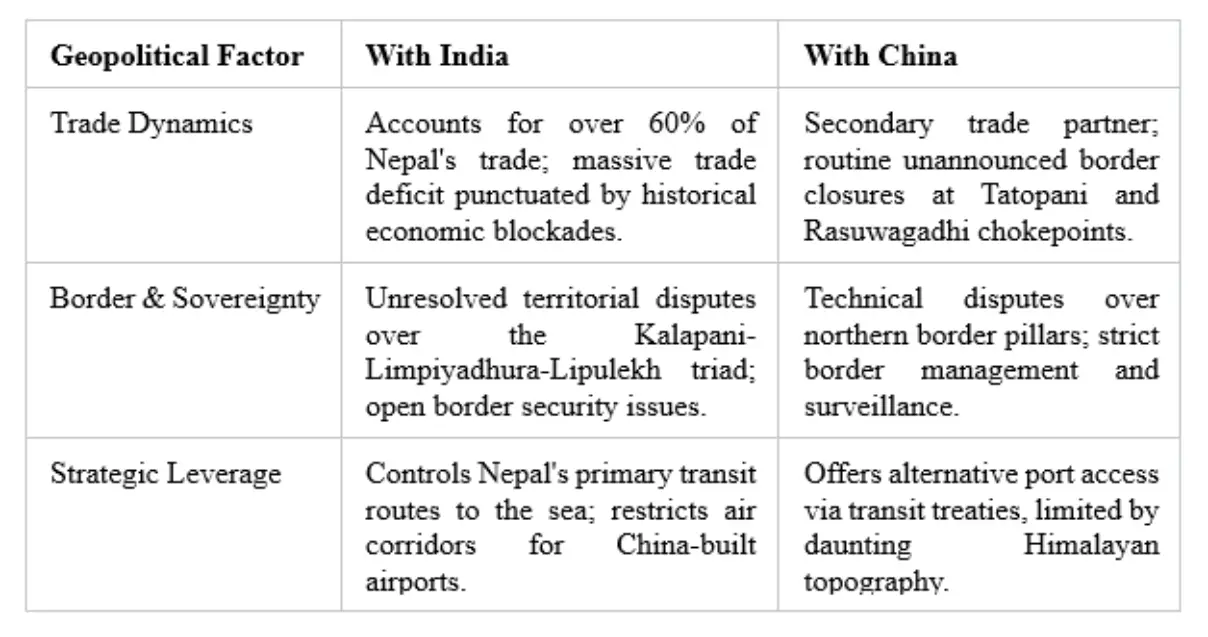
These structural realities leave Nepal with limited strategic room for manoeuvre. Neither relationship can be neglected, and neither can be allowed to dominate. The country’s geographical position ensures that both India and China will remain indispensable partners while simultaneously serving as sources of strategic pressure.
Compounding these external constraints is Nepal’s fragile international financial standing. The country has spent months facing the possibility of being placed on the Financial Action Task Force (FATF) grey list because of shortcomings in anti-money laundering legislation and weak prosecution of illicit financial activities. For a government seeking to attract foreign investment and modernise the economy, such a designation would significantly undermine investor confidence and weaken Nepal’s broader economic ambitions.
Navigating Nepal’s strategic balance
For Prime Minister Balen Shah and the Rastriya Swatantra Party, the political honeymoon is effectively over. The challenges confronting the government are no longer confined to domestic reform but increasingly involve managing the realities of international diplomacy. Preserving Nepal’s sovereignty while advancing its economic interests will require a more institutionalised and carefully calibrated foreign policy.
Against this backdrop, several policy priorities deserve consideration.
Reaffirm strategic non-alignment
The Prime Minister’s Office should avoid treating foreign policy as an extension of municipal activism. Instead, Nepal should reaffirm its commitment to the principles of Panchsheel, or the Five Principles of Peaceful Coexistence. Clear institutional guidelines governing the hosting of diplomatically sensitive events are equally necessary. While Nepal should continue to respect humanitarian obligations towards registered refugees, politically sensitive activities that directly challenge the territorial claims of neighbouring countries should be managed through transparent and consistent institutional mechanisms rather than ad hoc administrative decisions.
Strengthen development coordination
Nepal should revisit its framework governing foreign-funded development projects. Grants from India, China and the United States should pass through the Ministry of Finance and the National Planning Commission to ensure transparency, policy coherence and national oversight. Such an approach would strengthen federal institutions while addressing concerns regarding sovereignty and fragmented development planning.
Expand connectivity options
Resolving the continuing airspace challenges affecting Pokhara and Bhairahawa airports requires sustained technical engagement through bilateral and, where appropriate, trilateral diplomatic mechanisms. Simultaneously, Nepal should seek greater commercial cooperation with China while ensuring that its economy is never again rendered vulnerable to disruptions along its southern transit routes.
Restore international financial confidence
Finally, strengthening anti-money laundering legislation should be treated as a matter of urgent national priority rather than merely a regulatory obligation. Parliament must swiftly pass the pending legal amendments to ensure that Nepal meets international financial transparency benchmarks, thereby reinforcing investor confidence and insulating the country from external economic pressure.
The gathering at Namgyal School serves as a powerful reminder that, for a landlocked country positioned between the world’s two most populous nuclear powers, foreign policy is never a theoretical exercise. It is a daily balancing act in which even a seemingly routine commemorative event can acquire significant geopolitical consequences.
The Gen Z revolution successfully dismantled an entrenched political order and gave Prime Minister Balen Shah a powerful mandate for domestic reform. Yet governing Nepal demands far more than electoral legitimacy or anti-establishment politics. It requires institutions capable of navigating an increasingly contested regional environment through consistency, strategic restraint and diplomatic clarity. As the Balen-RSP government moves beyond its initial political honeymoon, it must combine its domestic reform agenda with a foreign policy that is institutionalised, legally grounded and, above all, carefully balanced.
Nepal cannot afford to become another arena for great-power competition. Instead, it must consolidate its position as a sovereign, predictable and credible state that enjoys the confidence of all its neighbours without becoming overly dependent on any of them. The diplomatic tensions surrounding the Dalai Lama’s birthday therefore extend well beyond a single commemorative event. They offer a revealing window into Nepal’s evolving political trajectory and the delicate geopolitical tightrope that will continue to shape the country’s domestic governance and external relations in the years ahead.