
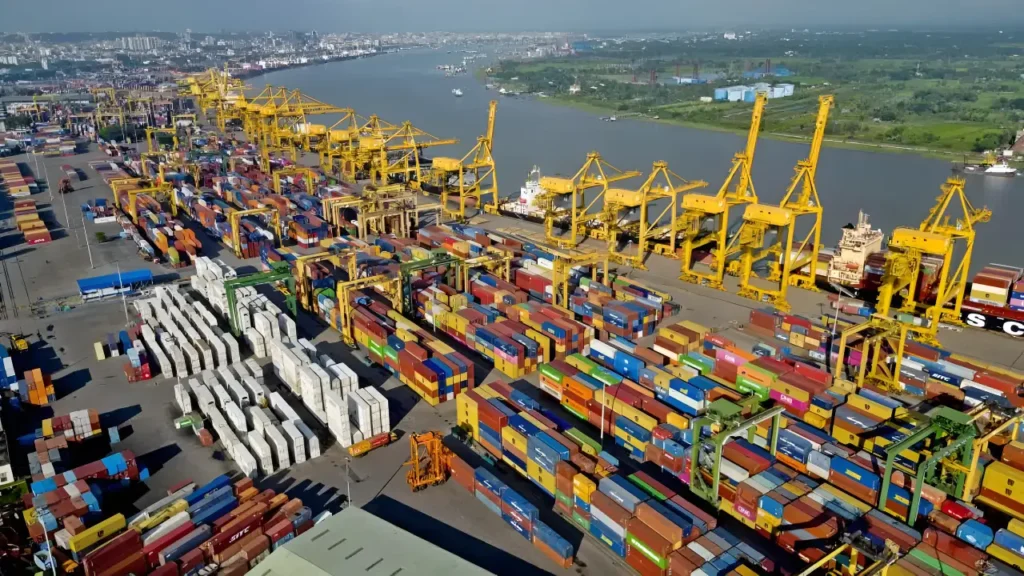
On 8 October 2026, the Chittagong Port Authority (CPA) signed a 15-year concession agreement with Dubai-based DP World to operate and maintain the New Mooring Container Terminal (NCT), including its Overflow Container Yard.
Presented as a step towards modernisation, efficiency and global competitiveness, the agreement raises fundamental questions about Bangladesh’s economic sovereignty, strategic autonomy, labour security and long-term national interests.
The issue is not whether foreign investment is desirable; it is whether the terms, transparency and consequences of a long-term concession adequately protect the interests of Bangladesh and its people.
Chattogram Port is not an ordinary commercial facility. It is the principal maritime gateway of Bangladesh, indispensable to the country’s import-dependent industries, export-oriented manufacturing, revenue generation and international trade.
The New Mooring Container Terminal handles more than 40 per cent of the port’s container throughput, making its operational future a matter of national economic importance. Any decision affecting such a strategic asset demands exceptional transparency, rigorous scrutiny and an unequivocal commitment to the public interest.
The first potential danger is the erosion of national control over a critical economic chokepoint. Although ownership of the terminal’s land and infrastructure, together with regulatory authority, remains with the CPA, operational control is being entrusted to a foreign company for 15 years.
Legal ownership and effective operational influence are not identical. The company managing a major terminal inevitably acquires substantial influence over cargo-handling procedures, operational priorities, technology, staffing and the daily movement of trade.
Bangladesh must therefore ensure that its regulatory authority is not merely nominal, but sufficiently robust to protect national priorities whenever commercial objectives and public interests diverge.
The second concern is the economic cost of an agreement whose long-term implications deserve careful examination.
DP World has committed approximately US$150 million over the concession period. Modern equipment, automation and improved management could enhance productivity, but the investment figure alone cannot establish whether the agreement represents fair value for Bangladesh.
The public deserves clarity regarding concession payments, revenue-sharing arrangements, performance obligations, tariff-setting powers, penalties for non-performance and the conditions governing termination or renegotiation.
Without transparent disclosure, citizens cannot independently assess whether the country has secured an equitable bargain or surrendered potentially greater future returns for uncertain immediate benefits.
Third, the agreement could expose Bangladesh to excessive dependence on a single foreign operator at a strategic gateway.
Operational expertise can be purchased, technology can be acquired and management capabilities can be developed domestically. If the arrangement fails to strengthen Bangladesh’s own institutional competence, local technical capacity and independent regulatory oversight, the country could emerge from 15 years of foreign management more dependent rather than more capable.
Modernisation must mean transferring knowledge to Bangladesh, not merely transferring responsibility away from Bangladeshi institutions.
The fourth danger concerns workers and industrial relations. Port employees and labour organisations have protested the agreement, demanding its cancellation or meaningful consultation.
Workers have raised concerns about the future management of the terminal, while the government has defended the arrangement as a means of improving efficiency. Their anxieties cannot simply be dismissed as resistance to reform.
Disruption at Chattogram Port could delay shipments, increase logistics costs, undermine export schedules and damage the confidence of international buyers. The government must therefore guarantee fair employment conditions, protect legitimate labour rights and establish a credible mechanism for resolving disputes before they threaten national trade.
Equally troubling is the prospect of public distrust when a strategic agreement proceeds amid protests and unresolved questions.
Police action against demonstrators risks deepening perceptions that commercial expediency has taken precedence over democratic consultation.
A government confident in its decision should welcome scrutiny, publish the relevant contractual provisions and explain how the arrangement benefits the country. Suppressing dissent cannot substitute for convincing the public that the national interest has been safeguarded.
Finally, the agreement must not become a precedent for transferring other strategic infrastructure into foreign management without equivalent scrutiny. Proposed investments in free-trade zones and rail-based inland container depots may offer opportunities, but each initiative requires independent economic evaluation, competitive procurement and enforceable safeguards.
Bangladesh must modernise its ports without mortgaging its economic independence. Efficiency matters, investment matters and global connectivity matters.
But transparency, accountability, labour protection and sovereign control matter just as much. A 15-year concession must serve the nation, not merely the operator.
The ultimate measure of success is not how efficiently containers move, but whether Bangladesh emerges stronger, more self-reliant and better equipped to determine its own economic destiny.
Dependence on a foreign operator for the daily management of such a critical trade gateway could also weaken domestic institutional capacity if technology transfer, skills development, and enforceable performance standards are not guaranteed.
Although the Chittagong Port Authority retains ownership of the infrastructure and regulatory authority, these safeguards are meaningful only if the contract gives them practical force.
The central question, therefore, is not whether DP World can modernise the terminal, but whether Bangladesh has secured transparent terms, measurable public benefits, and sufficient contractual protections to ensure that a foreign-managed port strengthens rather than compromises the country’s long-term economic independence. Otherwise, Bangladesh’s sovereignty is at stake with DP World to operate and maintain the New Mooring Container Terminal at Chattogram Port.