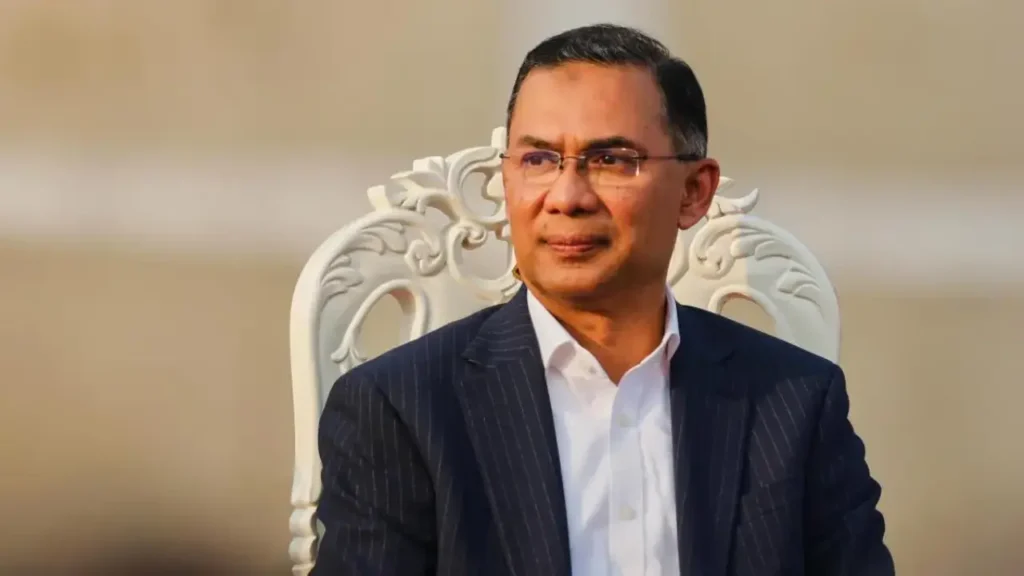
Prime Minister Tarique Rahman’s return to Dhaka after his five-day American visit coincided with another striking diplomatic movement: U.S. Ambassador to Bangladesh Brent T. Christensen travelled to New Delhi for a major regional conference of American ambassadors. The coincidence is politically intriguing.
What matters is what the meeting reveals about Washington’s evolving South Asian strategy—and what Bangladesh can discern from it.
On September 29, 2026 U.S. Ambassador to India Sergio Gor hosted an Ambassadors Regional Conference bringing together American envoys and chiefs of mission from eleven South and Central Asian countries, including Bangladesh, India, Pakistan, Nepal, Sri Lanka, the Maldives and the Central Asian republics.
Secretary of State Marco Rubio joined virtually. Public reports say the conference addressed regional diplomatic, strategic, security and economic priorities. No new Bangladesh-specific policy decision was publicly announced.
That last point deserves emphasis.
The meeting remains significant because Bangladesh was discussed within a larger American regional framework in which India occupies a central strategic position.
That framework matters.
Washington’s relationship with New Delhi has deepened considerably. Ambassador Gor has publicly described the U.S.-India relationship as stronger than five years ago, citing expanding trade, military exercises and broader strategic cooperation.
Bangladesh therefore operates within a regional environment in which American interests in India, Pakistan, the Indian Ocean, Central Asia, connectivity, security and commercial expansion intersect.
Where does Dhaka stand in that architecture?
The answer may depend increasingly upon Bangladesh’s capacity to define its own interests rather than merely respond to the priorities of larger powers.
Washington has simultaneously cultivated the new government in Dhaka. During his July visit, Special Envoy Sergio Gor expressed strong confidence in Tarique Rahman’s leadership and discussed bilateral relations, trade, investment, regional cooperation and security. Tarique Rahman himself has publicly pledged to deepen Bangladesh-U.S. cooperation in trade, energy, investment, defence and other areas.
The American position on Sheikh Hasina, meanwhile, appears deliberately restrained. A U.S. official recently said Washington had not taken a formal position on what should happen to Hasina and hoped Bangladesh and India would resolve the matter between themselves. The same official declined to comment on Bangladesh’s domestic political decisions, including restrictions on the Awami League.
Dhaka continues to press Delhi for Sheikh Hasina’s extradition issue to Bangladesh, making it one of the most sensitive questions in Bangladesh-India relations.
Against this backdrop, the Delhi conference invites a larger question: Is Bangladesh sufficiently confident in its own geopolitical weight?
Sovereignty is not merely the absence of foreign interference. It is the capacity to negotiate with every major power without surrendering strategic autonomy.
Our national interest demands something more sophisticated: balanced engagement, diversified partnerships, economic resilience and an unwavering commitment to independent decision-making.
The Delhi meeting should therefore be read neither as proof of a hidden plot nor dismissed as diplomatic routine.
It is a signal.
The real question is whether Dhaka will merely interpret signals—or possess enough strategic clarity to send some of its own.
In short, “The Delhi Signal” means that Washington is looking at Bangladesh as part of a wider South Asian strategic picture, not as an isolated country.