The Sixth Shillong Literary Festival (SLF), which concluded on November 14, offered more than a meeting ground for established writers. With initiatives to nurture emerging talent, encourage original writing and bring regional literature to wider audiences, the festival held out fresh hope for young writers in the Northeast.
The event also drew international literary attention, with Booker Prize-winning author Kiran Desai describing her visit to the region as a long-awaited experience and expressing keen interest in its literary traditions.
“I have waited all my life to see this part of India. Something essential to the human spirit and to the artistic spirit is in the mountains and in the forests,” Desai said.
Describing herself as an “eager student” of the region’s literature, she said she wanted to learn more about the literary traditions of Meghalaya’s Khasi, Garo and Jaiñtia communities.
Desai also underlined the importance of literary festivals in taking indigenous writing to wider audiences and creating meaningful connections. Literature, she said, was not simply a solitary pursuit but a means of becoming part of a larger community.
In a conversation on her novel The Loneliness of Sonia and Sunny, Desai explored loneliness, identity, cultural belonging and the challenges of navigating life between different worlds.
Drawing on her experience as an international student in the United States, she spoke about physical isolation and the time she spent alone, saying these experiences shaped her understanding of independence and influenced her writing. Though often painful, loneliness could also offer the space to examine one’s identity and gain a deeper understanding of oneself, she observed.
She also discussed the struggles of her central characters, Sonia and Sunny, with belonging, cultural identity and the responsibilities that come with telling stories.
Reflecting on the challenges Indian writers face while presenting the country to international readers, Desai cautioned against stereotypes and exoticised portrayals of Indian life.
She argued that fiction could capture personal experiences and emotions that journalism might not always be able to convey. “Journalism cannot express, but fiction can,” she said, adding that fiction could challenge journalistic accounts, national narratives and historical interpretations by bringing individual experiences to the fore.
Her sessions continued to draw literature enthusiasts at Ward’s Lake on November 13.
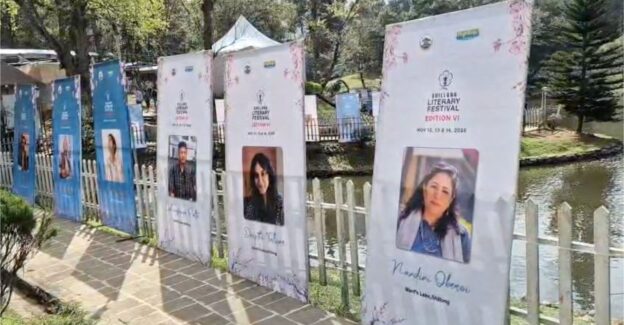
For Nandini Oberoi, retired professor of economics, editor and author, returning to Shillong for the festival was always a homecoming, made more special by the setting of Ward’s Lake.
“Festivals like this are important. They make room for stories that might otherwise go unheard and bring writers and readers into real dialogue. It is so heartening to see the festival go from strength to strength with each edition, and I look forward to coming back,” she said.
Oberoi took part in a discussion on Monpas with Sanjeeb Kakoty at the litfest. The session examined Vinay Sheel Oberoi’s book on the Buddhists of the high Himalayas and was moderated by Glenn C. Kharkongor.
She later moderated Chocho Momo and What Time Cannot Erase, an afternoon session in which Bijoya Sawian recalled the foremothers who raised and inspired her. Oberoi has also edited and published The Inner Courtyard, India’s first anthology of women’s writing in English.
Young writers get a platform
The festival’s promise for emerging writers was also reflected in the Meghalaya government’s efforts to create opportunities for young literary talent.
Chief Minister Conrad K. Sangma said the festival would provide young people with the encouragement, motivation and opportunities needed to take up writing.
A key initiative was First Bloom: Discovering New Writing from the Northeast, aimed at identifying and supporting emerging writers. Capacity-building workshops on creative writing, publishing and photography further strengthened the festival’s focus on nurturing new talent.
The announcement of a new short story competition also added to the opportunities available to aspiring writers.
The festival brought together writers, filmmakers, musicians and thinkers for discussions spanning science, nature, biography, cinema, history, food, music and poetry, highlighting the diversity of literary and cultural expression across the Northeast.
Writers explore nature, identity, storytelling
The day’s programme opened with Joram Beda in conversation with Yana Bagbi on his new book. Describing nature as an inexhaustible source of knowledge and discovery, Beda discussed the relationship between natural phenomena and scientific principles, including physics, mathematical equations, space-time, relativity and the properties of space.
Booker Prize winners Kiran Desai and Damon Galgut joined Anjum Hasan for a discussion on the realities, struggles and unexpected rewards of a writer’s life. They explored how family, surroundings and personal experiences shape literary work.
Hasan spoke of her admiration for R.K. Narayan and his deep connection with the place he came from, while Desai recalled growing up when reading was central to everyday life. The conversation also touched on the renewed interest in reading during the pandemic, with Galgut offering a humorous take on the image of the tortured writer.
Sandip Roy and Vineet Gill examined the art of documenting artists’ lives through biography, including Gill’s book on Nirmal Verma. In a conversation with Shahana Chatterjee, they discussed the role of memory, personal recollections and cultural references in reconstructing lives.
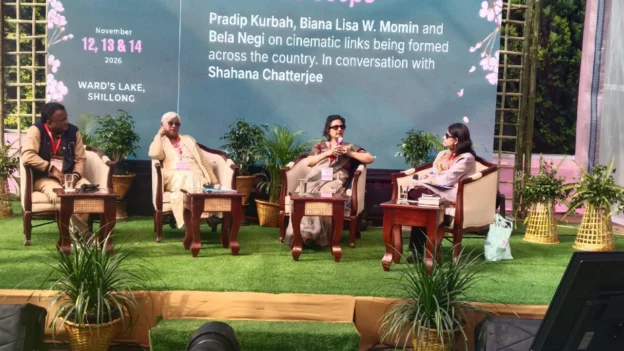
Filmmaker Pradip Kurbah and Biana Lisa W. Momin discussed independent cinema, representation and stories of misfits and underdogs. Kurbah spoke about his film Lewduh, set in Shillong’s Bara Bazar, which received recognition at the Busan International Film Festival.
The speakers questioned the label of ‘regional cinema’ and examined what defines Indian cinema. Momin also shared her journey as a pioneer from the Northeast and her efforts to open doors for emerging actors.
Bijoy Kumar Hrangkhawl, in conversation with Pradyot Bikram Manikya Deb Barma, traced Tripura’s history of insurgency, resistance and political movements through his memoirs. Recalling his years as an insurgent fighting for the oppressed, his imprisonment and his meeting with former Prime Minister Rajiv Gandhi, Hrangkhawl spoke about the struggle for constitutional protection and the importance of identity and political rights.
A Khasi-language session featuring Raphael Warjri, Aijinkmen Janong and Rangkitbok Dohkrut explored the links between music, poetry and cultural identity. From traditional folk music, instruments and rhythms to folklore and the cultural significance of Shillong’s cherry blossoms, the discussion highlighted the need to preserve traditional music for younger generations. The speakers also described music as an expression of emotion, healing and belonging.
P.S. Thangkhiew spoke about a short story competition instituted in memory of his father to encourage creativity and nurture aspiring writers. The competition offered prizes for writers and students, with categories for Khasi, Garo and other languages. Entries had to be original, with the use of AI prohibited.
Reflecting on changing reading and writing habits in the age of social media, Thangkhiew encouraged writers to experiment with sequels, prequels and new approaches to storytelling.
Other sessions included Shi Ryngkap Ki Khana Lyngot, with Streamlet Dkhar discussing her Khasi short story collection with Bijoya Sawian; The Unbecoming, featuring Kartikeya Vajpai in conversation with Patricia Mukhim; and Bookending The Past, in which Alka Saraogi and Gautam Hazarika explored research and storytelling in historical accounts and fiction.
Rupinder Brar discussed her new title, Corals Bloom Again, with Kanishka Gupta. The day also featured two Friday the 13th specials: Satyajit Sarna on horror, mystery and cautionary messages in his debut book Redtooth, and a thriller session with Zac O’Yeah and Ankush Saikia.
Prasenjit Kumar Basu, former chief economist for Southeast Asia and India at Credit Suisse First Boston, former chief Asia economist at Daiwa Securities and former Director of Asia Macroeconomics at UBS, described the festival as a showcase of literary talent from Meghalaya, Assam and eastern India.
“SLF is a marvellous showcase of the literary talent of Meghalaya, Assam and eastern India more broadly. For me, it was a wonderful opportunity to share my book, India Reborn (winner of the RC Majumdar Prize for Indian History, 2026), with a new and wider audience in this region,” he said.
Basu participated in The Great Game in the Himalayas.
Inclusion, Garo literature, cultural identity
The festival’s final day featured conversations on disability and inclusion, Garo literature and culture, Shillong’s food scene, Assam’s history, women in commerce, graphic storytelling and the meaning of home.
The closing ceremony, addressed by Tourism Minister Paul Lyngdoh, began with a performance by a Khasi band from the Shillong campus of the National Institute of Technology (SMIT).
Welcoming the emerging writers recognised through First Bloom, Lyngdoh said Shillong, with its long history of embracing diverse cultures, deserved recognition as the cultural centre of Northeast India.
Calling for greater engagement with Gen Z and millennials, he underlined the enduring value of the written word.
“The written word promises something that endures, endures beyond even your days,” he said.
He also offered a message on disagreement and public discourse: “When you disagree with somebody, do so, but do not become disagreeable as a person.”
Dr Vijay Kumar D., IAS, Commissioner and Secretary of the Tourism Department, said Ward’s Lake recorded a footfall of around 8,000 on the final day, compared with 1,000 to 1,500 on its busiest days, making this the festival’s most successful edition.
Thanking the Tourism Department, Festival Curator Malavika Banerjee, participating authors, the media and volunteers, he quoted Voltaire: “Let us read and let us dance. These are two amusements which will not cause harm to anybody. I think these two things we do wonderfully in Shillong.”
The First Bloom winners received ₹50,000 each, while the runners-up were awarded ₹25,000.
Michelle Syiemlieh won the fiction category for a crime narrative, with Mutum Mir taking the runner-up position for short stories set in Manipur and other parts of the Northeast.
In the non-fiction category, Jigdol Tenzing Gyalpo Bhutia won for his work on bird life in Sikkim. Phibashisha Marbaniang was the runner-up for her work on Khasi matriliny in rural Khasi Hills.
The final day’s discussions also brought questions of inclusion and representation into focus.
Suchitra Shenoy, speaking with Sandip Roy about her book on the lives of children with disabilities, described caregiving as an act of courage and dignity as a right rather than something that must be earned. Urging people to “look at our spaces”, the speakers called for greater accessibility and inclusion in public spaces and at festivals.
In a Garo-language session, Colnat Marak and Wilberth D. Marak spoke with Yankitina Goldiva D. Sangma about nature’s influence on Garo literature.
Wilberth D. Marak discussed his 518-page novel Delhini Me-tra (A Delhi Girl), recognised as the longest Garo novel. He explained how hills, rivers and waterfalls carry symbolic meaning in his writing. The discussion also explored nature’s dual character as a source of beauty and destruction.
Another Garo session featured Dominic Sangma, Sembetush A. Sangma and Arak M. Sangma in conversation with Bilhang K. Sangma on visual storytelling as a means of documenting and preserving Garo culture and folklore. They urged communities to record traditional stories before they disappear and raised concerns about AI’s impact on creativity.
Shillong’s food, history, meaning of home
Larsing Sawian, Priyadarshini Chatterjee and Zac O’Yeah joined Sandip Roy to discuss Shillong’s emergence as a food destination.
Chatterjee compared the city’s kong shops with Southeast Asia’s economy rice culture, while Sawian traced how restaurants such as Rynsan helped take regional cuisine to a national audience. O’Yeah argued that AI could never replace a writer who walks into a restaurant and experiences its food first-hand.
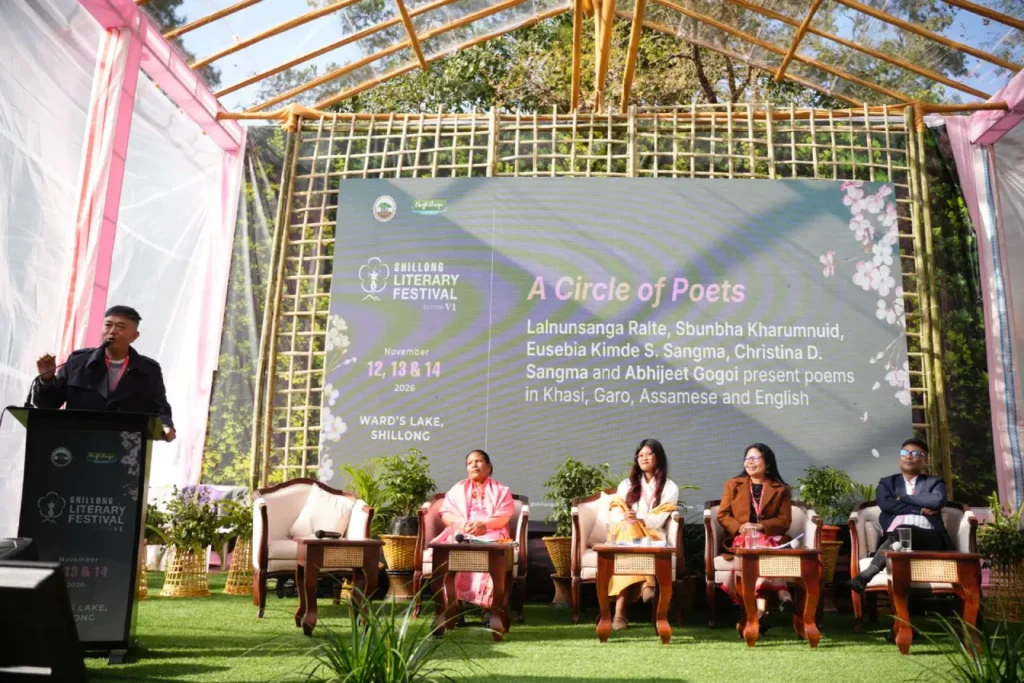
Poets Lalnunsanga Ralte, Sbunbha Kharumnuid, Eusebia Kimde S. Sangma, Christina D. Sangma and Abhijeet Gogoi presented works in Khasi, Garo, Assamese and English. The readings included Gogoi’s Breeze Beside the Halong, Christina D. Sangma’s A Mother’s Love and Eusebia Kimde S. Sangma’s Grace.
Shinjini Kumar, in conversation with Ankur Das, discussed commerce and culture in middle India and the ‘kya zaroorat hai’ mindset that often holds women entrepreneurs back.
“You can become a bonsai, but you can’t become a mango tree… mango trees have fruits, bonsai don’t have fruits,” she said.
The discussion also highlighted Meghalaya’s matrilineal tradition of women’s enterprise, including the contribution of Padma Shri awardee Trinity Saioo.
History found its place in the programme through Vijay Gogoi’s discussion with Sanjeeb Kakoty on his debut historical novel about the Ahom resurgence against the Mughals. Gogoi explained how the paik system, guerrilla warfare, river forts and smaller, faster boats helped the Ahoms resist a much larger empire at the Battle of Saraighat.
Mitra Phukan discussed her new novel with Anusha Viswanathan. Set in a small Assam town unsettled by gossip following an allegation against a teacher, the novel uses changing seasons to reflect the lives of its characters. The Brahmaputra, which Phukan said she “cannot escape”, remains a recurring presence in the story.
Graphic novelist Sarnath Banerjee, speaking with Debnita Chakravarti, described walking and drawing as the most authentic ways of understanding a city. On artificial intelligence, he said, “A final piece of work is of very little importance. It is basically how you got there.”
Mitra Phukan, Bela Negi and Anjum Hasan joined Indira Chandrashekhar for a discussion on home and belonging in fiction. Hasan distinguished between exclusive, contested homelands and hometowns that can belong to many, while Negi described the mountains of Uttarakhand as an almost active character in her writing.
Daniel Challam presented his new book, Postcards from the Khasi Hills: Shillong and Beyond in Panorama. Bringing together panoramic photographs from the colonial era, fictional letters in English and Khasi, and tanka poems, the book imagines the stories that the photographs leave untold. Challam ended the session with a moving letter dedicated to his late mother.
Writers reflect on decade of upheaval
The festival also turned its attention to how writers and artists have responded to a decade marked by disease, war, climate disasters and the rise of artificial intelligence.
Janice Pariat, Damon Galgut and Sarnath Banerjee joined Festival Curator Malavika Banerjee to reflect on these changes and their impact on creative expression.
Galgut observed how quickly the world appeared to return to its old ways after the pandemic. Pariat spoke about introducing AI into her classroom as a subject for discussion, while raising concerns about artists’ consent and the environmental cost of data centres.
The programme also featured India Reborn, with Prasenjit K. Basu in conversation with Kanishka Gupta.
Beyond the literary conversations and celebrated names, the sixth SLF’s most significant contribution may lie in the space it created for new writers, indigenous languages and stories from the Northeast. Through First Bloom, writing workshops and competitions, the festival sought to turn literary encouragement into tangible opportunities for the next generation.