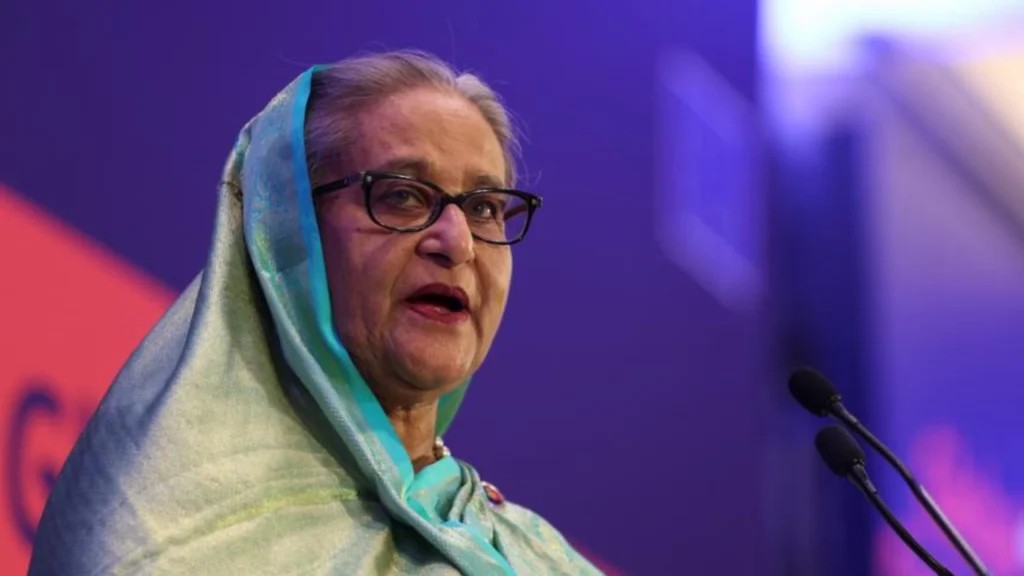
The question of Sheikh Hasina’s return to Bangladesh has now transcended the boundaries of domestic political landscape and entered the arena of international diplomatic scrutiny.
A joint letter reportedly signed by six serving and former parliamentarians from the United Kingdom, Scotland and the European Parliament, addressed to the British Foreign Secretary, has introduced an important international dimension to an increasingly consequential political and constitutional crisis in Bangladesh.
The letter reportedly seeks a written response within 14 days and advances four fundamental demands: credible guarantees of Sheikh Hasina’s personal security should she return; an assurance that she will neither face execution nor be subjected to capital punishment; an independent international monitoring mechanism involving the United Nations Office of the High Commissioner for Human Rights (OHCHR); and the restoration of an inclusive political environment in Bangladesh.
These are not inconsequential diplomatic observations. They raise questions that the international community cannot responsibly ignore.
A former prime minister who governed Bangladesh for approximately 15 years at a time, whose political legacy remains deeply prosperous, and whose return could profoundly reshape the country’s political landscape cannot simply be treated as an ordinary political matter.
Her constitutional rights, personal safety and entitlement to due process must be protected irrespective of the allegations against her or the political sentiments of those who oppose her.
Accountability must be individual, evidence-based, impartial and consistent with internationally recognised standards of fair trial.
The reported intervention of these six parliamentarians is particularly significant because it places the questions of judicial independence, capital punishment and political reconciliation before an established democratic constituency abroad. Their intervention does not constitute a judicial verdict on Sheikh Hasina’s innocence or guilt. Rather, it underscores the necessity of ensuring that the administration of justice is beyond reasonable suspicion of political manipulation though it is highly politically motivated.
Bangladesh must understand that international credibility is not secured through diplomatic rhetoric, selective accountability or the suppression of political opposition. It is earned through constitutional governance, institutional independence and demonstrable respect for human rights.
The proposed involvement of OHCHR therefore merits serious consideration. An internationally credible monitoring mechanism could help establish confidence in judicial proceedings, examine allegations of political persecution and monitor the protection of fundamental rights. Such oversight should be impartial and comprehensive, without privileging any political party or shielding anyone from legitimate accountability.
There is another dimension that deserves particular attention: the political exclusion of the Awami League. No democracy can claim moral or constitutional legitimacy while denying a substantial political constituency a meaningful opportunity to participate in national affairs.
The Awami League is the oldest, largest and Bangladesh’s founding political party and they were designedly banned in Bangladesh.
Political parties may be held accountable for the unlawful actions of their members, but collective political punishment is incompatible with democratic principles. A sustainable political settlement requires pluralism, political freedom and equal protection under the law.
The Constitution of Bangladesh must remain the supreme foundation of the republic. Its guarantees of equality, fundamental rights, democratic participation and the rule of law cannot become dispensable whenever political power changes hands.
Constitutional amendments, if contemplated, must emerge through legitimate democratic deliberation rather than political expediency.
Britain, given its historical relationship with Bangladesh and its continuing diplomatic engagement, has a responsibility to encourage democratic stability, not to dictate Bangladesh’s political future. Nevertheless, when credible questions arise concerning judicial independence, capital punishment and the safety of a former head of government, diplomatic silence would hardly constitute principled neutrality.
The 14-day response requested by the parliamentarians should therefore be regarded as an opportunity for constructive engagement rather than an affront to national sovereignty. Bangladesh should respond with clarity, evidence and constitutional confidence.
Ultimately, Sheikh Hasina’s political future cannot be determined exclusively by her admirers, her adversaries or foreign governments. Nor can the future of Bangladesh be held hostage to an endless cycle of political retribution. It must be determined through legitimate institutions; democratic participation and the sovereign will of its people.
The fundamental question is no longer simply whether Sheikh Hasina will return. It is whether Bangladesh possesses the institutional maturity to guarantee justice without vengeance, accountability without political persecution, and reconciliation without surrendering constitutional principles.
A nation born through an extraordinary struggle for freedom cannot afford to become indifferent to the very principles for which its people sacrificed their lives.
Bangladesh needs neither political vendettas nor externally imposed solutions. It needs constitutional democracy, institutional integrity, political inclusiveness and justice that commands public confidence.
The international community is watching. Dhaka must understand that the credibility of a nation is measured not by the power of its government, but by the fairness with which it treats even its most formidable political adversaries.
The return of a political leader may be a political event. The restoration of democracy must be a national imperative.
The reported letter and its 14-day request have been covered by recent Bangladeshi media. The six signatories are reported to include Bob Blackman MP, former MEP Charles Tannock, Martyn Day MSP, Paul McLennan MSP, Alan Brown MSP and Seamus Logan MP. The letter is a political and diplomatic appeal, not a judicial determination.
The OHCHR has independently emphasised fair-trial guarantees in the proceedings against Sheikh Hasina and reiterated its opposition to capital punishment.