In the winding, mist-veiled streets of Meghalaya’s capital, a profound test of wills is unfolding, driven not by political factions or corporate lobbies, but by the fierce, protective resolve of women elders and local residents.
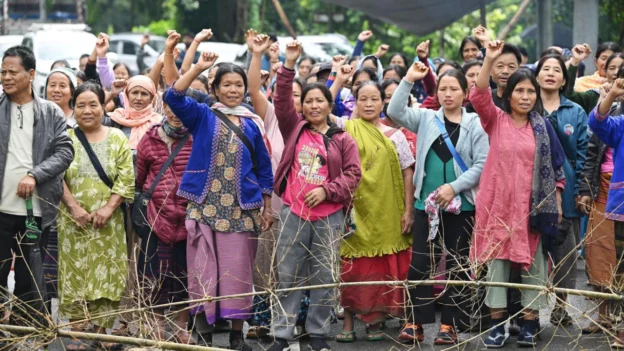
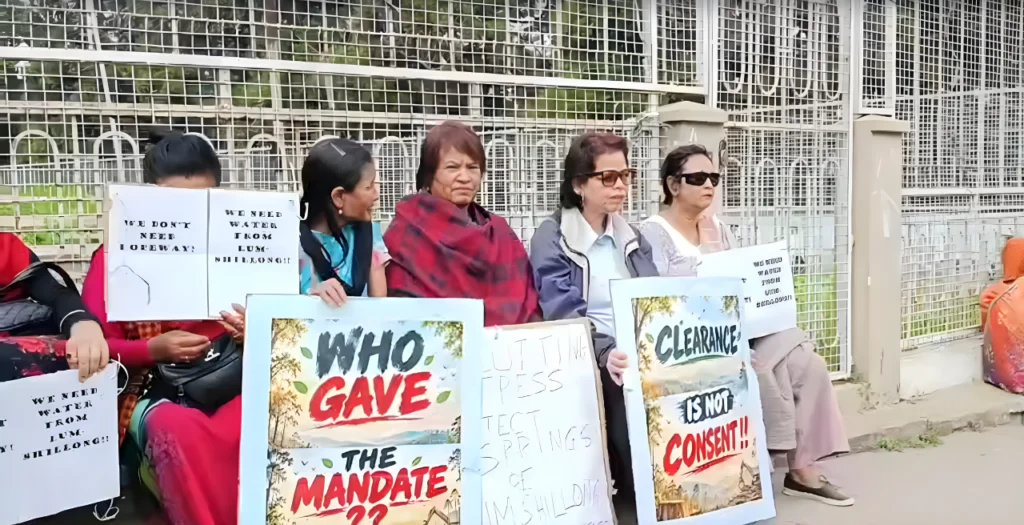
Operating under the banner of the Joint Action Committee (JAC) against the Shillong Peak Ropeway Project, hundreds of citizens, with resilient women at the forefront carrying placards highlighting pressing ecological concerns, recently gathered in front of the Kiang Nongbah statue near the Civil Hospital in Shillong.
Their collective demand is direct, uncompromising, and immediate: halt the project entirely before it irreversibly scars the indigenous ecosystem of Madan Laban and Lum Shyllong.
The protests stem from deep-seated fears regarding the ecological degradation of Lum Shyllong, a sacred and vital watershed region that anchors the local environment.
Addressing reporters at the demonstration, JAC leader Kong Benisha Mawlong emphasised that the visible public mobilisation of women proves the collective’s resolve remains unbroken after months of silent organising.
She directed sharp criticism towards Tourism Minister Paul Lyngdoh, accusing him of employing manipulative political tactics. Reflecting on his past as a prominent student leader who once united the Khasi community to protect indigenous interests, Mawlong questioned how someone who once fought for the hill’s protection could now champion a project that divides the community and impacts traditional land.
Mawlong stated that the JAC refuses to approach formal courts, arguing that legal battles often serve to prolong grievances and eventually dilute grassroots resistance. Instead, the collective has chosen direct, community-led action.
Expressing sorrow, she remarked that if Minister Paul Lyngdoh were not currently in power, he would likely be standing shoulder-to-shoulder with the protesting women, given his historic reputation as a defender of indigenous identity.
Instead, she claimed, his current administrative position has led him to mislead not just the residents of Raid Laban, but the entirety of Shillong and the wider state.
Addressing the minister’s claims that external experts familiar with Lum Shyllong endorse the project, Mawlong retorted that outsiders could hardly understand the delicate web of underground water sources and natural springs hidden within the hills.
She urged the government to do its homework and study the terrain properly, reiterating that the stance of the collective remains absolute: Lum Shyllong must remain untouched.
H. Bansiewdor Nonglang, Chairman of the Green Tech Foundation (GTF), echoed these sentiments, declaring that the movement has only just begun and will not cease until the government relocates the project to an alternative site.
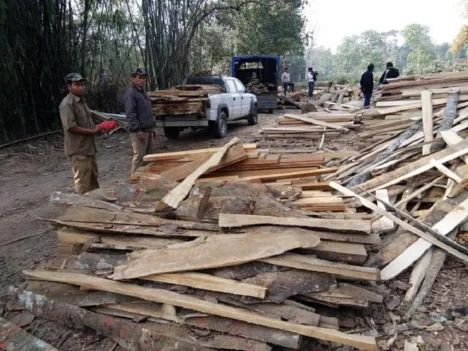
Nonglang pointed out that while public discourse has largely centred around the felling of over 500 trees, the government has remained opaque regarding the scale of concrete construction planned for the lower and upper terminals.
These terminals are projected to feature commercial complexes, restaurants and food courts, turning a pristine natural heritage site into a commercialised tourist hub. Once privatised and commercialised, Nonglang warned, the sanctity of Lum Shyllong will be lost forever.
Defending the GTF’s involvement, Nonglang explained that the organisation stepped in only after local women approached them in profound distress over the impending destruction of trees.
When local women voice concerns over water security, environmental groups have a moral obligation to listen and act, despite government accusations that the foundation is instigating unrest.
This anxiety is shared widely across Laban Pynllun, Lawsohtun and the broader Shillong urban agglomeration, transforming a localised dispute into a citywide movement.
The JAC warns that if the government persists, the state risks facing a massive civic movement spearheaded by women who refuse to back down.
Questions have also been raised regarding a recent consultative meeting where, out of 27 participants, 20 explicitly warned of severe hydrological impacts on Lum Shyllong.
Despite these warnings, the project was pushed forward, prompting the public to question the underlying motivations driving the initiative.
The core of the resistance lies in hydrology and water security. Technical concerns raised during the protests highlight what activists describe as an existential threat the ropeway poses to vital water systems, including the Umiam Hydro Power project and the Greater Shillong Water Supply Scheme originating from Mawphlang.
Activists posed a critical question to the public: Would citizens prefer daily ropeway rides at the expense of drinking water, or should the project be permanently relocated to safeguard public survival?
The JAC’s stance remains summarised by a simple, unyielding phrase: “No means no.”
Historical context forms the backbone of the women’s arguments. Elders recall that British colonial authorities recognised the unmatched abundance of natural springs originating from Lum Shyllong, leading them to establish planned settlements and intricate water-harvesting networks.
These include Ummulong, Jalynnoh, Wah Risa and Wah Sohkhlur, which, according to the protesters, feed into the Umkhrah and Umshyrpi rivers, ultimately sustaining the Umiam Dam and the Mawphlang reservoir.
Disrupting this hydrological balance, activists warn, could spell an ecological disaster for Shillong.
Dismissing government accusations that their opposition is politically motivated, the women asserted that protecting drinking water transcends partisan politics.
The movement’s moral authority is underscored by the active participation of senior women, some aged 60 to 70, and others battling severe illnesses such as cancer, who marched on the frontlines despite their physical vulnerabilities.
For these women, the fight for Lum Shyllong is a defence of their children’s future. They have made it clear that if any harm comes to the hills or the protesters, the responsibility will lie squarely with those who chose commercial expansion over ecological preservation.