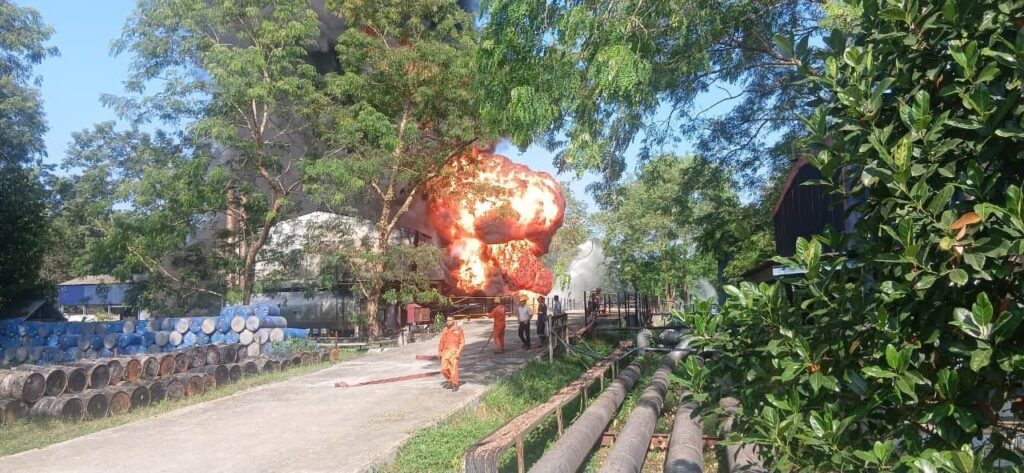
Tengakhat tragedy renews concerns over safety audits, contractor oversight and regulatory accountability following earlier oilfield emergencies
The deaths of four workers in the November 6 fire at Oil India Limited’s (OIL) Intermediate Tank Farm in Tengakhat, Dibrugarh district, have brought the safety of Assam’s oil installations under renewed scrutiny. Earlier disasters have also raised questions about the effectiveness of safety audits, emergency preparedness and regulatory oversight.
The latest incident, triggered by an explosion during maintenance work, cannot be viewed in isolation. The Baghjan blowout and fire in 2020 and the ONGC gas blowout at Bhatiapar in Sivasagar district in 2025 point to recurring concerns over operational safety, contractor management and the implementation of corrective measures.
Despite safety protocols and periodic inspections, serious incidents have continued to expose gaps between prescribed procedures and their implementation on the ground.
However, no consolidated official record of industrial fires at Assam’s oil installations since 2014 is publicly available. A comprehensive assessment would require company-wise and year-wise data from OIL, ONGC, Numaligarh Refinery Ltd (NRL), other refinery operators and state fire-service records.
The Baghjan disaster remains one of the most glaring examples of the consequences of failures in operational safety and emergency response.
On May 27, 2020, OIL’s Well No. 5 at the Baghjan oilfield in Tinsukia district suffered a blowout during a workover operation. Uncontrolled natural gas and condensate escaped from the well.
The site caught fire on June 9, and the blaze continued for several months before it was finally extinguished on November 15, 2020.
Initial well-control measures failed. A casing valve ruptured during an attempt to inject killing fluid, forcing OIL to suspend the operation in late August.
The company subsequently brought in Singapore-based specialists from Alert. On September 13, 2020, 110 days after the blowout, part of the escaping gas was diverted to two flaring pits and the remainder to an early production system. This reduced the fire but did not seal the well.
The well was finally killed on November 15 using the snubbing technique, with specialist assistance. It was permanently abandoned on December 3, 2020.
The disaster claimed the lives of two OIL firefighters, Durlov Gogoi and Tikeswar Gohain. An ONGC firefighter was injured.
Around 15 houses were completely burnt and another 10 to 15 were partially damaged. About 3,500 people from 650 families were displaced. The nearby Dibru-Saikhowa National Park and Maguri-Motapung wetland also suffered ecological damage.
The National Green Tribunal (NGT)-appointed expert committee found serious shortcomings in OIL’s operational practices and safety arrangements. It questioned the placement of cement plugs, the neglect of integrity testing and the absence of senior OIL officers during a critical phase of drilling.
The committee also found that the company had failed to implement necessary health, safety and environmental safeguards. It described the disaster as preventable and pointed to regulatory failures by the state as well.
The NGT held that OIL could not shift the entire responsibility to its contractor. It also recorded that the company had begun operations at Baghjan Well No. 5 without mandatory consents under the Water and Air Acts and had not adequately ensured environmental safeguards.
The tribunal directed OIL to initially deposit Rs 200 crore for restoration, with further deposits depending on the expert committee’s recommendations.
The findings also exposed serious shortcomings in environmental restoration. The expert committee found that less than 2 per cent of the area affected by condensate had been remediated.
The work was largely confined to soil, without systematic site characterisation. Remediation sites were also found to be neither protected nor properly demarcated.
The Ministry of Environment, Forest and Climate Change was also held responsible by the NGT for a “complete and comprehensive violation” of eco-sensitive zone norms.
The regulatory record raises a critical question: how effectively were the recommendations following Baghjan implemented?
OIL had informed authorities that it maintained a safety-audit system covering drilling and workover operations. This included pre-spud audits, pre-workover audits, surprise inspections and annual multidisciplinary audits during Internal Safety Week.
The company also cited inspections, mock drills, emergency-response exercises, contractor-safety management and near-miss reporting.
The Petroleum and Explosives Safety Organisation also conducts regular, external and surprise safety audits of oil installations.
However, the Baghjan findings indicated that the existence of safety procedures and audits did not guarantee compliance on the ground. OIL subsequently said it would review its audit system and introduce more stringent audits in accordance with Oil Industry Safety Directorate guidelines.
The Parliamentary Standing Committee on Petroleum and Natural Gas examined the disaster in its Nineteenth Report, titled Safety and Security of Oil Installations of Public Sector Oil Companies with Specific Reference to Baghjan Blow-out Incident.
Although corrective measures were subsequently taken, including accelerated overhauling of equipment, the parliamentary committee called for stronger accountability and sustained oversight.
The available public record does not establish whether every recommendation was fully and effectively implemented.
The 2025 ONGC blowout at Bhatiapar in Sivasagar district further revived concerns over the monitoring of outsourced operations.
On June 12, 2025, Well RDS-147A at the Rudrasagar oilfield suffered a gas blowout during a zone-transfer operation. The well was being operated by private firm SK Petro Services on behalf of ONGC.
The gas leakage continued for 16 days before ONGC capped the well on June 27. The company deployed its crisis-management team and brought in international well-control experts from CUDD Pressure Control, USA.
Gas pressure was reduced from 2,600 psi to 500 psi during the operation. Water blanketing was carried out round the clock as a safety measure, while the company undertook a junk-shot operation and pumped killing fluids.
Unlike Baghjan, the Bhatiapar blowout did not result in a fire, injury or casualty. However, around 350 families in neighbouring areas were evacuated as a precaution.
The Pollution Control Board, Assam, subsequently issued a show-cause notice to ONGC, alleging that it was operating Well No. 147 at Bhatiapar-Barichuk without mandatory consent to establish and consent to operate under environmental laws.
The incident also raised questions about contractor supervision and regulatory compliance. The precise cause and responsibility remained subject to investigation, and no publicly available evidence established that ONGC had failed to conduct a mandatory pre-operation safety audit.
The contrast between Baghjan and Bhatiapar is significant. At Baghjan, the uncontrolled gas release turned into a fire that continued for months and claimed two lives. At Bhatiapar, ONGC managed to prevent ignition and cap the well after 16 days, without casualties.
Nevertheless, the evacuation of hundreds of families and the need for international specialists demonstrated the continuing challenges of containing major oilfield emergencies.
Against this background, the Tengakhat fire has once again brought the accountability of oil operators into focus.
Following the November 2026 incident, local organisations and an Assam MP demanded an independent investigation and a comprehensive safety audit of OIL installations across the Northeast. They also called for scrutiny of earlier incidents, including Baghjan and Dikom.
The central issue is no longer whether oil companies have safety manuals, inspection schedules and emergency protocols. It is whether these systems are independently verified, properly implemented and capable of preventing accidents during high-risk operations.
Accountability also extends beyond contractors. OIL and ONGC remain responsible for the safety of their installations, including operations outsourced to private agencies.
The Ministry of Petroleum and Natural Gas, the Environment Ministry, the Assam Pollution Control Board and district administrations also have responsibilities for regulatory monitoring, statutory clearances, enforcement and emergency coordination.
The NGT’s Baghjan findings made it clear that an operator cannot escape institutional responsibility by attributing failures to a contractor.
With four workers dead in Tengakhat, the pressing questions are whether previous safety recommendations were adequately implemented, whether maintenance operations underwent rigorous safety checks and whether emergency-response arrangements were sufficient.
For Assam’s oil-producing belt, repeated industrial emergencies have made safety enforcement and accountability as important as production.
OIL spokesperson P. M. Bujarbarua said the company had constituted a technical team to investigate the incident.
“We have a technical team, and everything will come out after they submit the report,” he said.
He said safety audits were conducted at the installations, adding that the inquiry would establish what went wrong.
“The safety audit is carried out. But where the fault lies will come out in the inquiry report,” he said.
However, a retired OIL official, speaking on condition of anonymity, attributed the incident primarily to a lack of periodic safety audits.
“Had these audits been conducted regularly, the loopholes in the safety system would have been exposed,” he said.
He pointed to a shortage of competent safety inspectors, which, he said, had resulted in fewer inspections and an excessive workload for existing personnel.
He also alleged that safety norms were being diluted to maintain operations and increase production.
“The intention is to get the work going and increase productivity, bypassing safety norms,” he said.
The retired official further alleged that untrained contract workers were being deployed at hazardous sites without adequate protection. Personal protective equipment (PPE) was rarely provided to them, he claimed.
He also blamed cost-cutting practices for the continued use of obsolete equipment that had exceeded its operational lifespan, creating dangerous working conditions. Alarm sensors, he alleged, were often absent.
Weak and fragmented safety laws, he said, had contributed to bureaucratic apathy and a tendency among agencies to shift blame rather than fix responsibility.
“The actual accident figures are not reflected, and factory owners rarely learn lessons from safety disasters,” he added.