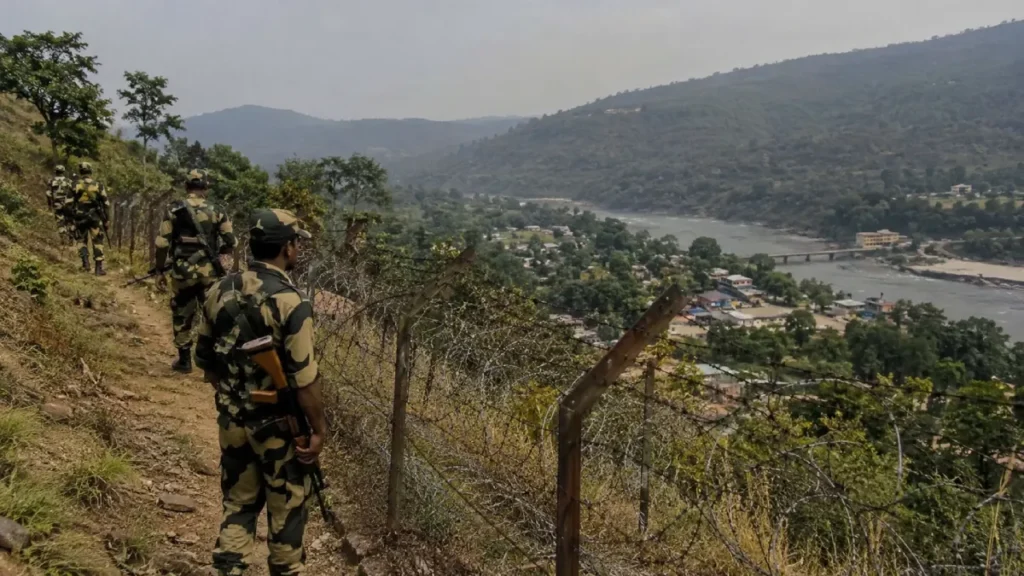
The security architecture guarding India’s northeastern frontier is confronting serious questions over its structural integrity following a series of cross-border entries along the porous Meghalaya–Bangladesh border.
Beyond the immediate political rhetoric surrounding illegal immigration, a closer examination of recent interceptions points to a more complex challenge. It suggests the presence of organised human-smuggling networks that may be exploiting difficult terrain, gaps in coordination and established local transit routes.
The issue, therefore, extends beyond individuals slipping past physical barriers. It points to an apparent infiltration pipeline in which people can move from the border into the Indian mainland using road and rail networks.
A critical example emerged on September 16, 2026, when a multi-agency operation intercepted 27 Bangladeshi nationals — including 16 men, 11 women and children — in neighbouring Assam.
The group had reportedly entered India on foot through the Dawki sector of Meghalaya before securing local road transport towards Guwahati in search of employment.
Acting on targeted intelligence, the Assam Police, Government Railway Police and Railway Protection Force first apprehended 12 individuals at the Assam State Transport Corporation campus in Paltan Bazar, Guwahati.
Subsequent questioning led railway law-enforcement personnel to track the Jammu Tawi Express beyond Rangiya junction, where the remaining 15 members of the group were deboarded at New Bongaigaon Railway Station.
Investigative findings indicated that the detainees came from several districts of Bangladesh, including Dhaka, Sunamganj, Gopalganj, Bagerhat, Khulna and Mymensingh.
None reportedly possessed valid passports or visas, while several adults were found carrying forged Indian identification cards. These documents allegedly enabled them to pass ticketing checks and board interstate trains.
The Assam Police Border Division subsequently initiated deportation procedures. However, the route followed by the group raised questions about the effectiveness of border monitoring beyond the immediate frontier.
In response to growing public concern and representations from civil society, Home Police Minister Prestone Tynsong addressed the issue and outlined the government’s position. The minister said he had convened a high-level coordination meeting with officials of the Border Security Force and the state police to discuss recurring cases of infiltration.
He said joint instructions had been issued to increase ground-level activity and maintain heightened vigilance along vulnerable stretches of the border. Tynsong also sought to put the movement in a wider context, saying the underlying driver appeared to be the broader socio-political situation in Bangladesh rather than any concerted attempt to create law-and-order problems.
He noted that many of those detected and apprehended appeared to be ordinary citizens seeking to leave Bangladesh in search of better opportunities elsewhere. At the same time, he said detailed discussions had been held internally, with specific directions issued to district administrations, police forces and border-security personnel.
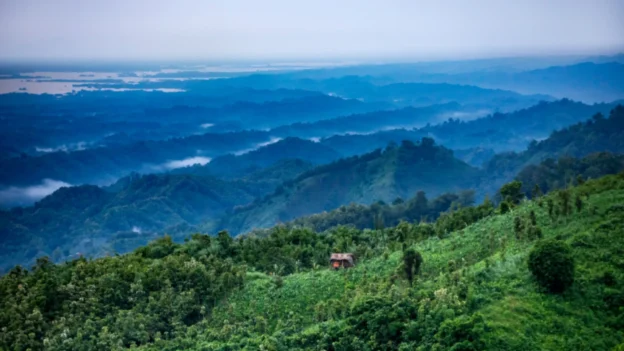
The Home Minister also pointed to physical and geographical vulnerabilities, particularly in East Khasi Hills and West Jaintia Hills. Large stretches of the border remain unfenced, while difficult terrain and poor physical accessibility make surveillance particularly challenging.
Tynsong said those attempting to cross the border take advantage of such geographical gaps. He also acknowledged the involvement of local middlemen and agents operating small-scale illegal networks for financial gain.
While declining to disclose sensitive operational details, he said joint counter-measures were being pursued to strengthen security in the region.
The movement of the 27 foreign nationals across more than 200 kilometres from Dawki — an established settlement and commercial transit point rather than an inaccessible wilderness — towards Jorabat has nevertheless drawn considerable scrutiny.
The group reportedly travelled through highways and local markets without being intercepted until it reached Assam, raising questions about how effectively movements beyond the immediate border zone are being detected.
Roykupar Synrem, Chairman of the Confederation of Meghalaya Social Organizations, alleged what he described as “severe systemic lapses” at multiple levels of the security system.
He attributed the initial breach to an alleged failure at the border perimeter and argued that the subsequent movement of the group through Meghalaya raised questions about the effectiveness of highway checks and other mechanisms intended to detect unauthorised movement. Synrem also raised questions about the extent to which information may have been shared or acted upon across the various agencies responsible for border management and internal security.
These are allegations made by Synrem and could not be independently verified. They should therefore be viewed as his assessment of the security response rather than as an established finding of institutional failure.
The Dawki incident also appears to form part of a broader pattern rather than being an isolated case.
Within a four- to five-day period, security agencies and local groups reportedly intercepted nearly 50 foreign nationals across several sectors, including 11 individuals in Amlarem and separate groups in Shella.
Community leaders have argued that such apprehensions may represent only a portion of the actual movement, with some groups potentially travelling onwards to urban centres or other parts of the country without being detected.
Officials in New Delhi have for years described the India–Bangladesh frontier as highly porous and have identified illegal cross-border activity and migration as persistent challenges.
A senior Ministry of Home Affairs official, for instance, said in 2023 that the border had a “high degree of porosity” and that checking illegal cross-border activities and illegal migration remained a major challenge. The Centre has also acknowledged that difficult stretches of the border require a combination of surveillance technology, intelligence and coordination with state governments and other agencies.
The character of the border itself adds another layer of complexity. Communities on either side have long maintained social, economic and familial links, while formal border-haat arrangements also recognise the extent of legitimate cross-border interaction.
Against this backdrop, security officials and border-management assessments have increasingly focused on the role of informal networks, transporters and local facilitators in enabling illicit movement. The challenge, therefore, is not simply one of strengthening the physical boundary, but of identifying and disrupting the networks that may operate beyond it.
The economic and operational mechanics behind such movements have also come under scrutiny from local civil-society organisations. The Hynñiewtrep Integrated Territorial Organisation has called for structural changes and has taken its ground-level observations directly to security officials.
During meetings on September 1 with Border Security Force Meghalaya Frontier Inspector General O.P. Upadhyay and on September 25 with Jowai Sector Deputy Inspector General Naval Singh, representatives of the organisation raised concerns about movements through vulnerable areas such as Muktapur in West Jaintia Hills.
Local residents and civic groups have reportedly been intercepting suspected infiltrators in the area since 2025.
The organisation also presented information concerning alleged local networks facilitating movement from border areas towards Shillong, with charges reportedly reaching as high as Rs 50,000 per person. It further claimed that such networks may exploit vulnerable women who enter through these routes.
These claims, however, would require independent verification and further investigation to establish the scale and structure of the networks involved.
Addressing such vulnerabilities requires a response that goes beyond conventional border patrolling and places greater emphasis on coordination, information-sharing and monitoring of transit routes.
Proposals put forward include dedicated liaison mechanisms between border forces and state anti-infiltration authorities, structured intelligence-sharing with border communities, stronger identity-document verification and appropriate legal action against those found to be facilitating illegal entry.
The response from border officials during the late-September meetings indicated recognition that securing the frontier requires an evolving strategy.
Physical barriers and static guard posts alone may not be sufficient where people attempting to cross the border can potentially make use of forged documents, local transport networks and established routes into the interior.
The wider challenge is therefore one of coordination — linking border surveillance with policing, intelligence gathering, transport monitoring and information from communities living close to the frontier.
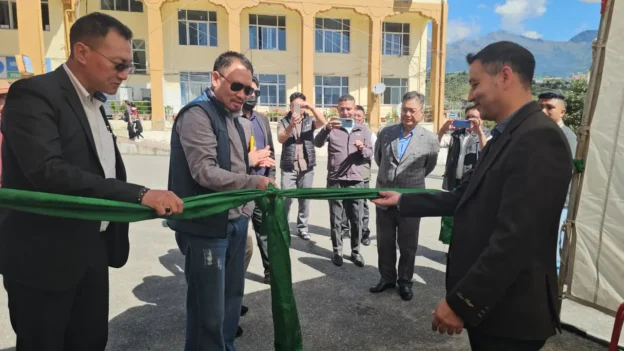
Escalating local demands reached another critical juncture on September 29, 2026, when leaders of the Pnar Students’ Movement met Deputy Chief Minister and Home Police Minister Prestone Tynsong.
Represented by President Embhah Passah, the delegation urged the state government to treat the issue of public safety and border security with greater urgency. The organisation strongly demanded the revival and re-establishment of the Anti-Infiltration Directorate check gate along the strategically important Jowai–Dawki Road, along with the sanctioning and funding of the necessary enforcement posts.
The student leadership argued that recent incidents indicated a rise in attempted crossings through vulnerable stretches of the Dawki sector. It said the movement of undocumented persons through these routes could have implications for local socio-economic conditions, place additional pressure on law-enforcement resources and raise concerns about public safety.
The movement also reminded the Home Department that an anti-infiltration mechanism had previously operated in the Dawki region to inspect vehicles and monitor pedestrian movement. The student body questioned why the facility had become non-functional in recent years and argued that the absence of such a mechanism had left an important transit corridor more vulnerable.
It called for the immediate redeployment of a functional Anti-Infiltration Directorate gate at a strategic location along the Jowai–Dawki highway, along with approval and funding for the personnel required to operate it. The delegation also sought stronger overall border surveillance.
It urged that joint operations involving the police, district administration, intelligence agencies and other competent authorities be intensified along vulnerable routes, including roads, footpaths, riverine passages and transit points.
The student leadership maintained that national security and the protection of local communities required sustained attention, warning that failure to address these concerns could lead local youth and the wider community to pursue democratic forms of protest.