
The story of Bangladesh’s prison break is no longer simply about how thousands of prisoners managed to escape during the political upheaval of July and August 2024. The far more troubling question is what has happened to those who remain outside the reach of the state — and why, two years later, Bangladesh’s security agencies have still been unable to trace hundreds of them.
The numbers alone should raise questions.
According to Inspector General of Prisons Brigadier General Syed Mohammad Motaher Hossain, 2,247 prisoners escaped from several prisons during the 2024 uprising. Of these, 690 are still at large. More significantly, the prison authorities have no information or confirmed records relating to 166 of them. All 166 escaped from Narsingdi District Jail, where prison records, servers and databases were destroyed during the attacks.
That means that two years after the prison breaches, the state is not merely failing to recapture hundreds of fugitives. In 166 cases, it cannot even establish the most basic information needed to begin tracing them.
That should be a security question before it becomes an administrative one.
The figures also reveal how little progress has apparently been made over time. Comparing the prison authorities’ figures from December 2024 with those released in August 2026 suggests that only 10 of the remaining fugitives were arrested over roughly 20 months.
The explanation offered by the prison authorities — that records were destroyed during attacks and that the prison system remains severely overcrowded — explains part of the administrative difficulty. Bangladesh’s prisons are reportedly holding around 98,000 inmates against an official capacity of about 45,000.
But overcrowding cannot by itself explain the whereabouts of hundreds of people who have been outside prison custody for two years.
Nor does it answer the larger question: what have the country’s police, intelligence and counter-terrorism agencies been doing to systematically identify, locate and recapture those who escaped?
The distinction matters because the 690 fugitives are not a homogeneous group. They include convicted criminals, people facing serious criminal charges, high-risk offenders and individuals accused in militancy-related cases. The Inspector General of Prisons has said that nine prisoners facing militancy-related cases escaped during the uprising. Six have since been arrested, while three remain at large.
The security implications therefore extend beyond the prison system.
The most uncomfortable possibility is that some of those who escaped may have found protection, shelter or new networks outside the formal reach of the state. That possibility cannot simply be asserted as fact. But neither can it be dismissed when Bangladesh has simultaneously witnessed the renewed activity of Islamist and militant networks since the August 2024 political transition.
There is already independent reporting that several established militant organisations have sought to rebuild their organisational space. The European Union Agency for Asylum, citing security assessments, notes that groups including Jama’atul Mujahideen Bangladesh, Ansar al-Islam, Harkat-ul-Jihad-al-Islami and Neo-JMB have remained active, while radical groups have increased their organisational activity since August 2024. It also records that 174 prisoners linked to militant outfits were released on bail between 5 August and 5 December 2024, including senior figures from banned terrorist organisations.
The re-emergence of these networks gives the missing prisoners a much wider security context.
Among the newer formations is As-Shahadat, which the S. Rajaratnam School of International Studies describes as a militant group linked to the banned Ansar al-Islam and influenced by Taliban and Al-Qaeda ideology. It has reportedly focused on recruiting madrasa students and has extended its activities into India, particularly West Bengal, where recruits have been identified.
Ansar al-Islam, also known as Ansarullah Bangla Team, remains another important part of this landscape. There are also continuing concerns over JMB and its newer networks, while Hizb ut-Tahrir Bangladesh — although not a conventional militant organisation — has moved more visibly into public mobilisation. On 7 March 2025, it held a public demonstration in Dhaka calling for a caliphate, its first such demonstration since being banned in 2009.
This is where the prison fugitives become a question for the wider security architecture.
Could hardened criminals who escaped during the 2024 upheaval subsequently have been absorbed into criminal, radical or militant networks? Could some have used such networks to obtain shelter, forged identities, logistical assistance or protection from arrest? And could individuals with pre-existing ideological or organisational connections have used the chaos surrounding the prison breaches to disappear into an already expanding underground ecosystem?
These are questions that require investigation, not assumptions.
There are, however, reasons why they cannot simply be brushed aside. Independent assessments have documented the increased activity of radical Islamist groups since the political transition, including attempts by established organisations to rebuild their networks. The Observer Research Foundation has also reported concerns about the revival of links between Bangladesh-based radical networks and Pakistan-based organisations such as Lashkar-e-Taiba, Jaish-e-Mohammed and HuJI. Those remain security assessments and reported intelligence concerns rather than facts that can be independently established in every individual case.
The same caution must apply to claims that some of the escaped prisoners were deliberately allowed to disappear.
Sources claiming access to Bangladesh’s security establishment have suggested that some fugitives may have received what they describe as a “free passageway”. One source close to the Directorate General of Forces Intelligence (DGFI) Bangladesh has further claimed that around 120 of the escapees were connected to the upper hierarchy of militant or radical organisations, including networks associated with As-Shahadat, Ansar al-Islam and Hizb ut-Tahrir.
Those claims are serious if true. But they remain unverified intelligence-source allegations and should therefore be treated as such.
The more important question is whether Bangladesh’s security agencies have themselves investigated this possibility.
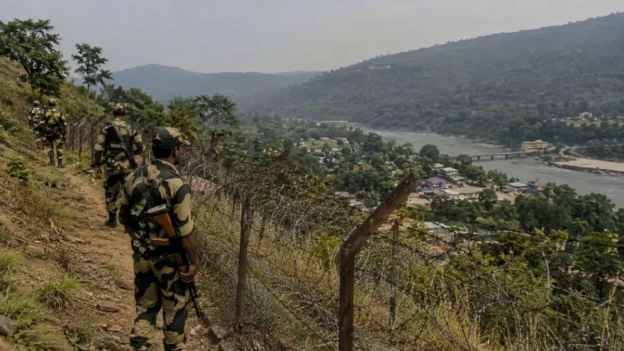
That question becomes particularly relevant because the security environment along Bangladesh’s western and eastern borders is already changing. There are documented concerns about Bangladesh-based militant networks seeking to establish or reactivate connections in West Bengal, Assam and Tripura. ORF has noted the exploitation of the India-Bangladesh border by radical Islamic outfits and transnational criminal networks, while previous investigations have uncovered links involving JMB and Ansarullah Bangla Team and networks in India.
As-Shahadat’s reported recruitment activity in West Bengal is particularly significant. So too are continuing concerns about Ansar al-Islam and JMB-linked networks attempting to establish themselves in different parts of Assam and the wider Northeast. These developments do not prove that escaped prisoners have joined such organisations. But they establish the environment in which such a possibility deserves serious scrutiny.
That is why the prison authorities’ explanation about destroyed records and overcrowding, while relevant, cannot be the end of the discussion.
The destruction of records explains why 166 identities are difficult to establish. It does not explain why hundreds of known fugitives remain outside custody after two years. Nor does it explain whether intelligence agencies have constructed a consolidated database of the fugitives, cross-referenced their previous criminal and militant associations, monitored their known associates, examined financial and communications trails, or coordinated their pursuit across Bangladesh’s borders.
The question is particularly important because Bangladesh’s security establishment itself has undergone considerable restructuring since the 2024 political transition. The heads of several major security and intelligence institutions have been replaced or reshuffled, including the RAB, DGFI, National Security Intelligence, the National Telecommunication Monitoring Centre and the Counter Terrorism and Transnational Crime unit.
In such an environment, the continued disappearance of hundreds of fugitives raises a question that goes beyond prison administration.
It raises questions about institutional continuity, intelligence coordination and the ability of the state to maintain a reliable picture of its own high-risk criminal population.
The concern becomes even sharper if some of these fugitives have subsequently entered networks whose interests extend beyond ordinary criminal activity. A hardened criminal does not necessarily become a militant simply because he disappears into an extremist network. But criminal skills, local contacts, knowledge of terrain, access to illicit markets and experience of operating outside the law can become useful to organisations seeking to build clandestine networks.
That is the convergence that deserves attention.
Bangladesh is already dealing with an ecosystem in which older jihadist organisations, newer Al-Qaeda- and Islamic State-inspired formations, political Islamist mobilisation, cross-border recruitment and transnational criminal networks can potentially overlap. The question is whether a portion of the prison fugitives has been absorbed into that ecosystem — and whether some networks have deliberately used the chaos following the 2024 prison breaches to strengthen themselves.
There are also wider regional implications.
For India, the concern is not simply the movement of fugitives across a porous frontier. It is the possibility that individuals who have spent years inside criminal networks could find new protection and purpose within organisations operating across Bangladesh and the eastern Indian states.
West Bengal, Assam and Tripura already feature in assessments of Bangladesh-linked extremist networks. The possibility of fugitives moving into these networks would therefore transform what began as a prison-security failure into a wider cross-border security concern.
This is why the number 690 matters.
It represents not merely the number of prisoners Bangladesh has failed to recapture. It represents 690 unresolved security questions — including 166 cases in which the authorities themselves say they lack basic information.
Two years after the uprising, the question should no longer be how Bangladesh’s prisons were breached.
The more consequential question is who disappeared through those breaches, where they have gone, who has helped them remain beyond the reach of the state, and whether some of them have since become part of networks with the capacity to destabilise Bangladesh and its neighbourhood.
The Inspector General of Prisons’ emphasis on overcrowding, prison capacity and administrative restructuring is relevant. His statement that Bangladesh’s prisons require reform and that the present system cannot adequately accommodate the inmate population is a legitimate institutional concern. The prison administration has also reportedly reorganised structures at headquarters and divisional levels to improve efficiency.
But those reforms address the prison system of tomorrow.
The 690 fugitives are a security problem of today.
What is required now is not another explanation of why the prison system failed in 2024, but a clear account of what Bangladesh’s security agencies have done since then to find those who escaped — particularly the high-risk offenders and militants — and whether any evidence exists that some have been absorbed into radical, criminal or cross-border networks.
Until those questions are answered, the prison break of 2024 cannot be regarded as a closed chapter.
It remains an unresolved security vulnerability at the heart of Bangladesh’s post-uprising transition — and potentially one that extends well beyond its borders.