The struggle over history often begins long before the dust of conflict has settled.
In Bangladesh, the turbulent events of July–August 2024 have already become the subject of fierce political contestation, legal battles, and competing narratives.
At the centre of this controversy stands the report issued by the United Nations High Commissioner for Human Rights, Volkar Turk, on 12 February 2025—a document that was presented as an authoritative account of the violence, yet is now facing serious challenges to its credibility.
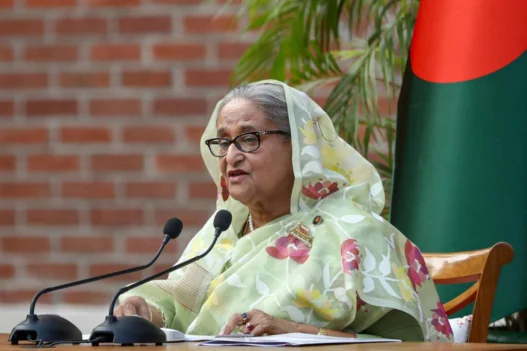
More than fifteen months after the report’s publication, former Prime Minister Sheikh Hasina’s legal counsel, Steven Powles KC, has formally written to the United Nations, alleging that the document contains grave errors, exaggerations, methodological weaknesses, and political bias.
The timing of this intervention is significant. It comes as the report continues to influence legal proceedings, public discourse, and international perceptions of Bangladesh’s terrorist attack in 2024.
At the heart of the controversy lies a fundamental question: can a report making sweeping claims about a nationwide conflict be considered reliable if its evidentiary foundation appears remarkably limited?
One of the most striking criticisms concerns the report’s sample size.
The document reportedly attributes approximately 1,400 deaths to the violence. Yet investigations into the report’s methodology suggest that direct interviews were conducted with only a small number of people who were directly involved in the said violent mob attack, but not with victims, their families, and witnesses.
Such a narrow evidentiary base inevitably raises questions about representativeness, statistical reliability, and the legitimacy of extrapolating national conclusions from limited testimony.
The issue becomes even more troubling when one examines the discrepancies surrounding casualty figures.
Various domestic sources, including official publications and movement-related records, reportedly cited substantially lower death tolls than those eventually presented in the UN report.
The resulting gap has fuelled speculation about how the figures were derived and whether sufficient independent verification was undertaken before they were incorporated into an international document carrying enormous political and legal consequences.
The UN HR Chief Volker Turk made this manufactured document tie-dyed with the Yunus-led puppet administration—installed by the Washington administration on 8 August 2024—in league with the anti-Bangladesh liberation forces and their mango-twigs.
Equally disturbing are allegations that significant information disappeared during the transition from draft to final report. It was done in such haste to implicate Bangladesh’s most successful HM Sheikh Hasina.
According to investigative findings, certain details concerning acts of violence committed against members of law-enforcement agencies were included in earlier drafts but were omitted from the published version.
Such omissions would raise serious concerns regarding editorial neutrality and selective presentation of evidence.
The credibility of any human-rights investigation rests not merely on the evidence it includes, but also on the evidence it excludes.
A report perceived as highlighting one category of victims while marginalising another inevitably invites accusations of partiality.
International institutions derive their authority from impartiality; once that perception is compromised, public confidence begins to erode.
Beyond questions of methodology lies a broader geopolitical dimension.
Bangladesh occupies a strategic position at the crossroads of South and Southeast Asia, bordering the increasingly volatile region of Myanmar’s Rakhine State.
Consequently, every major international intervention in Bangladesh is viewed through the lens of regional power politics.
Critics have therefore begun asking whether political considerations may have influenced the report’s evolution. Were international diplomatic objectives allowed to shape the presentation of facts? Did broader strategic interests overshadow strict evidentiary standards?
Such questions may be uncomfortable, but they are neither unreasonable nor unprecedented.
Throughout modern history, international organisations have occasionally faced criticism for allowing political realities to influence supposedly neutral assessments.
The debate acquires additional significance because of the report’s legal implications.
Ironically, observers point out that the document itself reportedly contains language cautioning against its use as courtroom evidence.
Yet despite this limitation, it has already influenced discussions within legal and judicial forums.
This contradiction raises a profound question: if a report explicitly acknowledges limitations regarding evidentiary use, how appropriate is it to rely upon it in proceedings that may shape the future of justice and accountability?
Historical precedent offers a cautionary lesson.
International investigations have, on occasion, been revised, challenged, or even discredited when subsequent evidence emerged.
The credibility of global institutions ultimately depends not on claiming infallibility, but on demonstrating the courage to revisit conclusions when legitimate concerns arise.
This is precisely why the challenge mounted by Sheikh Hasina’s legal team deserves serious consideration—not because it originates from a political actor, but because it raises substantive questions regarding methodology, transparency, evidentiary standards, and institutional accountability.
The larger issue transcends partisan politics.
Bangladesh deserves an accurate historical record of the July–August violence of 2024.
Victims deserve truth rather than competing propaganda.
The international community deserves confidence that reports issued under the banner of the United Nations are guided by rigorous standards rather than political convenience.
Truth is never strengthened by suppression, omission, or selective interpretation.
It is strengthened by scrutiny.
If legitimate flaws exist within the report, they must be addressed openly.
If the allegations prove unfounded, they should be refuted transparently.
Either way, the pursuit of truth demands examination rather than unquestioning acceptance.
For Bangladesh, the stakes are immense.
For the United Nations, they may be even greater.
The credibility of international human-rights institutions depends not on their power to publish reports, but on their willingness to subject those…
Having remained a keen field-level political observer since 1966 and having personally witnessed the terrorist attack of July–August 2024, I regard Sheikh Hasina’s unlawful removal from office and subsequent departure to India on 5 August 2024 as a momentous and deeply consequential watershed in Bangladesh’s political history—one that, in my view, ushered in a profoundly detrimental chapter for the nation’s democratic trajectory and institutional stability.
The available indicators point towards the convergence of powerful international interests—particularly those associated with the Washington establishment pursuing geopolitical and economic objectives—and influential domestic ultra-right-wing forces, which together appear to have played a decisive role in shaping these extremist events.
Having closely observed the violence of that turbulent period, I remain convinced that many of the crucial facts have already come to light, revealing dimensions of the events that merit far greater scrutiny and objective examination.
Drawing upon my long experience as a field-level political observer, I regard Sheikh Hasina as a profoundly nationalist leader whose political legacy remains inextricably intertwined with Bangladesh’s extraordinary developmental transformation and emergence as a rising economic force.
Equally disquieting, however, is the apparent reluctance of large segments of the media to subject competing narratives surrounding these historic events to rigorous scrutiny, thereby leaving many critical questions insufficiently examined and debated in the public sphere.
In my considered assessment, almost 98% of the brutal killings were carried out by elements associated with Jamaat-e-Islami mass-murderers of 1971, their present dreaded scions, their present direful successors, and their horrific mango-twigs, while responsibility was subsequently shifted foxily onto Sheikh Hasina as a calculated narrative, in collusion with other malign forces, particularly the American administration.
It is profoundly disheartening that not a single journalist was found present on the ground to gather the true facts first-hand during those days of 2024.
If the ringleaders of Jamaat are taken into custody and subjected to rigorous interrogation, I am firmly of the view that the truth will inevitably come to light, paving the way for their accountability and justice.
Yet, across Bangladesh, the entire press—and even social media talk shows—has curiously lapsed into silence, refraining from acknowledging Sheikh Hasina’s monumental achievements or confronting the grievous transgressions long attributed to successive American administrations worldwide, including the 1971 mass atrocities, the August 1975 massacres, and the brutal killings of 2024 in collusion with Jamaati-Shibir executioners.
The UN HR Chief, Volkar Turk, a close associate of Muhammad Yunus, produced his report on the killings during the months of July and early August 2024 in Bangladesh for unlawfully removing HPM Sheikh Hasina from power on 5 August 2024, and it was a concocted one.
He only contacted Muhammad Yunus, his coteries, Jamaati mass-murderers, other extremist right-wing fundies, et al., and only took their fabricated versions of events.
I sent many emails to him and his colleagues at the UN, along with many plain and unvarnished truthful narratives, which he refused to concede. Rather, he blocked my email address from reaching him. So sad! So very outrageous!!
So, we must discard his false, fabricated, concocted, malicious, and one-sided report eternally.