Beyond the curtain, million-dollar machinations have quietly unfolded in Bangladesh!
The United States bore unequivocal and overarching responsibility for orchestrating the regime change in Bangladesh. The ledger of sovereignty—inscribed in dollars, defined by power, and overshadowed by the lingering spectre of August 2024 in Bangladesh.
There are defining junctures in a nation’s life when the quiet testimony of documents outweighs the grandiloquence of public declarations—when spreadsheets, grant ledgers, and institutional records speak with an authority that no political rhetoric can easily dismiss. Bangladesh now stands at such a moment. Emerging disclosures concerning foreign financial flows and political programming have ignited a grave constitutional inquiry: who truly determines the destiny of a sovereign republic—not the people but the external forces headed by the American deep state and the CIA in league with their direful local confederates operating behind a façade of assistance.
As Thomas Jefferson wisely cautioned, “The price of freedom is eternal vigilance.” That vigilance must not be confined to guarding against internal decay alone; it must extend to resisting the subtle encroachments of external influence—those carefully veiled interventions that arrive under the benign banners of democracy promotion, development cooperation, and institutional strengthening.
At the heart of the current discourse lies a deeply unsettling proposition: that extensive foreign assistance, particularly from Western governments and affiliated entities, have functioned not merely as developmental support, but as instruments of political calibration within Bangladesh. The scale and convergence of these funding streams, revealed through what many term a “paper trail,” demand sober scrutiny rather than reflexive dismissal.
Any serious examination must begin with the supreme charter of the nation—the Constitution of the People’s Republic of Bangladesh. Its Preamble affirms unequivocally that sovereignty resides in the people, while Article 7 enshrines the Constitution as the supreme law, rendering void any act inconsistent with its provisions. Article 11 further commits the State to democracy, human rights, and the rule of law. These are not symbolic aspirations; they are binding obligations that define the legitimacy of governance itself.
Critics argue that the convergence of international aid agencies, democracy institutes, development contractors, and affiliated non-governmental organizations has created an intricate ecosystem of political engagement—one that extends beyond neutral support into the realm of structural influence. Proponents, of course, maintain that such initiatives merely strengthen democratic resilience. Yet the question persists: can democracy truly remain organic if its scaffolding is externally financed and strategically aligned?
History offers sobering lessons.
In Bangladesh, the spirit of 1971 remains the moral bedrock of the state—a testament to sacrifice, self-determination, and resistance against domination. Sovereignty, as envisioned in the Constitution, is indivisible. It cannot be diluted, delegated, or quietly reconfigured through administrative channels, however well-intentioned those channels may appear.
A particularly troubling dimension of the current debate is the question of institutional dependency. When domestic organizations—be they civil society groups, media platforms, or governance initiatives—become reliant on external funding, the locus of agenda-setting inevitably shifts. Influence in the modern world seldom manifests through overt coercion; it operates through narrative framing, capacity alignment, and long-term structural embedding.
The warning of John Adams resonates powerfully in this context: liberty, once compromised, is not easily reclaimed. In contemporary terms, sovereignty may not be seized abruptly; it may instead be recalibrated gradually, until the boundaries of political possibility are imperceptibly redrawn.
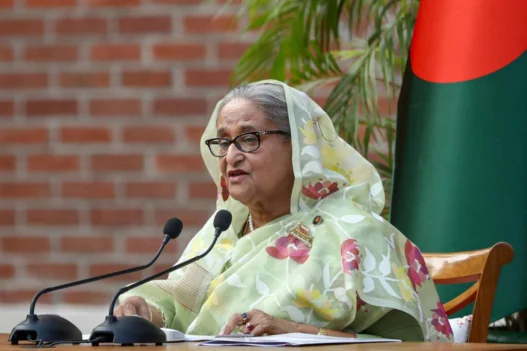
The most contentious claim emerging from this discourse is that the events of 5 August 2024—marked by the removal of most successful Prime Minister Sheikh Hasina—were not merely the product of domestic political dynamics, but were orchestrated, by powerful external actors pursuing geopolitical interests.
If democracy is, as Abraham Lincoln defined it, “government of the people, by the people, for the people,” then its legitimacy cannot be externally engineered. It must emerge authentically from the people, untainted by undue external manipulation.
This is not an argument against international cooperation. Bangladesh, like all nations, exists within an interconnected global order where collaboration in areas such as health, education, and development is both necessary and beneficial. However, when such cooperation intersects with the political architecture of the state, a higher threshold of transparency, accountability, and constitutional fidelity becomes imperative.
The “paper trail” now in public view is not merely a record of past transactions; it is a mirror reflecting deeper structural questions about power, influence, and accountability.
If left unexamined, these questions risk eroding public confidence in democratic institutions. If addressed with integrity and clarity, however, they offer an opportunity to reaffirm the constitutional supremacy of the people’s will.
There is, therefore, an urgent need for vigilant inquiry—rooted not in conjecture, but in evidence; not in rhetoric, but in constitutional principle. Bangladesh must engage with the world, but it must do so on terms that preserve its independence, dignity, and sovereign agency.
For in the final reckoning, the destiny of Bangladesh cannot—and must not—be scripted beyond its borders.