When the world’s greatest footballers walk onto the field at the 2026 FIFA World Cup, millions of eyes will follow them. Television cameras will track every movement, every goal, every celebration. But somewhere along the touchline, another pair of eyes will be searching for a different story.
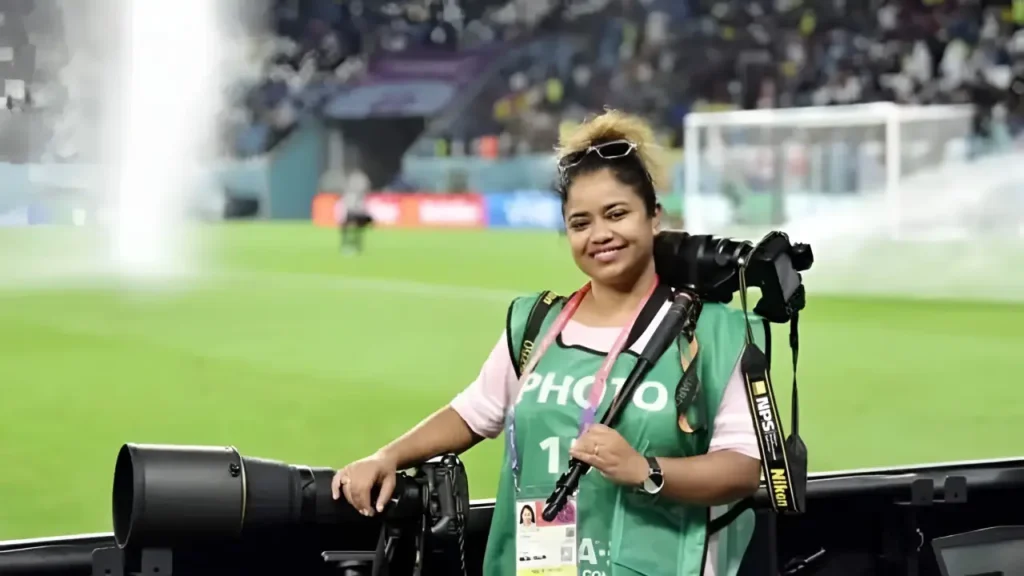
Behind the camera will stand Gitika Talukdar, a daughter of Assam, carrying with her a journey that began thousands of kilometres away from football’s grandest stage.
Her story does not begin in a stadium.
It begins in the quiet landscapes of India’s Northeast, in a family rooted in Chamata, a modest area of Nalbari district in Assam. Because her father served in the Sashastra Seema Bal, a transferable central government force, Gitika was born in Itanagar, Arunachal Pradesh, and spent her childhood moving across towns and states. Her school years unfolded between Itanagar, Tezu, Doomdooma and later Guwahati, exposing her to different cultures, languages and communities long before she would travel the world with a camera in her hand.
Few could have imagined then that this girl from a family with no connections to the sports media establishment would one day become one of India’s most recognised sports photojournalists.
The road was anything but easy.
In an era when social media often glorifies overnight success, Gitika’s journey is a reminder that meaningful achievements are usually built in silence. Long before the international assignments, the accreditation badges and the global recognition, there were years of struggle that nobody saw. Some assignments paid little, journeys that demanded sacrifice, and moments when the future seemed uncertain.
Sports photojournalism is among the most competitive professions in the media industry. For a young woman from Northeast India, entering that world without influential backing was a challenge many would have considered impossible. Yet impossibility has a curious habit of surrendering before persistence.
Gitika chose not to chase shortcuts. She chose the slower path—the difficult path.
While building her career as a photojournalist in Guwahati, she immersed herself in sports coverage, learning not merely how to photograph athletes but how to capture emotion. Her images began telling stories that statistics could never convey: the anxiety before a match, the heartbreak of defeat, the ecstasy of victory, and the humanity behind every sporting spectacle.
Education remained equally important. Her academic journey eventually took her beyond India to South Korea, where she completed her Master’s degree at Seoul National University. The experience broadened her worldview and strengthened her belief that talent from the Northeast could compete on any international platform.
Years passed. Gradually, the world began to notice.
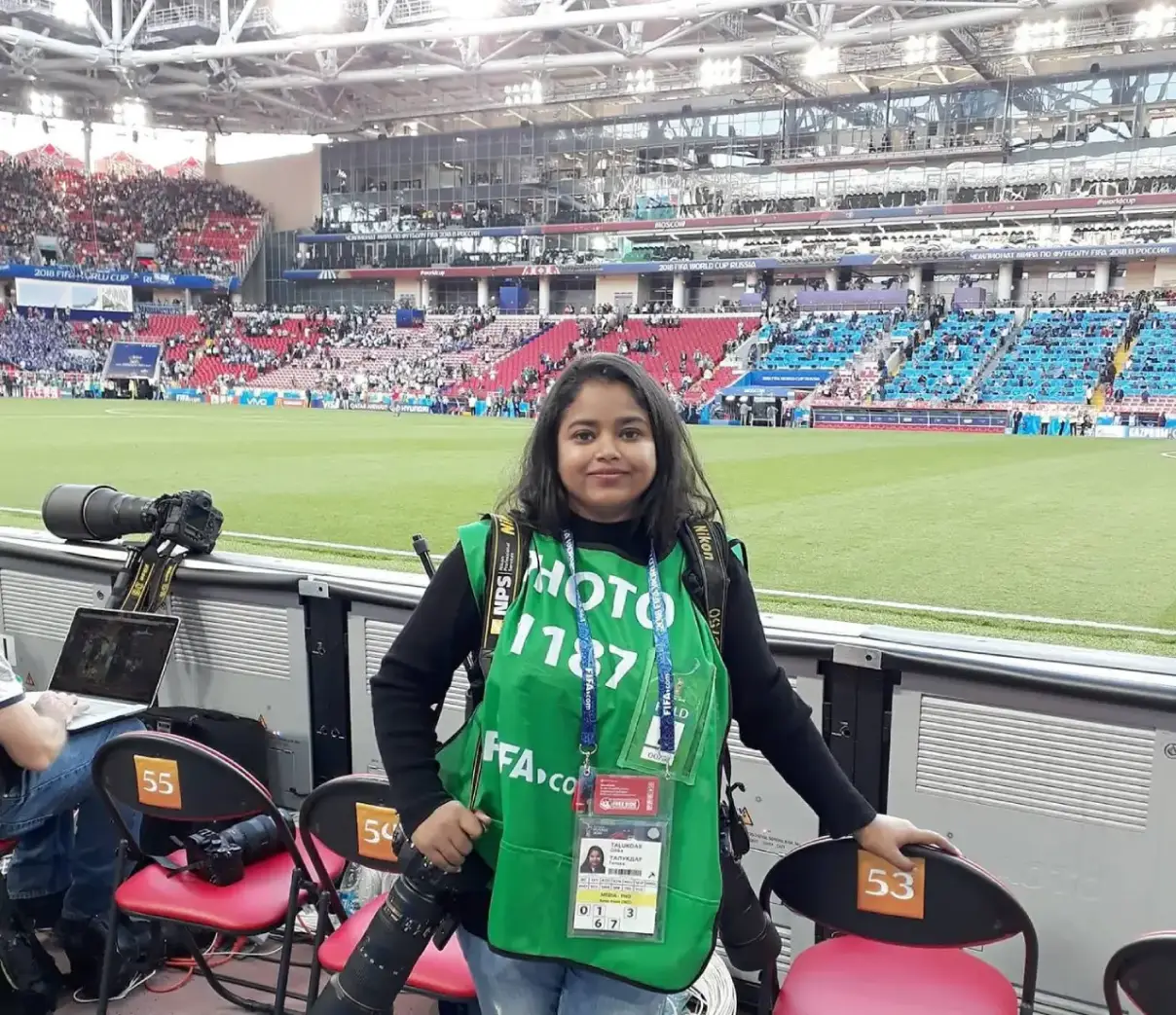
The breakthrough moments arrived one after another. The FIFA World Cup in Russia. The FIFA World Cup in Qatar. Women’s World Cups. Olympic Games. International sporting events that most journalists only dream of attending became part of her professional landscape.
Yet perhaps her most remarkable achievement is not covering these events. It is why she kept returning.
In May 2026, FIFA officially accredited Gitika Talukdar for the third consecutive men’s FIFA World Cup. As she prepares to travel to the United States, Canada and Mexico for what will be the largest World Cup in football history, featuring 48 nations, she enters an exclusive circle of media professionals trusted repeatedly by football’s governing body.
This year, she is also the only female photojournalist from India representing the Indian media contingent at the tournament.
The significance of that achievement extends far beyond personal success.
For decades, the Northeast has produced athletes, artists, scholars, and innovators who have excelled despite geographical distance from India’s traditional centres of power and opportunity. Gitika’s journey belongs to that larger story. Every accreditation she receives is a quiet reminder that excellence can emerge from places often overlooked on national maps.
When speaking about her latest FIFA recognition, she described it as an emotional moment. The words carried the weight of a long struggle.
“It has been a long journey. Nothing came in a single day or through a single attempt,” she wrote in a social media post reflecting on her career. “Years of hard work, sincerity, and dedication towards my passion and profession have opened doors to incredible global exposure and opportunities.”
Those words resonate because they are increasingly rare in a world obsessed with instant gratification. Her success was not manufactured by privilege or accelerated through powerful patrons. She openly acknowledges how difficult it was to build a career without a godfather.
Yet she never allowed bitterness to define her. Instead, gratitude became her compass. She repeatedly credits the people who stood beside her, the values her family instilled, and the faith that sustained her during difficult periods. There is a humility in her reflections that perhaps explains why so many people identify with her journey.
History offers several examples of individuals who transformed humble beginnings into extraordinary achievements. The celebrated Japanese photojournalist Tsuneko Sasamoto broke barriers in a profession that once excluded women. American photographer Lynsey Addario travelled through conflict zones to become one of the world’s most respected visual storytellers. What connects such stories is not geography, nationality, or profession. It is resilience.
Gitika’s story belongs in that tradition.
She has become more than a photographer documenting sporting history. She has become evidence that determination can redraw the boundaries of possibility.
For young people in Assam, Arunachal Pradesh, and across the Northeast, her journey carries a message more powerful than any motivational slogan. Dreams do not become reality because circumstances are favourable. They become reality because someone refuses to abandon them.
Somewhere in Chamata, a young girl may read about Gitika’s latest achievement and imagine her own future differently. Somewhere in Itanagar, Tezu, Doomdooma or Guwahati, another student may realise that global stages are not reserved for people from privileged backgrounds. They are open to anyone willing to devote years to mastering their craft.
That may ultimately be Gitika Talukdar’s greatest contribution.
The photographs she captures at the FIFA World Cup will freeze historic moments in time. But the example she sets through her life may inspire something even more enduring.
As she prepares to stand once again on football’s biggest stage, camera in hand, she carries with her the aspirations of an entire region. Through her lens, the world will witness another World Cup.
And through her journey, the world can witness the power of perseverance.