The dust of the 2026 Assembly elections is yet to settle, but the echoes from the paddy fields of Upper Assam remain loud. While traversing the stretch from the historic gates of Sivasagar to the bustling tea estates of Tinsukia, one phrase repeatedly punctuated political discourse: the “Three Gogois.”
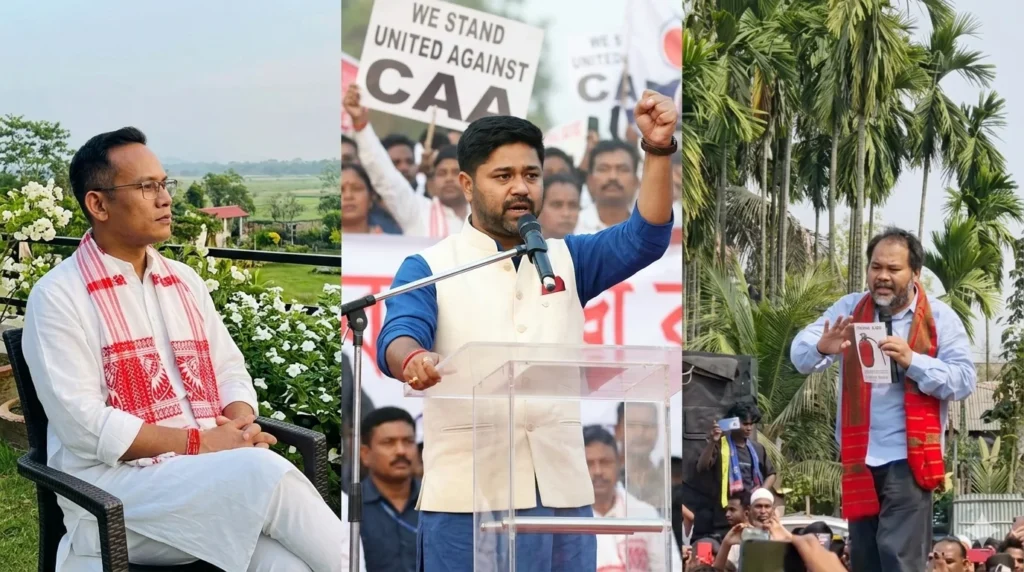
The recent articulation by Akhil Gogoi—that himself, Gaurav Gogoi, and Lurinjyoti Gogoi would politically “throw” Chief Minister Himanta Biswa Sarma into the Brahmaputra—has captured headlines. But beyond its rhetorical flourish lies a deeper question: does this narrative consolidate opposition unity, or does it inadvertently sharpen fault lines in an already polarised polity?
The Ahom legacy: power, history, and identity
To understand the resonance of the “Gogoi” brand, one must revisit the historical arc of the Ahom community. For 600 years, the Ahoms ruled a sovereign land, successfully resisting the Mughals and shaping the modern Assamese identity. From the legendary Ahom General Lachit Borphukan to post-independence giants like Hiteswar Saikia and Tarun Gogoi, the community has remained the gravitational center of Assam’s administration.
However, in 2026, the Ahom identity is no longer monolithic. While they trace their roots to the Tai prince Sukaphaa, the internal diversity of the community—and its current demand for Scheduled Tribe (ST) status—creates a complex political friction. Currently listed under the OBC category, the Ahoms’ push for ST status is met with a sharp counter-argument: critics suggest that because the community has historically held “creamy position” in socio-economic and political hierarchies, they do not meet the criteria of tribal “backwardness.”
The “Three Gogoi” narrative: unity or exclusion?
In the high-pitched electoral theatre of Upper Assam, the collaboration between Akhil Gogoi (Raijor Dal), Lurinjyoti Gogoi (AJP), and Gaurav Gogoi (Congress) under the Asom Sonmilito Morcha (ASM) was intended as a sub-regional shield against the BJP’s juggernaut.
Yet, for many “deprived” communities like the Moran, Motok, Chutia, and the Tea Tribes, the “Three Gogoi” slogan carries a different subtext. These groups have also been demanding ST status for decades. When the opposition campaign leans heavily on the symbolism of a single dominant surname, it risks sending a message of “Ahom hegemony” to the smaller ethnic groups. This perception is a goldmine for the BJP, which has masterfully cultivated a “Rainbow Alliance” of smaller ethnic identities to bypass the traditional Ahom-centric power structures.
The Brahmin factor and social hierarchy
Assam’s social composition further complicates any attempt at reductive mobilisation. While numerically small—estimated between 13 to 14 lakh—the Brahmin community retains a socio-cultural influence that far outweighs its headcount. In crucial constituencies like Jorhat, where Gaurav Gogoi recently fought a high-stakes battle, Brahmin and upper-caste voters form a decisive bloc of over 30,000 to 40,000 votes.
By framing the election as a battle of “Gogois versus Sarma,” the opposition inadvertently played into the hands of caste-based polarisation. Himanta Biswa Sarma, belonging to the Brahmin community, has projected himself not just as a leader of one caste, but as the protector of “indigenous rights.” When opposition rhetoric becomes too focused on Ahom identity, it risks alienating the urban middle class and the Brahmin-Kalita vote bank, who may perceive the rhetoric as exclusionary.
The Tea tribe pivot
Perhaps the most significant challenge to the “Gogoi” narrative is the Tea Tribe community. Comprising nearly 17-20% of the state’s population and dominating over 35 seats in Upper Assam, their electoral psychology has shifted.
Historically a Congress bastion, the Tea Tribes have increasingly moved toward the BJP, lured by direct benefit transfers (DBT) like the Orunodoi scheme and the recent grant of land pattas. For a tea garden worker, the historical glory of the Ahom kings or the intellectual debates over “sub-regionalism” often take a backseat to the immediate reality of wage hikes and housing. The “Three Gogois” represent the old political elite of the Brahmaputra Valley; the BJP, meanwhile, has presented itself as the new provider.
A strategic blunder or a necessary risk?
In the intricate social landscape of Assam, where history, migration, and identity converge, political messaging must balance assertion with accommodation. The “Three Gogoi” slogan was a catchy attempt to craft a counter-hegemonic identity, but it may have hit a ceiling.
For Gaurav Gogoi, seen as a future Chief Ministerial face, the challenge remains: can he transcend the “Gogoi” tag to become a leader for the Misings, the Bodos, the Bengalis, and the Brahmins alike? Polarisation may yield short-term gains in specific pockets of Sivasagar or Dibrugarh, but in a state as diverse as Assam, victory belongs to those who can weave a tapestry, not just fly a single flag. As 2026 shows us, the grammar of Assam’s politics is changing—and symbolism alone is no longer enough to win the war of the Brahmaputra