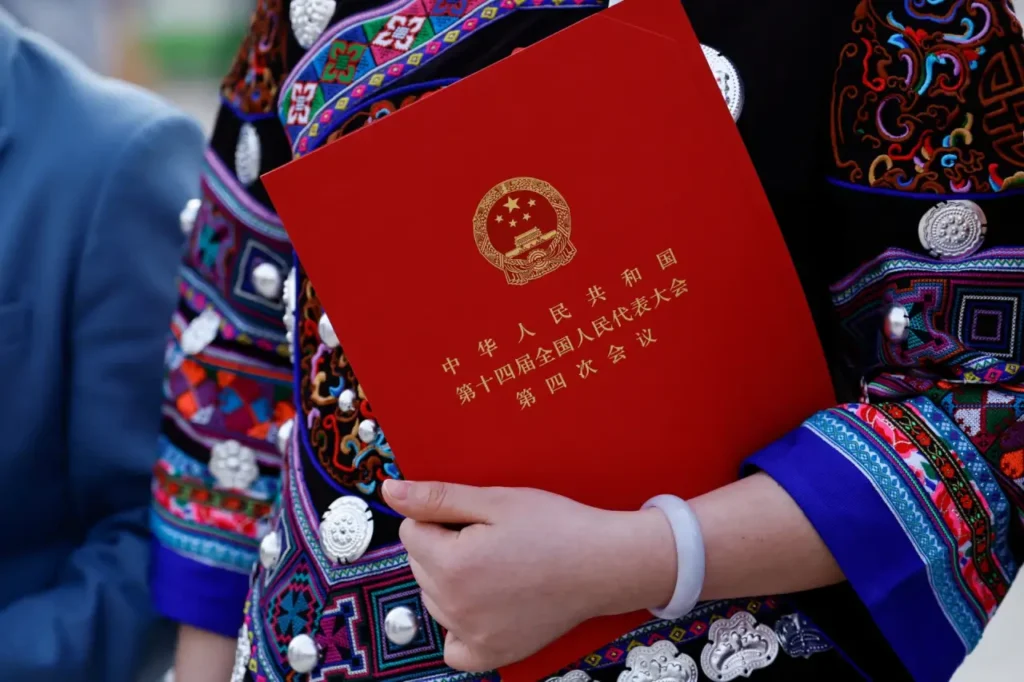
On March 12 this year, China’s parliament passed a new “Law on Promoting Ethnic Unity and Progress” to be implemented from July. The law is significant in enhancing further Chinese Communist Party (CCP)’s control over the ethnic minority regions and enhance its ongoing assimilation efforts.
The new law is in light of President Xi Jinping’s ascendence to the political leadership in 2012 and his rebooting the country’s dynamics with the slogans of China Dream and China Rejuvenation. As with other sectors, Xi has been restructuring the ethnic domain as well with “sinicisation” as the main theme. Xi had been alluding to China’s ethnic situation to a pomegranate fruit to underline the tightly-knit units in a whole. The new “ethnic unity” law is a result of this reordering, aimed to fill the vacuum of loose political control. Also, the last CCP congress in October 2022 stressed on national security and opposing foreign interference, including in ethnic affairs.
Divided into seven chapters and 65 articles, the new law intends to build a “community of the Chinese people” as a part the CCP’s ethnic work. It wants to build a shared destiny among the ethnic groups “sharing in joy and sorrow, honor and disgrace, and life and death”. Previously, China used the community building process with other countries and the same is now applied domestically for the ethnic groups. While “partnerships” have been mentioned in external relations, in the domestic context it indicates to CCP’s dominance and broadly to Han-nationality domination.
China has 56 ethnic groups, of which the majority is that of Han population at nearly 90 percent. The rest are scattered all over the country, with the major ethnic groups being Hui and Uighur Muslims, Tibetan, Mongolian and others. The brunt of the new law is expected to impact the Uighurs, even though Tibetans and Mongolians will be eventually affected. The law emphasises more on obligations of citizens, families and even children rather than on their rights.
The law imposes on all citizens an “obligation to preserve national unity and the unity of the nation’s ethnicities, and shall preserve the nation’s sovereignty, security, and developmental interests”. It categorically opposes interference of “foreign forces”. Further, it states that “All acts using excuses such as ethnicity, religion, or human rights to insult and disparage, contain and suppress, or infiltrate and undermine the PRC are to be resolutely opposed.” In order to establish a “correct perspective”, the state will “guide each ethnic group in promoting identification with Chinese culture”.
The forerunner to this law is National Security Law for Hong Kong that China passed in June 2020 but expanded in 2024. In this law as well “patriotism” is stressed compared to the 1980s promise to implement “one country, two systems” till 2049. Hundreds were arrested in Hong Kong since then, including pro-democracy activists, media personnel and others. Hong Kong experience suggest to loss of any autonomy in future for ethnic minorities in China.
While the ethnic law states that “All ethnicities in the People’s Republic of China are equal. Discrimination against or oppression of any ethnicity is prohibited”, in practise such equality remained one-sided with accusations of Han-majority grabbing public positions in ethnic minority areas, displacement of local minorities in the economic field, discrimination in religious, cultural practices and others.
It was widely reported that the party-state restrictions on ethnic minorities include in Xinjiang ban on wearing hijab, beard, fasting, performing Friday prayers, rituals and forcible inter-ethnic marriages were carried out. An estimated 16,000 mosques have been demolished in Xinjiang in the last decade and over a million Uighurs kept in detention camps. A UN Human Rights committee mentioned about a million Uighurs were incarcerated in political re-education camps and endangered state security cases mounted.
In Tibet, Inner Mongolia and other regions, Chinese language (Putonghua) was made compulsory instead of the local ethnic languages, besides restriction on religious symbols and rituals. Colonial boarding schools, ghetto living quarters were also reported from these areas. Mass surveillance through facial recognition cameras, DNA databases, and social media monitoring. China is using Universal Forensic Extraction Devices to copy phone contents in ethnic minority regions. China has also introduced a “double-linked household” system where neighbours are obliged to report on one another.
The sea change in CCP’s stance on ethnic minorities can be traced to a transition from national integration policies to the recent assimilation procedures. When the CCP was about to capture state power in 1949, its “Common Program” mentioned equality of all ethnic groups in the country as well as provided provisions for “autonomy” to the ethnic minorities. The Soviet inheritance is clear on China’s ethnic stance. For broad-basing its appeal and stabilise its control, the CCP required support in the society. However, during the 1960s Cultural Revolution assimilation policy were implanted, jettisoning the national integration policies earlier.
The reform programme of the late 1970s did not bring much relief to the ethnic groups in preserving their identities and autonomy as modernisation meant exploitation of resources in ethnic minority regions often with forced labour, expansion of infrastructure projects that brought these regions closer to the Han people. Today, state-sponsored nationalism in China is further aggravating the impact ethnic minority rights.
The most intensive assimilationist policies were followed by Chen Quanguo when he was the CCP Secretary in Tibet (2011-16) and then in Xinjiang (2016-21). Chen introduced the most punitive measures to wear down the identity of the Tibetans by sending CCP cadres to monasteries, intensifying political education, installing surveillance cameras every few hundred meters, encouraging Han marriages with Tibetans to change demographics, introducing colonial boarding house and others. These measures are also to prepare for the 15th Dalai Lama transition period where the CCP intends to utilise “golden urn” process for appointing its Dalai Lama.
Chen intensified “strike hard” policies in Xinjiang with a ferociousness unseen in its history. Earlier on July 5, 2009, in a massive Uighur protest, over 187 people, mainly of Han nationality were killed in a span of two hours in Urumqi. Later, China deployed more than 24,000 security troops to control the situation. What followed later is an intensive campaign to overcome dissent and extend control of the CCP.
Chen introduced internment camps, grid surveillance, facial recognition, QR codes for homes to monitor the situation and intensive campaign to control dissent. These measures attracted sanctions by western countries on the CCP leaders which were retaliated by China, with the support of over 50 countries, a majority of them being Islamic.
Chen’s pervasive measures to control Tibet and Xinjiang forms the basis for the new ethnic law and portends to further assimilation and eradication of identity in ethnic minority areas. This is a major signalling by Beijing towards its domestic audience, as well as to the external, that it is determined to assert its socialist choices on its diverse ethnic groups. While China’s policies are comprehensive, the ethnic groups responses are also formidable.
China’s new ethnic unity law is a major step in the country’s assimilation policies towards ethnic minorities. Earlier China had promised several freedoms but today it is actively erasing such freedoms and attempting to sinicize all the 55 other ethnic minorities into the majority Han-fold. However, many of these minorities are living in the peripheries of China and hence such policies have implications for the minorities welfare as such and to the stability of the neghbourhood.
While China has been preparing its best through legal, political, economic, military and other means to assimilate ethnic groups into its socialist project under a unified Han nationality, the actual outcome is based on the intensity of responses of these ethnic groups – some of them took to political violence such as the Uighurs and others like Tibetans through non-violence.