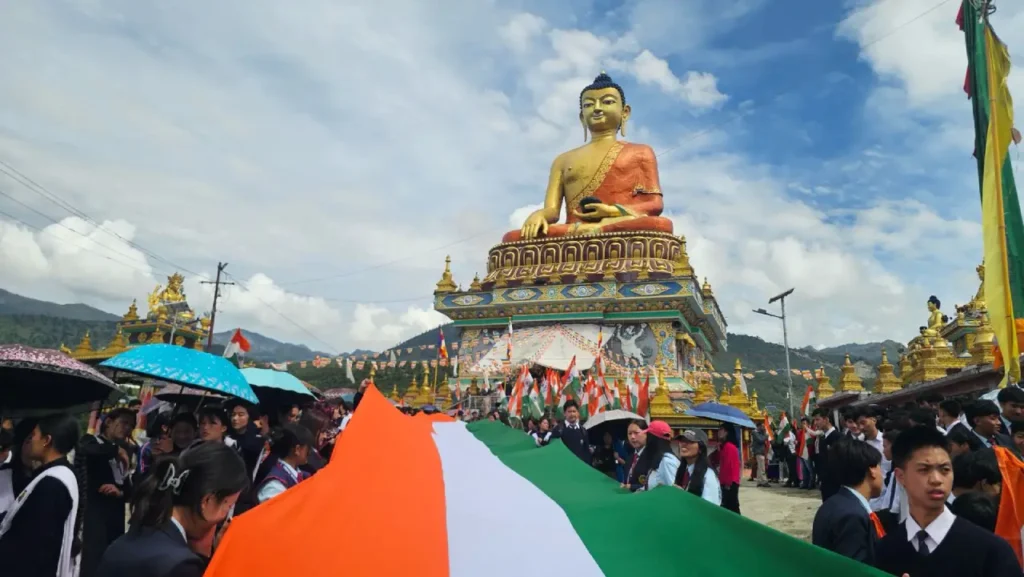
The spirit of patriotism swept through the streets of Tawang on Wednesday as a 100-metre-long Tricolour made its way through the high-altitude Himalayan town, carried by hundreds of people as part of the Har Ghar Tiranga campaign.
Beginning at the Giant Buddha Statue and ending at the historic Tawang War Memorial, the Tiranga Yatra brought together soldiers, government officials, students, NCC cadets and local residents. For a town perched at around 3,500 metres above sea level and just a few dozen kilometres from the Line of Actual Control, the symbolism of the march went beyond the usual Independence Day celebrations.
Here, the National Flag is carried against a landscape where history, faith and the country’s border story converge.
The yatra was flagged off by In-charge Deputy Commissioner Tawang Rinchin Leta and Superintendent of Police Tawang Tasi Darang, in the presence of Zilla Parishad Member (ZPM) Kyidphel Tenzin Monpa, ZPM Tawang Sonam Nordzin, senior officers, officials and members of the public.
Earlier, addressing the gathering at the Giant Buddha Statue, Leta highlighted the significance of the Har Ghar Tiranga campaign and recalled the role of the National Flag and Vande Mataram in India’s freedom struggle.
He said these symbols had given courage and inspiration to freedom fighters and continued to unite people across the country under a shared national identity.
Leta appealed to residents to proudly hoist the National Flag at their homes from 9 to 17 August and participate wholeheartedly in the nationwide campaign. At the same time, he reminded citizens that according the Tricolour its due respect and dignity was a fundamental duty, urging them to follow the prescribed protocols while hoisting and handling the flag.
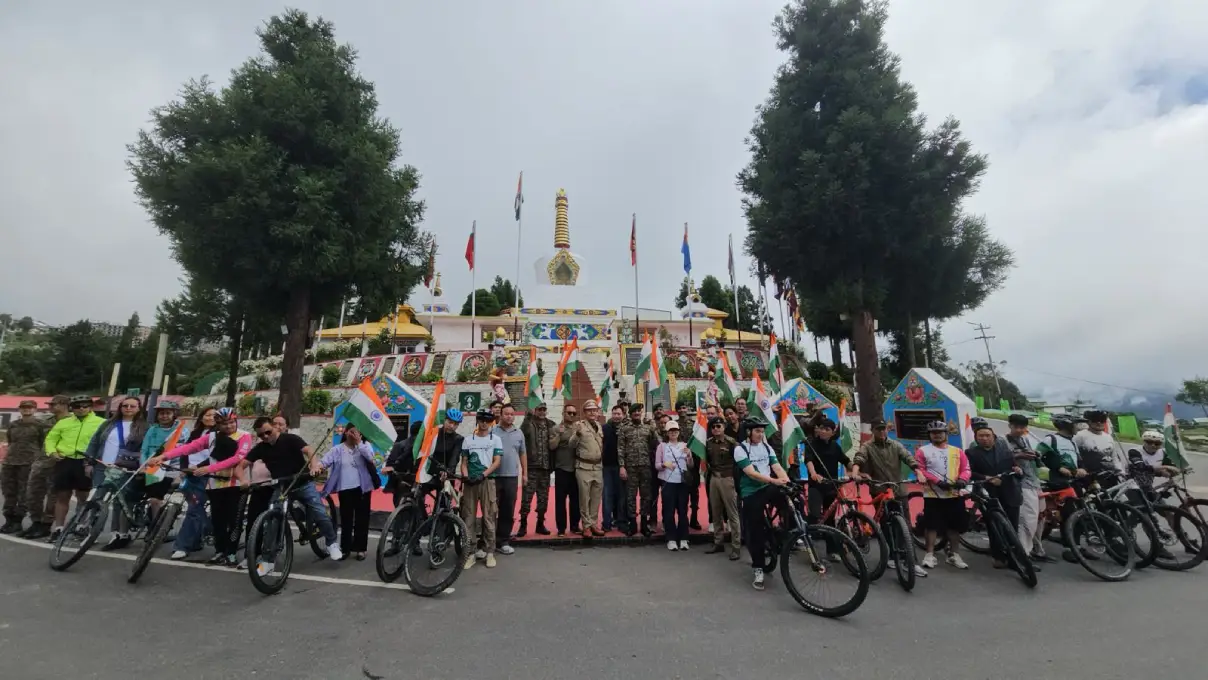
The patriotic spirit, meanwhile, extended beyond the main Tiranga Yatra. A Tiranga Bike and Cycle Yatra also made its way from Chhamleng, near Tawang Monastery, to the historic Tawang War Memorial, with bikers and cyclists carrying the National Flag through the mountain roads.
Across Tawang township, the celebrations also took a more civic turn. From Tawang Monastery to Changbu, including the three major markets and adjoining colonies, members of the public joined a Swachhata Abhiyaan to clean and beautify their surroundings ahead of Independence Day.
Markets and public spaces took on a festive appearance, illuminated with Tiranga-themed lights, while the National Flag was hoisted across markets, colonies, homes and establishments. The township gradually became a vibrant canvas of saffron, white and green.
For Tawang, however, the sight of the Tricolour carries a particular historical resonance.
The westernmost district of Arunachal Pradesh, Tawang lies between Tibet to the north and Bhutan to the south-west. Its landscape is shaped by high mountain passes, monasteries, lakes and villages, while its strategic location has placed it at the centre of India’s frontier history.
It is also a land where spirituality and history are deeply intertwined. Tawang Monastery, founded in the 17th century in accordance with the wishes of the Fifth Dalai Lama, remains one of the most important centres of Tibetan Buddhist tradition in India. The Monpa community, whose culture and traditions have shaped the region for centuries, continues to form the social and cultural heart of Tawang.
The town’s modern history is equally inseparable from India’s frontier story.
In 1951, the first administrative centre at Tawang was established by Major Bob Khathing, marking an important phase in the consolidation of Indian administration in the region. Tawang subsequently became a full-fledged district in 1984.
But it is the memory of 1962 that gives many patriotic occasions in Tawang an added dimension.
During the India-China War of 1962, the Tawang sector became one of the principal theatres of fighting. Places such as Bum La and Nuranang remain associated with the conflict, while the stories of soldiers who fought in the difficult Himalayan terrain continue to occupy an important place in the region’s collective memory.
For local residents, the war is not simply a chapter in a history textbook. Its memory has been passed down through families and communities, making the events of 1962 part of the lived history of the frontier.
“This occasion is important for us because it reminds us of how we stood together to protect our sovereignty and identity when the war came to our doorstep,” said a resident, recalling how he and his family witnessed the 1962 conflict.
At the Tawang War Memorial, that memory is given a physical form.
The memorial commemorates the Indian soldiers who lost their lives in the 1962 war. Its granite plaques carry the names of 2,420 members of the armed forces who died in the Kameng sector, making it one of the most powerful reminders of the human cost of defending India’s frontier.
It was to this memorial that the long Tricolour eventually arrived.
The yatra witnessed spirited participation from personnel of the Indian Army, Border Roads Organisation and paramilitary forces, NCC cadets, representatives of all four market committees, students of Dorjee Khandu Government College and Town Secondary School, besides citizens from different walks of life.
As the Tricolour moved through the town, the streets echoed with chants of Vande Mataram and Bharat Mata Ki Jai.
For the younger participants, it was an Independence Day activity. For those living in a strategically sensitive border district, however, the celebration also carried the weight of a history that is never too distant.
Tawang’s proximity to the frontier means that national security is not an abstract idea. The roads, passes and valleys around the town have long been part of India’s border infrastructure, while the presence of the Army and other security forces is woven into everyday life.
That relationship between the civilian population and the armed forces has also been publicly celebrated over the years. The Tawang administration and the Army have jointly organised programmes aimed at strengthening civil-military ties, with national leaders repeatedly highlighting the bond between the people of the region and the armed forces.
The significance of the Tricolour in Tawang therefore extends beyond the flag itself. It represents a connection between a culturally distinctive Himalayan community and the larger Indian political and constitutional framework within which it lives.
That sense of belonging has its own local history.
Tawang’s Monpa culture has evolved through a distinctive blend of Buddhism and older indigenous traditions. The district’s cultural landscape reflects centuries of interaction across the eastern Himalayas, while its religious institutions remain an important part of local identity.
Against this backdrop, Independence Day is not simply about remembering 15 August 1947. In a borderland such as Tawang, it also becomes an occasion to reflect on the meaning of being part of India while preserving a distinct cultural identity.
For a young community member, carrying the Tricolour was about more than participating in a national campaign.
“It gives us a sense of belonging and commitment to our country, which has always stood with its people and with tribes like ours who belong to these borderlands,” she said.
Similar sentiments were echoed by others who joined the yatra, many of whom saw the occasion as an expression of both national pride and their connection to the land they call home.
From citizens cleaning their neighbourhoods to bikers and cyclists carrying the Tricolour through the mountain roads, the celebrations reflected patriotism not merely as an emotion, but as a shared responsibility towards the nation.
The yatra culminated at the Tawang War Memorial, where it was warmly received by the Deputy Commander and senior officers of the Tawang Brigade.
In the solemn presence of the memorial dedicated to soldiers who made the supreme sacrifice, participants joined in a mass singing of Vande Mataram.
The moment brought together two powerful strands of memory — the freedom struggle that gave birth to independent India and the soldiers who, 15 years later, fought and died defending its frontier.
The Tawang Brigade also provided refreshments to participants at the conclusion of the programme.
As the 100-metre Tricolour was folded away and the chants gradually subsided, the meaning of the day’s celebration remained visible in the landscape around Tawang.
The mountains have witnessed centuries of religious and cultural exchange, the movement of peoples and the changing boundaries of political power. They also witnessed the violence of 1962 and continue to stand beside one of India’s most strategically important frontiers.
On Wednesday, however, Tawang offered a different image of the borderland — not one defined by conflict, but by citizens, soldiers and young students walking together beneath the National Flag.
From the wheels rolling through the streets to the Tiranga illuminating the markets and the National Flag fluttering against the majestic mountains, the celebrations brought together many expressions of the same national spirit.
In Tawang, where the memory of sacrifice remains close and the frontier is part of everyday life, the Tricolour was more than a symbol of Independence Day. It became a reminder of history, belonging and a shared commitment to the land that lies at India’s eastern edge.