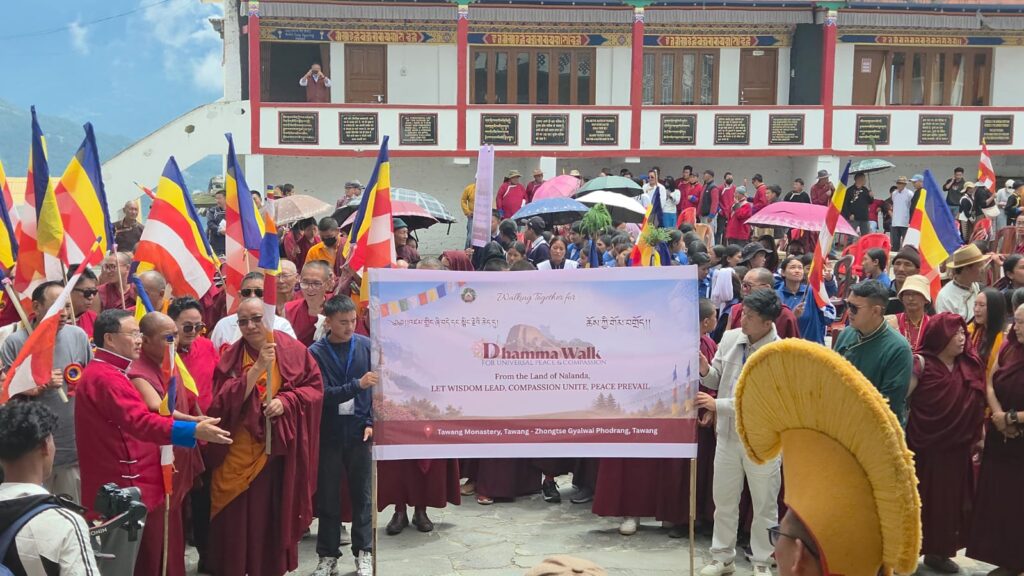
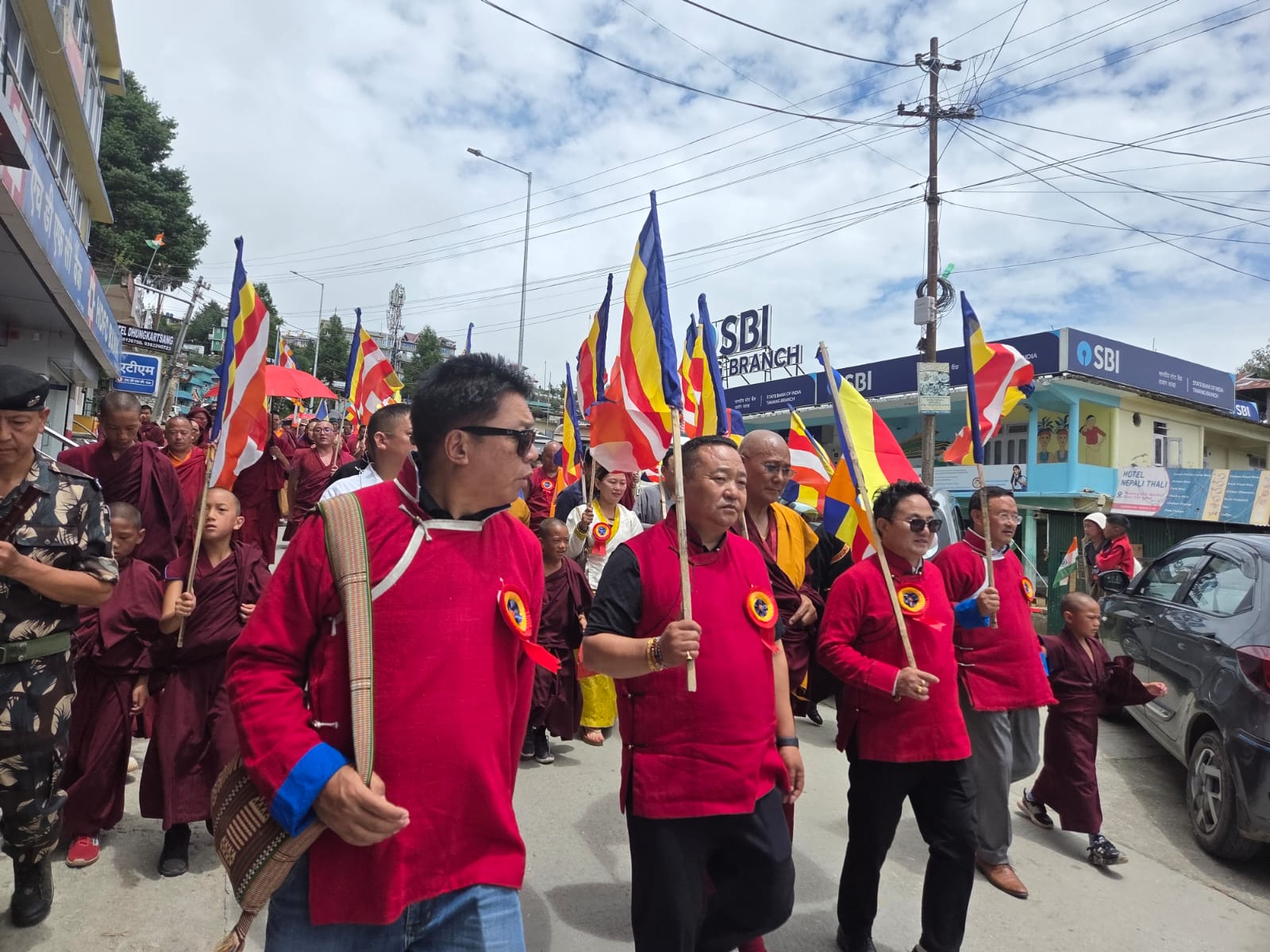
Tawang woke to a different kind of movement on Sunday. Hundreds of monks, nuns, students, young people, elderly residents and members of the local community walked together through the high Himalayan town, carrying a message that appeared simple but carried an unusual resonance in this frontier: peace, compassion and universal brotherhood.
The 2.5-kilometre “Dhamma Walk,” held to commemorate the 91st birthday of His Holiness the 14th Dalai Lama, brought people onto the streets of Tawang at a moment when the town’s location, history and Buddhist identity remain deeply intertwined with the geopolitics of the India-China border. The Tawang event was the second such Dhamma Walk, following the first edition held in Leh on August 2, 2026, extending the initiative’s message of peace and compassion across India’s Himalayan Buddhist communities.
The walk was facilitated by the Indian Himalayan Council of Nalanda Buddhist Tradition (IHCNBT) and organised by its Arunachal Pradesh Chapter in collaboration with Tawang Monastery, Khinmey Monastery, Sera Jay Jamyang Choshorling Monastery, Monpa Mimang Tsokpa, Being Monpa Foundation, The Tawang Foundation and Mon Drati Educational & Cultural Society.
For Tawang, peace is not an abstract idea. It is a word that exists alongside memories of war, military deployments, territorial claims and a frontier that remains contested more than six decades after the 1962 conflict.
The significance of Sunday’s walk therefore lies not simply in the number of people who participated, but in where they walked and what the landscape represents.
A walk rooted in history
Tawang was briefly occupied by Chinese forces during the 1962 India-China war before Chinese troops withdrew following the unilateral ceasefire. Accounts of the conflict record the Chinese occupation of Tawang as lasting roughly 49 days.
The episode remains embedded in the historical memory of the town. Tawang had already become strategically and politically important after India established administrative control over the region in 1951. It was also the first Indian town reached by the Dalai Lama after he crossed into India in March 1959 following his flight from Tibet.
That history helps explain why a Buddhist gathering in Tawang can carry a meaning that extends beyond religion.
Peace, stability and the Himalayan frontier
The Dhamma Walk comes as India-China relations are again entering a potentially important phase.
Chinese President Xi Jinping is expected to travel to New Delhi in September for the 18th BRICS Summit, scheduled for September 12–13. His participation has been reported as likely, although it should not yet be described as an officially confirmed presidential visit. If it takes place, it would be Xi’s first visit to India since October 2019.
The timing is significant. The optimism surrounding the 2019 Mamallapuram meeting was followed within months by the violent Galwan Valley clash of June 2020, which fundamentally altered the trajectory of bilateral relations. The India-China border has since remained heavily securitised, while diplomatic engagement has continued alongside efforts to manage military tensions.
Tawang itself again became a flashpoint in December 2022, when Indian and Chinese troops clashed in the Yangtse area. The incident reinforced the reality that even as Delhi and Beijing discuss stabilising their broader relationship, the frontier remains the most sensitive component of that relationship.
India’s position has remained clear: peace and tranquillity along the border are essential to the broader relationship with China.
That position has acquired renewed relevance following allegations this year concerning Chinese activity in the Taksing sector of Upper Subansiri.
The allegations, raised by the Nah Welfare Association, claimed that Chinese People’s Liberation Army personnel had expanded their presence around areas including Oying, Paniar, Marpan, Portrang and Tingdingtang and established military infrastructure in some locations. The claims, however, were not independently confirmed. The Indian Army rejected the allegations, while Chief Minister Pema Khandu also said there had been no Chinese incursion.
The episode nevertheless underlined a larger reality: in Arunachal Pradesh, the border is not only a military line. It is a lived space where local communities, infrastructure, history and security intersect.
That is precisely the context in which Tawang’s Dhamma Walk acquires a wider significance.
Culture, identity and India’s Himalayan heritage
The walk also comes shortly after another form of assertion by New Delhi — this time through maps.
The Indian government has formally identified 27 places and geographical features in Arunachal Pradesh using standard Indian names. The list includes land areas, mountain passes, a lake and the Sher-e-Thapa Memorial associated with the 1962 war. The move followed years of China’s own attempts to impose Chinese names on places in Arunachal Pradesh, which Beijing refers to as Zangnan.
As The Borderlens reported earlier this month, the latest Indian exercise is more than a contest over labels. In a disputed frontier, names on an official map are also statements about political and territorial belonging.
China has previously released successive lists of standardised names for locations in Arunachal Pradesh — six in 2017, 15 in 2021 and another 11 in 2023. India’s latest move thus represents a response to a contest that is being fought not only through troops and patrols but also through cartography, history and competing territorial narratives.
And the significance of that contest is especially visible in places such as Tawang.
China’s claim over Arunachal Pradesh is tied in part to its argument that the region constitutes what it calls “Southern Tibet.” Tawang occupies a particularly sensitive place within that narrative because of its historical relationship with Tibet and the importance of Tawang Monastery to Tibetan Buddhism.
India, for its part, has repeatedly rejected China’s territorial claims and maintains that Arunachal Pradesh is an integral and inalienable part of India. New Delhi reiterated that position earlier this month while stressing that the state of the border remains central to the India-China relationship.
Seen from that perspective, Sunday’s Dhamma Walk can be read at two levels.
At one level, it was exactly what its organisers intended: a public expression of peace, compassion, non-violence, harmony and human fraternity, rooted in the Nalanda Buddhist tradition.
At another, it was an expression of India’s own cultural confidence in a frontier where competing historical narratives have strategic consequences.
The programme brought together monastic communities, local residents, students and youth. The Chief Guest was the Abbot of Tawang Monastery, Tulku Phara Dramey Rinpoche, while Tawang MLA Namgey Tsering and Lungla MLA Tsering Lhamu also attended.
The programme began at Tawang Monastery — Zhongtse Gyalwai Phodrang — with the lighting of the lamp, Manglacharan, felicitation of dignitaries and addresses on the significance of the Dhamma Walk. The walk was then flagged off at 10 am, before culminating back at Zhongtse Gyalwai Phodrang. A cultural presentation by MIPA, refreshments and a closing ceremony followed.
The organisers had appealed to monastic communities, educational institutions, youth organisations and residents to participate in large numbers and carry forward the values associated with the Nalanda Buddhist tradition: wisdom, compassion, non-violence and peace.
That message has particular resonance in Tawang. Because there are few places in India where the language of peace sits so directly beside the memory of war.
A message of peace
The coming weeks could make this contrast even sharper.
If Xi Jinping does travel to New Delhi for the BRICS Summit, the two countries will once again have an opportunity to assess whether the cautious stabilisation of India-China relations can develop into something more substantial. But whatever course that engagement takes, Tawang offers a reminder that the larger relationship is also shaped by the confidence, continuity and resilience of communities living in the Himalayan frontier.
Tawang’s message was not a message of confrontation. Nor was its call for peace a retreat from the realities of the frontier. It was a message of peace from a place that knows what conflict costs, and of harmony from a community deeply rooted in its land, culture and traditions.
The frontier is protected by soldiers, strengthened by infrastructure and sustained by people whose connection to the land is deep and enduring. In Tawang, that connection was expressed not through confrontation, but through a confident affirmation of peace, compassion and harmony.
That may be the deeper significance of the Dhamma Walk. In a place where history, culture and the frontier come together so visibly, hundreds of people walked not away from the realities around them, but with a clear sense of who they are and what they stand for.
Tawang did not need to raise its voice to make that message heard. It simply walked.