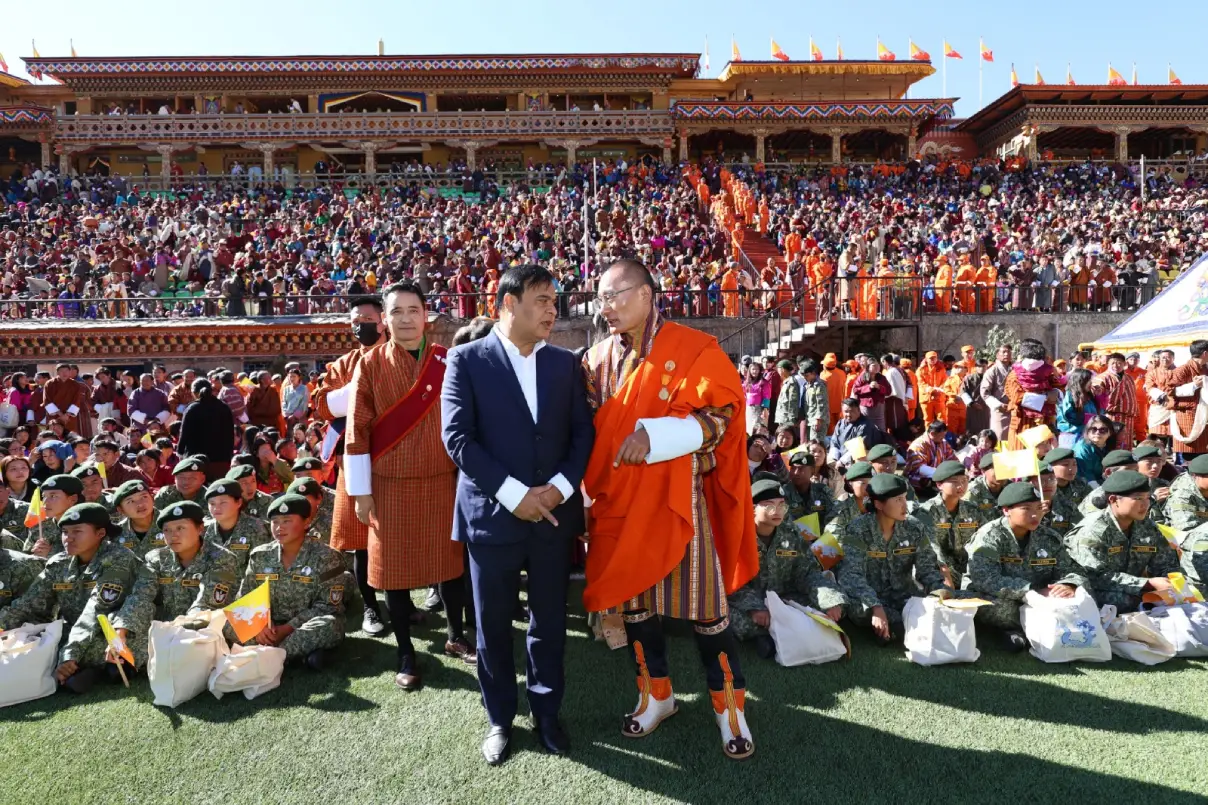
As Assam Chief Minister Dr Himanta Biswa Sarma concluded his successful visit to Bhutan, the ties between Druk Yul and the people of northeast Bharat have seemingly grown stronger. Sarma, who embarked on the official visit from 16 to 19 December 2024, at the invitation of the Royal Bhutan government in Thimphu, engaged in discussions on various bilateral issues with King Jigme Khesar Namgyel Wangchuck and Prime Minister Dasho Tshering Tobgay. As the first Chief Minister of Assam to receive such an invitation, Sarma’s visit was historic and included his attendance at Bhutan’s 117th National Day celebrations in the picturesque capital city.
Accompanied by his wife and senior officials, Sarma focused on trade, regional security, and mutual collaboration during his interactions with the friendly regime in Thimphu. Upon arriving at Paro International Airport via Drukair, the Assam delegation was warmly welcomed by Bhutanese Foreign Minister DN Dhungyel, Indian Ambassador Sudhakar Dalela, and other dignitaries. A business event hosted by the Assam government in Thimphu, as a precursor to Advantage Assam 2.0—an investment summit scheduled for 25 and 26 February in Guwahati—saw Sarma and PM Tobgay discuss avenues for fostering investments and partnerships across South Asia. Sarma extended an invitation to PM Tobgay to grace the summit and a mega cultural event, expressing gratitude for his presence at the last edition of Advantage Assam.
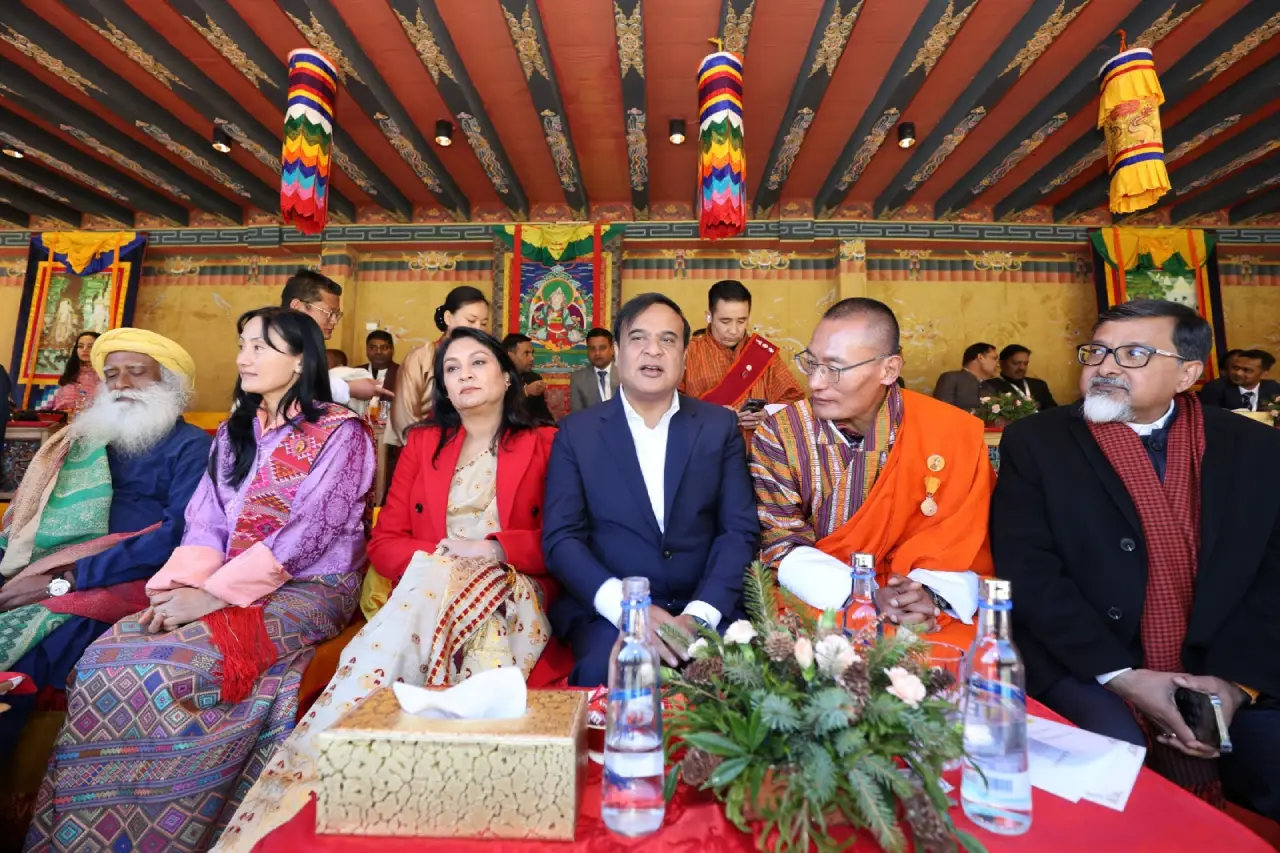
During a separate meeting with PM Tobgay, Sarma highlighted the historical connectivity between Assam and Bhutan through seven established trade routes, underscoring the enduring nature of their economic ties. He assured Bhutan of Assam’s commitment to bolstering trade infrastructure along their shared border, advocating for the creation of additional trade routes to meet the needs of Bhutanese traders.
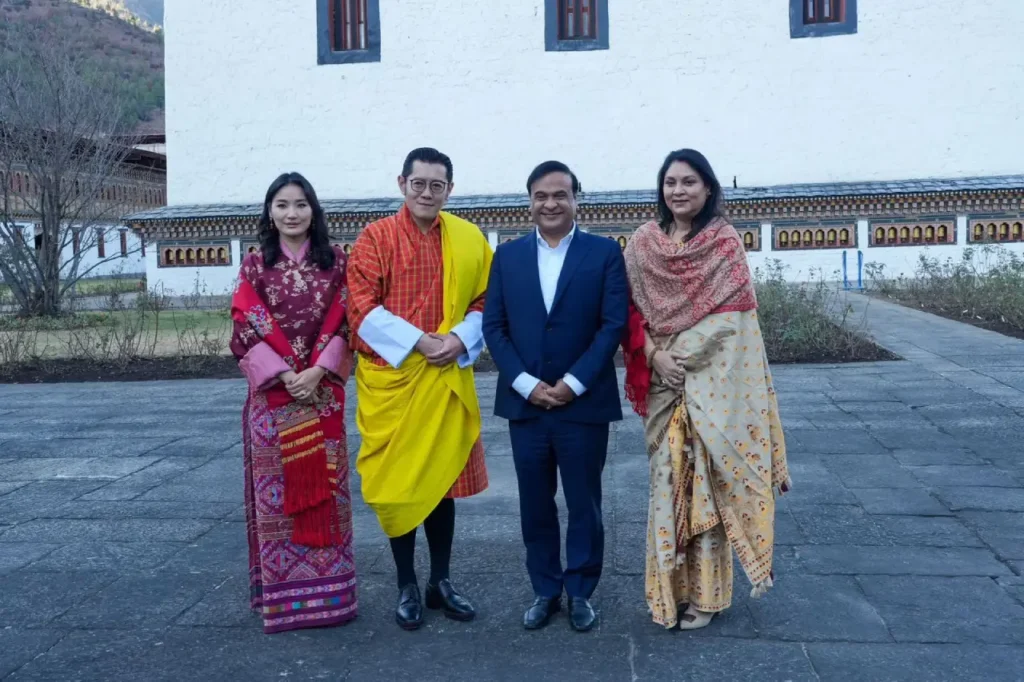
Sarma also met Bhutan’s King Jigme Khesar and Queen Jetsun Pema at the Golden Throne Room in Tashichhodzong. Their discussions explored ways to strengthen cultural, historical, and economic ties between Assam and Bhutan, with an emphasis on energy cooperation, tourism, healthcare, education, skill development, and water resource management. Later, Sarma joined a gathering at India House in Thimphu, where he met India’s revered spiritual preacher Sadhguru and congratulated educationist Arun Kapur, who was honoured during Bhutan’s National Day celebrations for his exemplary contributions to education. The Chief Minister also visited Bhutan’s iconic spiritual centre, Simtokha Dzong, and Kuenrey Hall, where he offered prayers by lighting a lamp in front of the majestic statue of Gautam Buddha.
Bhutan’s National Day, celebrated annually on 17 December, commemorates the coronation of its first king, Ugyen Wangchuck, in 1907. The 117th statehood celebrations, held at Changlimithang Stadium in Thimphu, honoured Bhutan’s rich cultural heritage and reaffirmed its commitment to peace, prosperity, and happiness. Nearly 200 international guests attended this year’s auspicious event.
Bhutan, which prioritises Gross National Happiness over GDP, shares a 699-kilometre border with northeast Indian states, including Sikkim, West Bengal, Assam, and Arunachal Pradesh. Assam’s 266-kilometre boundary with Bhutan features settlements on both sides. Historically, the regions maintained connectivity when India’s far eastern territories were known as Kamrup, a connection that persisted into the present day. Even during recent decades, Bhutan’s southern territories served as hideouts for Assam’s separatist militants until Bhutan’s armed forces flushed them out in 2003. A newly inaugurated immigration checkpoint at Darranga, near Bhutan’s Samdrup-Jongkhar locality, now facilitates smoother international travel, akin to recognised points such as Phuentsholing and Paro.
Ecologically, Bhutan shares proximity with the Brahmaputra River basin. Surface water from Bhutan’s hilly regions requires careful management for drinking, irrigation, and disaster mitigation, particularly during monsoons when swollen rivers like Kurichhu can overflow into Lower Assam’s riparian localities. A comprehensive and sustainable development initiative addressing the region’s resourceful yet ecologically fragile nature is an urgent necessity.
The Chief Minister’s visit has undeniably strengthened ties between Assam and Bhutan, laying a foundation for future collaborations that respect both regions’ unique cultural, historical, and ecological interdependence.