As the military rulers of Myanmar (also known as Burma and Brahmadesh) plan for a nationwide election in the coming months, anti-junta and pro-democracy groups have raised serious concerns, arguing that the military regime lacks both legal and political legitimacy to conduct credible polls. These critics point out that the junta no longer exercises effective territorial or administrative control over much of the country, making the possibility of a free and inclusive election virtually impossible. Progressive Voice, a rights-based advocacy organization, has unequivocally asserted that “with relentless junta attacks causing widespread instability and mass displacement, its planned election would be neither free nor fair, nor credible.”
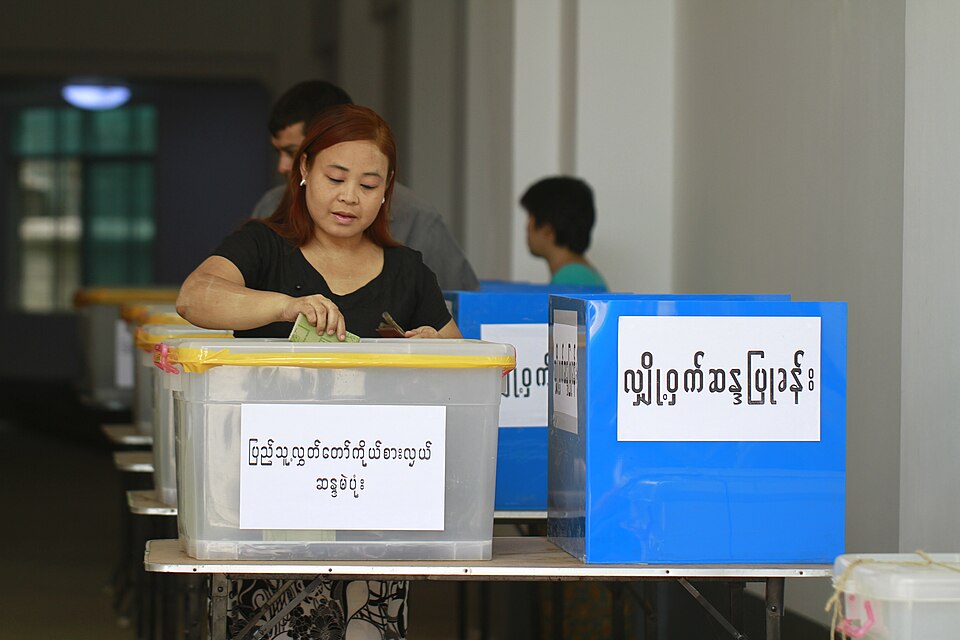
Junta chief Min Aung Hlaing has, on multiple occasions, reiterated that a general election will be held by the end of 2025 or in early 2026. A recent statement published in the state-run Global New Light of Myanmar reaffirmed the regime’s intention to proceed with elections soon. The Union Election Commission (UEC) even announced that individuals or groups can apply to register political parties. UEC chairman U Ko Ko added that electronic voting machines will be deployed to ensure quick, accurate, and transparent results.
The current batch of generals, who seized power in Naypyitaw on 1 February 2021 by overthrowing the democratically elected government of Daw Aung San Suu Kyi, continue to promise that they will eventually hand over power to the Burmese people. However, there is a widespread assumption that Suu Kyi—an octogenarian Nobel Peace Laureate who remains imprisoned—and her party, the National League for Democracy (NLD), will be barred from participating in any future elections.
Since the coup, the junta has repeatedly extended the state of emergency. More than 6,500 civilians have been killed by security forces, over 3.5 million have been displaced (many fleeing to Thailand, Bangladesh, and India), and at least 22,000 individuals—including the ousted President Win Myint and more than 25 journalists—remain in detention without trial. Reflecting the severity of the situation, a UN official recently observed, “There cannot be an election when they imprison, torture, and execute opponents.”
The military regime currently controls only about half of Myanmar’s 330 townships. According to the National Unity Government (NUG), around 144 townships are now under the control of ethnic armed organizations and civilian resistance forces. More than 75 other townships remain in active conflict zones where the population resists military rule. Technically, over 75% of Myanmar’s territory is now governed by non-junta administrations, effectively eroding the military’s control.
The situation is particularly stark in western Myanmar’s Rakhine State (Arakan), where the Arakan Army has seized control of 14 out of 17 townships. The junta now effectively governs only the Rakhine capital Sittwe, Manaung, and parts of Kyaukphyu. The rest are under the control of the Arakan Army, which has mounted a formidable resistance against the Tatmadaw.
Progressive Voice has described the junta’s planned polls as a “sham election,” asserting that the regime is using the promise of elections to distract from its brutal crackdown on civilians. The arbitrary dissolution of 40 political parties, including the NLD—which won landslide victories in the 2015 and 2020 elections—underscores the junta’s intent to engineer a manipulated and one-sided outcome. Moreover, the UEC has declared that voting will occur in 267 townships—a number derived from the junta’s unilateral and illegal redistricting of the country’s 330 townships to manufacture the illusion of broad electoral participation.
“This election is nothing but a façade,” a Progressive Voice statement read. “It is a strategy to seek and entrench false legitimacy so the junta can reinforce its tyranny.” Speaking to this writer from Yangon (formerly Rangoon), Khin Ohmar, chairperson of Progressive Voice, warned that any international support for the junta’s election—whether direct or indirect—would threaten the pro-democracy movement by legitimizing military rule and reinforcing the cycle of violence. She called on the international community to unequivocally reject the junta’s plans and instead support grassroots efforts to build a federal democratic system.
“The international community must unequivocally denounce the junta’s planned election and support the Myanmar people’s efforts to build federal democracy from the ground up,” said Ohmar. “Any support for this sham election—whether through diplomatic recognition or quiet engagement—only emboldens the junta’s brutality.”
What Myanmar urgently needs, she emphasized, is genuine solidarity and meaningful support that strengthens the people’s resistance and helps them achieve a democratic transition. “Imposed solutions aimed at quick fixes will only prolong military tyranny and deepen the suffering of Myanmar’s people,” Ohmar said. She concluded with a call for global citizens to stand with the Burmese people in their struggle to end military rule and establish an inclusive federal democracy rooted in justice and peace.
In essence, the military’s promise of elections appears less a pathway to democracy than a calculated move to secure legitimacy amidst chaos. The reality on the ground—mass displacement, violent repression, and the disintegration of junta control—raises a clear and urgent question: Can Myanmar truly witness a free and fair election under military rule? The answer, increasingly, seems to be no.