Who is Hasanul Haq Inu?
Hasanul Haq Inu is a secular, democratic, and progressive Bangladeshi politician whose public life spans more than five decades—from the final years of Pakistan’s rule to the present day. His political activism began in 1968 when he joined the Bangladesh Chatra League, one of the critical engines of the movement for self-determination that led to the formation of Bangladesh. In 1969, he was elected General Secretary of the BUET (Bangladesh University of Engineering and Technology) unit and emerged as an organiser in the historic uprising of that year against the Pakistani military regime. Later that year, he joined the secret political group known as the ‘Nucleus’, which played a key role in the country’s independence movement.
During the Liberation War, Inu served as the Camp Commandant and Instructor of Guerrilla Warfare for the Bangladesh Liberation Front (BLF). In this capacity, he trained approximately 10,000 freedom fighters who then took part in the liberation of occupied Bangladesh from the Pakistani forces. His role was that of a war veteran and organiser, contributing directly to the independence struggle through training, mobilisation, and operational preparation.
In the early years after independence, Bangabandhu Sheikh Mujibur Rahman appointed him in 1972 as the founding General Secretary of the Jatiya Krishok League (National Farmers’ League). Shortly afterwards, Inu helped establish the country’s first post-independence opposition party, Jatiya Samajtantrik Dal (Jasod), joining its Central Executive Committee in 1972. Inu became a central organiser in the long democratic movement that opposed military rule throughout the 1980s. He played major roles in uniting opposition parties under the Fifteen Party Alliance and the Five Party Alliance, alliances that eventually succeeded in restoring parliamentary democracy.
He later helped establish the Left Democratic Front and led Jasod’s campaigns demanding accountability for 971 war crimes. He served multiple terms as Jasod’s General Secretary and President. In the 2000s, Inu helped create the 14-Party Alliance—an important political front advocating secularism, democratic reforms, and resistance to fundamentalism and corporate globalisation.
After 2006, he campaigned for electoral reform, transparency, accountability for abuses of state power, and the restoration of free and fair elections. He was elected to Parliament in 2009, 2014, and 2018. In recognition of his integrity, competence, and statesmanship, he was invited to join the Cabinet as Minister for Information, despite belonging to a different political party and notwithstanding policy disagreements with the ruling Awami League. His appointment reflected cross-party acceptability, not partisan loyalty.
He served twice as Minister and became a member of the Constitutional Reform Committee of Parliament. Throughout his life, Inu has remained a committed defender of secularism, democracy, and the spirit of 1971—values that now place him squarely in the line of attack by the forces that opposed Bangladesh’s independence and increasingly shape the current regime.
The August Coup d’État and the capture of the ICT
In July–August 2024, a movement initially framed as student protests against the government job quota system quickly escalated into what Justice Observatory Bangladesh (JOB) and many international observers describe as a right-wing Islamist coup d’état. The early phase of the movement involved genuine student grievances; however, it was rapidly infiltrated and overtaken by extremist elements, including factions aligned with Jamaat-e-Islami.
Jamaat-e-Islami opposed Bangladesh’s independence in 1971 and collaborated with the invading Pakistan Army in genocide and crimes against humanity against the Bengali population. The party and its allied militias—Razakars, Al-Badr, Al-Shams—played central roles in mass killing, rape, enforced disappearance, and the targeting of intellectuals. Today, under the unconstitutional interim government led by Dr Muhammad Yunus, Jamaat and its allied networks have emerged as decisive power brokers.
The regime’s political dependence on Jamaat has created an opportunity for the party, long ostracised for its role in 1971, to pursue old vendettas against those who stood on the opposite side of history. One of the starkest manifestations of this shift is the takeover and repurposing of the International Crimes Tribunal (ICT). Established in 2009 under the International Crimes (Tribunals) Act 1973, the ICT was originally designed to prosecute the perpetrators of the 1971 atrocities. Today, it is being used against individuals who fought for independence, including individuals like Hasanul Haq Inu.
The appointment of a Chief Prosecutor who previously defended convicted war criminals before the same Tribunal further illustrates this inversion. A tribunal created to hold collaborators accountable is now being harnessed by a Jamaat-influenced regime to pursue those who embody the secular, pro-Liberation legacy of Bangladesh.
The case against Hasanul Haq Inu before the ICT
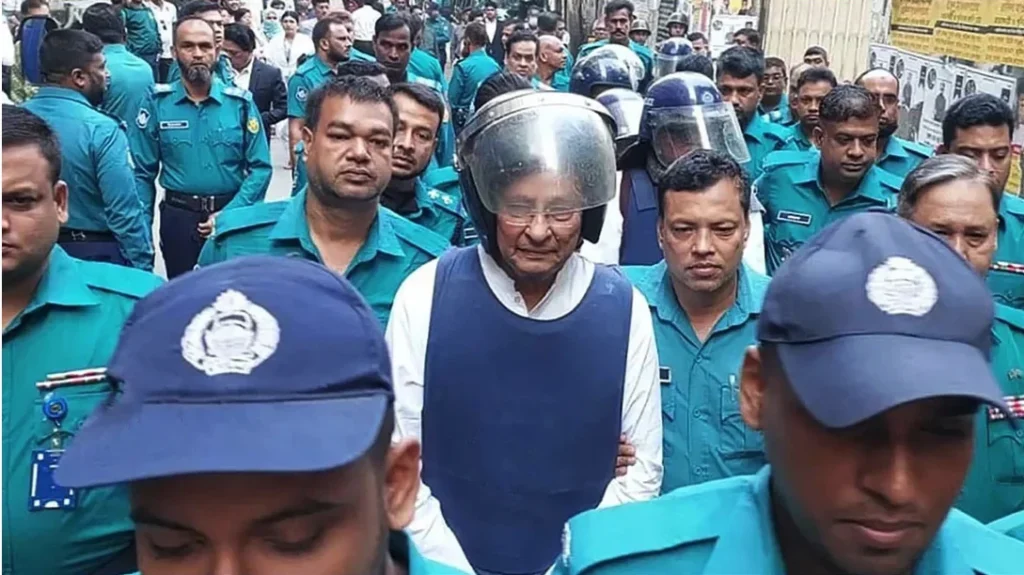
Since his arrest on 26 August 2024, over one hundred murder cases have been filed against Inu nationwide, in addition to two cases before the ICT. He has been formally shown arrested in 92 of those cases. On 25 September 2025, the ICT Prosecution submitted charges against him for crimes against humanity, including murder, in Case No. 3 of 2025. ICT took cognisance and ordered him to be produced as the sole accused. His trial began on 30 November 2025 after the Tribunal summarily rejected both his discharge petition and review petition.
Crucially, the prosecution’s case does not rely on allegations of physical acts of violence or operational control over security forces. Instead, it rests almost entirely on political consultations, public statements, media interviews, and alleged telephone conversations. These communications are being recast as incitement, conspiracy, and command responsibility for six deaths and multiple injuries in Kushtia district during the July–August events.
In essence, ordinary political speech and alleged communications are being transformed into the basis for one of the gravest charges in international criminal law. This would be astonishing in any jurisdiction; it is doubly so when the target is a respected war veteran and secular figure who has consistently warned against extremism.
Inu and Jasod’s position on the Quota Movement and subsequent violence
The quota protests, which began as a socio-political movement, later descended into violence, resulting in casualties among students, law enforcement officers, and civilians. Inu repeatedly warned against escalation and urged institutional, peaceful solutions. He and Jasod consistently advocated reform of the quota system—not its abolition or its full retention—and called for the immediate establishment of a Quota Reform Commission.
He criticised the government’s delay in engaging with student representatives and emphasised that the issue was solvable through socio-political dialogue, not confrontation. When violence broke out on 16 July 2024, Jasod publicly expressed sorrow and mourned the lives lost, including among students.
Inu, as a freedom fighter committed to democratic values, condemned both extremist acts and excessive force by the police. He called for restraint, de-escalation, and transparency, criticising intelligence failures and the administration’s uneven treatment of victims.
He drew public attention to signs that militant or extremist groups were exploiting the movement to conduct organised sabotage, including attacks on public institutions. He repeatedly clarified that students were not responsible for these acts.
Even after the Prime Minister Sheikh Hasina’s offer of dialogue was rejected by the student protesters, Inu continued to advocate for discussions, issuing an appeal on 4 August urging the student leadership and political actors not to miss the “last opportunity” to resolve the crisis peacefully. The prosecution now attempts to invert this record and depict a man urging restraint, reform, and dialogue as the source of violence—a political distortion incompatible with the documented facts.
Failures of judicial scrutiny by the ICT
ICT’s handling of Inu’s discharge petition exposes major deficiencies in reasoning and process. The Tribunal misapplied the prima facie standard, treating it as a formality rather than a safeguard. Instead of examining whether the evidence, even if accepted at its highest, satisfies the essential legal elements of crimes against humanity, the Tribunal deferred almost all issues to trial, effectively nullifying the safeguards put in place at the charge-framing stage.
The order echoes the prosecution’s narrative without meaningful scrutiny and fails to address central defence arguments: that Inu had no command authority; that the case is politically motivated; that other actors have been immunised through blanket indemnity; that the 2024 amendments to the ICT Act raise constitutional concerns; that core evidence lacks authentication; and that the prosecution’s chronology and framing contain demonstrable factual errors.
The reasoning of the ICT is repetitive and formulaic, and it does not demonstrate independent judicial analysis. To observers, the Tribunal appears to have become an extension of the prosecution rather than an impartial arbiter.
Conflict of interest and prosecutorial misconduct
The Chief Prosecutor, Tajul Islam, is a highly partisan figure closely linked to Jamaat-e-Islami and its tactical front, the Amar Bangladesh Party (AB Party). In previous ICT cases, he acted as a defence lawyer for individuals convicted of 1971 atrocities. Under the current Jamaat-reliant regime, he now leads prosecutions against secular, pro-Liberation figures. This dual role underscores the political inversion driving the Tribunal’s recent direction.
He also participated directly in events surrounding the August 2024 coup. In his presence on 5 August, another prominent AB Party leader publicly abused the President and Army Chief in language amounting to sedition, threatened to “blow up” the cantonment, and proclaimed August as the new “national December”.
These statements were later confirmed by AB Party in a press conference in 2025. Despite this, rather than being investigated, Tajul has been elevated to Chief Prosecutor. His conduct in office reflects a pattern of misconduct and disregard for due process. He has attempted to criminalise legitimate legal arguments by labelling them “sedition”; he has made inflammatory public statements that undermine the presumption of innocence; he has denied publicly documented facts, such as the government’s indemnity announcement; he has misrepresented procedural rules to restrict the defence; and he has threatened defence counsel with being made an accused. These actions undermine the integrity of the Tribunal and violate basic prosecutorial ethics.
Why Inu is being targeted – and why this is a miscarriage of justice
Inu is being targeted precisely because he represents what Jamaat-e-Islami and its allies opposed in 1971 and still oppose today. As a war veteran who contributed to the independence struggle, a lifelong defender of secular and democratic values, and a politician respected across party lines, he stands in stark contrast to the ideological forces now empowered by the 2024 events.
The interim government, increasingly dependent on Jamaat, has presided over the inversion of the ICT’s purpose. A tribunal created to prosecute collaborators of 1971 is now prosecuting a man who resisted those forces then and continues to do so now.
This is not justice; it is a political reckoning disguised in the language of international criminal law. The charges distort the meaning of crimes against humanity by treating political speech and alleged communications as incitement and command responsibility. They do not meet domestic or international legal thresholds.
The Tribunal’s orders reflect prosecutorial narratives rather than independent judicial reasoning. Conflicts of interest are not incidental—they are structurally embedded in the case. For all these reasons, the prosecution of Hasanul Haq Inu is a textbook miscarriage of justice and a grave abuse of the ICT’s mandate.
It threatens not only Inu’s life and liberty, but the future of accountability for 1971 and the broader struggle for secular democracy in Bangladesh. 8. What You Can Do The international community—lawmakers, civil society organisations, media, and citizens—has a vital role in halting this misuse of justice in Bangladesh.
Wherever you are, you can speak out against the August 2024 coup and the capture of the ICT; write to your elected representatives; urge your foreign ministries and embassies to intervene; call for independent trial monitoring; and amplify the voices of those resisting this reversal of history.
International human rights organisations should send trial observers to the ICT immediately. International media should cover the Tribunal seriously, especially given the documented intimidation and capture of domestic media. Solidarity networks working on Bangladesh issues should be supported with the resources necessary to document abuses and advocate effectively.
On this International Human Rights Day, 10 December 2025, Justice Observatory Bangladesh (JOB) calls for urgent international action to stop the judicial persecution of Hasanul Haq Inu and to defend the principles for which Bangladesh was born.