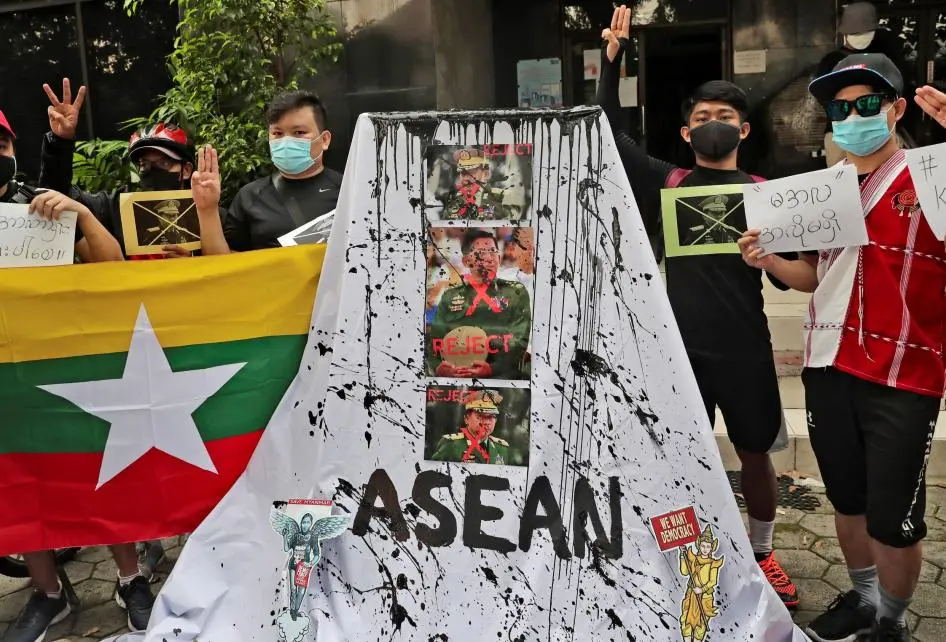
On the eve of the Association of Southeast Asian Nations (ASEAN) Summit scheduled for May 5–9 in Cebu, Philippines, civil society groups from Myanmar and those in exile have urged the regional bloc not to enable the military junta’s search for legitimacy. The summit, they argue, is set to become a focal point for renewed scrutiny of the junta’s continued violence and widespread human rights abuses against civilians.
ASEAN now faces a defining moment. According to Progressive Voice, a participatory rights-based policy research and advocacy organisation, the bloc must respond to Myanmar’s deepening polycrisis with principled leadership rooted in human rights, backed by concrete and time-bound measures to halt violence and restore its credibility as a rules-based, people-oriented institution.
Progressive Voice has pointed to an open letter issued on April 24, 2026, endorsed by 201 Myanmar, regional, and international civil society organisations, calling on ASEAN to end the junta’s campaign of terror, ensure accountability, and operationalise cross-border humanitarian aid. Five years after the adoption of the Five-Point Consensus (5PC), the group argues, ASEAN’s continued reliance on the framework has only emboldened the military to act with complete impunity.
The organisation also criticised the ASEAN Chair’s statement on the same day welcoming the release of U Win Myint while merely referring to Daw Aung San Suu Kyi without her official title. Progressive Voice noted that avoiding the designations of President and State Counselor risks signalling tacit recognition of the junta and its planned electoral exercise, undermining both the ASEAN Charter and the democratic will of Myanmar’s people.
In its weekly brief, Progressive Voice underscored what it described as the junta’s familiar strategy—selective prisoner releases alongside escalating violence—as part of a broader attempt to secure legitimacy, including through engagement with ASEAN. While ASEAN has excluded “non-political representatives” from Myanmar since 2021, the group maintains that this falls short, reiterating calls for a complete bar on all junta-linked participation.
The group further highlighted concerns over Thailand’s Foreign Minister’s visit to Naypyidaw on April 22, 2026. While discussions reportedly included Daw Aung San Suu Kyi’s situation, the junta has offered no credible updates or access. Progressive Voice warned that such engagements risk normalising the regime and paving the way for its re-entry into ASEAN processes through post-election mechanisms.
Echoing these concerns, Karen community organisations cited expanding airstrikes near Mae Hong Son and stressed that large swathes along the Thailand–Myanmar border remain under Karen and Karenni governance. They have called on Thailand to intensify pressure on the junta, including demanding an immediate cessation of hostilities, while Thai civil society groups have also criticised Bangkok’s diplomatic outreach.
Progressive Voice asserted that there is no justification for legitimising the junta, which continues to ignore the 5PC, commit atrocities, and enable transnational criminal networks, including scam operations that threaten regional stability.
The organisation also urged Thailand, as a member of the United Nations Human Rights Council, to uphold its commitments under the Council’s 61st session by facilitating cross-border humanitarian assistance. Given its geographic proximity, Thailand is seen as critical to delivering aid to displaced populations, even as refugee conditions worsen amid funding shortfalls. While the European Union’s €15 million pledge has been welcomed, broader international support remains essential.
As ASEAN Chair, the Philippines is being called upon to take a firmer stand by excluding all junta representatives and engaging instead with Myanmar’s democratic stakeholders, including the National Unity Government, the Steering Council for the Emergence of a Federal Democratic Union, Ethnic Resistance Organisations, and civil society groups.
Progressive Voice maintains that only such measures—alongside support for accountability efforts in jurisdictions like Timor-Leste and Indonesia—can pave the way for lasting peace and regional stability.