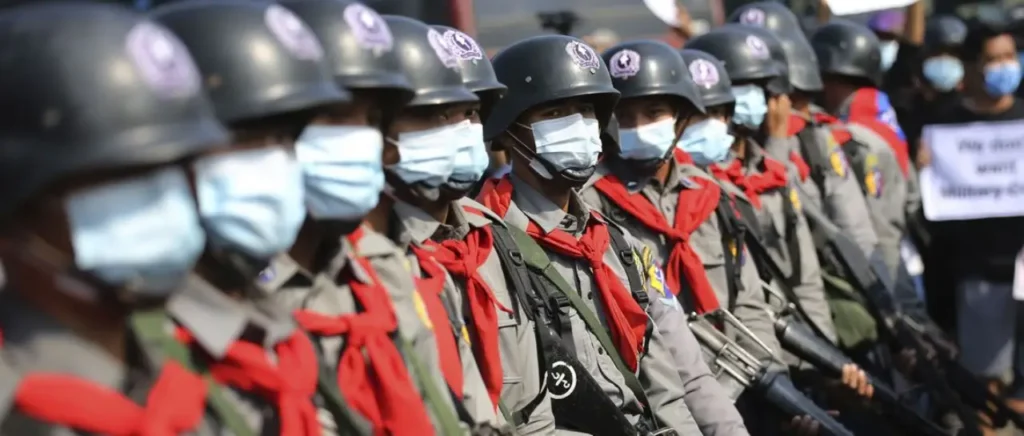
The Myanmar military junta, which only a year ago appeared to be on the retreat—with vast swathes of territory taken by the People’s Defence Force (PDF) and ethnic armed groups—has staged a noticeable comeback. Backed by an election held under tightly controlled conditions and a new government led by former military ruler Min Aung Hlaing, the balance has shifted. The junta has regained the upper hand in several regions, suggesting a recalibration rather than collapse.
This turnaround is being attributed to a mix of external support and internal consolidation. What some countries describe as a “more practical approach,” particularly toward engagement with the junta, appears to have worked in its favour. Territories earlier captured during offensives by resistance groups—especially the Three Brotherhood Alliance (3BA)—in northern Shan and Kachin states, as well as intense fighting in Karenni and Kayin, have gradually been retaken by the military.
A major turning point in the conflict came in October 2023 during Operation 1027. The 3BA—comprising the Ta’ang National Liberation Army (TNLA) and the Myanmar National Democratic Alliance Army (MNDAA)—inflicted a significant defeat on the junta. By late 2023, they had captured around 20 towns and key strategic sites across northern Shan State, gaining control over vital border, commercial, and administrative hubs, and sharply reducing the junta’s presence.
Among the most critical losses were key trading towns along the China border. Laukkai, capital of the Kokang Self-Administered Zone, was seized by the MNDAA. The TNLA captured several townships, including Namhkam, Kutkai, Monglon, Mongngaw, Namtu, Mantong, and Namsang. These offensives disrupted military logistics and command structures, with ripple effects felt across Rakhine, Chin, Karenni, and Kayin states, where the military suffered additional setbacks.
However, the present situation indicates a partial reversal. The military has launched sustained airstrikes alongside coordinated ground offensives, enabling it to recover some lost territory. A number of key regions have seen repeated junta-led strikes, and the military appears poised to continue its counteroffensive in the coming months.
One recent example is the recapture of Takaung, located on the Mandalay–Thabeikkyin–Tigyaing–Bhamo road. The town had been under the control of the PDF, operating under the Ministry of Defense of the National Unity Government (NUG), along with local resistance forces, since August 12, 2024. Its loss marks a significant shift in that corridor.
Over the past 20 months, the junta—using continuous airstrikes backed by calculated ground operations—has reportedly regained control of over 14 of the 104 towns originally captured by resistance forces. These include Kawlin, Myawaddy, Lashio, Hsihseng, Mobye, Thabeikkyin, Nawnghkio, Kyaukme, Hsipaw, Momeik, Mogok, Singu, Banmauk, and Takaung. While limited in number, these gains signal a broader shift in battlefield dynamics.
A key factor behind this shift appears to be Chinese intervention, particularly in northern Shan State. Beijing is believed to have exerted pressure on the Kokang and Ta’ang forces to relinquish some captured territories. This pressure was aimed at stabilising border regions ahead of the junta’s planned 2026 elections, securing trade routes into China, and protecting Chinese economic interests.
Under such pressure, the TNLA agreed to a ceasefire with the junta following talks held in Kunming between October 27–28, 2025. As part of this arrangement, the TNLA withdrew from key areas such as Mogok—known for its ruby mines—in the Mandalay region, and Mongmit. This marked a significant shift in the conflict’s northern theatre.
Chinese influence may also extend to Rakhine State, where major Chinese investments are concentrated. The Arakan Army (AA), despite achieving considerable battlefield success, has reportedly moderated its operations in sensitive areas. Notably, it has avoided launching a full-scale assault on Kyaukphyu, a strategic deep-sea port town central to China’s Belt and Road Initiative.
The AA had earlier aimed to “liberate” all of Rakhine but appears to have recalibrated its strategy. Reports suggest that Chinese pressure to safeguard infrastructure—particularly the twin oil and gas pipelines running from Kyaukphyu to Yunnan—has played a role in limiting escalation in that region.
Beyond external influence, internal challenges have also affected the resistance. Fatigue, prolonged conflict, and instances of infighting have weakened several groups. While the PDF and the National Unity Government (NUG) dismiss reports of major setbacks as “junta propaganda,” they acknowledge that resistance forces are under strain. References to “weary PDF soldiers and defeated Ta’ang army members” indicate the pressures on the ground.
Media reports suggest that some resistance groups have withdrawn from fighting, while others have been weakened by internal divisions and supply shortages. The Burma Coup Resistance Notes group, which advocates for resistance forces, has pointed to “the toll of five years of continuous conflict, citing harsh living conditions, constant danger, mental strain, and shortages of food and ammunition.”
At the same time, claims of defections remain contested. The Kachin Independence Army (KIA) rejected an April 5 regime media report that alleged eight KIA and PDF members surrendered in Myitkyina. KIA spokesperson Naw Bu termed the report “fabricated,” even as fighting continues in Hpakant Township, located west and northwest of Myitkyina and near the KIA headquarters in Laiza.
There have also been reports of alleged mass defections, though no verified figures exist. Some media reports estimates suggest that around 110,000 men aged 18 to 35 have been forcibly conscripted since April 2024, with each intake reportedly around 5,000 recruits following the enforcement of the conscription law on February 10, 2024.
On the ground, fighting remains intense across multiple regions. In Chin State, media reports indicate that regime forces recaptured Falam district and Surbung Airport on April 25. This was followed by airstrikes in Kanpetlet Township near Kyindwe, which reportedly killed nine civilians. Kanpetlet had earlier been seized by the Chin Brotherhood in December.
Sagaing Region, long considered a resistance stronghold, is also witnessing renewed military pressure. Reports from local sources indicate that the junta has made advances into fortified areas previously held by the PDF. Thousands of civilians have fled townships such as Pale, Yinmabin, Salingyi, and Kani in anticipation of military offensives.
Eyewitness accounts describe large-scale displacement, with residents crossing the Chindwin River to escape advancing military columns from the Northwestern Regional Military Command (RMC) in Monywa. Reports also indicate detentions of civilians in Yinmabin, though the reasons remain unclear.
Strategic locations continue to shape the conflict. Tigyaing Township was recaptured by the military on March 26, and efforts are underway to regain Indaw, a key logistics hub. Control of the Tigyaing–Katha road would allow the military to re-establish supply routes toward Indaw, which had been seized by the KIA and PDF on April 7, 2025.
Indaw’s importance lies in its position as a road and rail junction connecting Mandalay to Kachin State, including Myitkyina, where the Northern Regional Military Command is based. Military advances into Nabar village and surrounding areas suggest a coordinated push to reclaim this corridor.
Despite battlefield developments, the conflict remains far from resolved. Media reports quote analysts such as Morgan Michaels of the International Institute of Strategic Studies suggest that while the military may be reasserting itself, the resistance is unlikely to disappear. Even if weakened, it retains the capacity to sustain prolonged insurgency.
International pressure continues, though its effectiveness remains limited. The European Union has extended sanctions on Myanmar until at least May 2027, targeting over 100 individuals and entities through asset freezes, travel bans, and an arms embargo. Financial assistance to the junta remains suspended.
Meanwhile, UN Special Rapporteur Tom Andrews has called for stronger international accountability measures. In his report From Impunity to Justice, he criticised the global response as inadequate and condemned the UN Security Council’s failure to refer Myanmar to the International Criminal Court, calling it an abdication of responsibility.
Taken together, these developments point to a conflict entering a new and complex phase. The junta’s resurgence is real but incomplete, shaped by external pressures, internal fractures within the resistance, and shifting strategic priorities. The outcome remains uncertain, with both sides adapting to an evolving battlefield.