There arise, in the chronicle of a nation, rare intervals when silence resounds more profoundly than thunder. Bangladesh now dwells within such a disquieting interlude—an uneasy hush wherein the absence of its oldest, largest, and the country’s founding political force, the Awami League, echoes across the republic like a sentence left hauntingly unfinished.
The Constitution of Bangladesh, in its solemn preamble, proclaims “a society in which the rule of law, fundamental human rights and freedom… will be secured for all citizens.” It further enshrines in Article 37 the unequivocal right to assemble and form associations, while Article 38 guarantees the freedom of association. These are not ornamental clauses; they are the very sinews of a democratic state. To suspend, by ordinance or statute, the lawful existence of a major political party is to test the tensile strength of those constitutional commitments.
History teaches us that democracy is not merely the presence of elections, but the presence of choice. As Nelson Mandela once reminded the world, “A nation should not be judged by how it treats its highest citizens, but its lowest ones.” The disenfranchisement—whether legal or de facto—of millions of supporters of a political tradition raises difficult questions about the inclusivity of the current order.
The Awami League is not an incidental formation; it is woven into the very fabric of Bangladesh’s birth. Its present stillness, therefore, is not a routine political ebb—it is a structural silence. The absence of its participation in the recent electoral process has inevitably cast a shadow over the perception of representativeness. Democracy, as Abraham Lincoln so memorably defined, is “government of the people, by the people, for the people.” When a significant portion of “the people” finds its political vehicle immobilized, the definition itself begins to strain.
Yet this is not merely a question of legality; it is also one of political reality. Reports of detentions, fear, and the shrinking of civic space—whether contested or confirmed—contribute to a climate where participation becomes perilous. In such a surrounding milieu, stillness is not always chosen; it is often imposed. And imposed silence, history warns us, rarely endures without consequence.
The events of 1971 remain the moral compass of the nation. The Constitution itself, in Article 11, pledges that “the Republic shall be a democracy in which fundamental human rights and freedoms… shall be guaranteed.” That promise was not forged in comfort; it was wrought in sacrifice. As Winston Churchill once observed, “Courage is what it takes to stand up and speak; courage is also what it takes to sit down and listen.” Bangladesh today requires both—the courage to question and the wisdom to hear.
For the Awami League, the path forward is fraught but not foreclosed. Political history across continents demonstrates that exclusion, however prolonged, often gives rise to recalibration. Engagement—domestic and international—remains an indispensable instrument. In an interconnected world, perceptions are shaped not only within national borders but also within global policy circles. Strategic advocacy, including dialogue with influential stakeholders abroad, may help restore equilibrium and ensure that Bangladesh Awami League’s glorified history narrative can be diminished or distorted by an evil design orchestrated by both foreign and local forces under no circumstances whatsoever.
At the same time, the responsibility does not rest solely with one party. The strength of a republic lies in the magnanimity of its institutions and the fairness of its processes. To allow dissenting voices, to accommodate rival visions except anti-Bangladesh forces, and to uphold constitutional guarantees even for opposers —these are the hallmarks of democratic maturity.
As Martin Luther King Jr. profoundly stated, “The arc of the moral universe is long, but it bends toward justice.” Whether Bangladesh’s current trajectory proves transient or enduring will depend on how faithfully it adheres to its founding principles.
The stillness of today may yet give way to the movement of tomorrow. But history will record not only what was done, but what was allowed—and what was denied.
In the shadowed aftermath of 5 August 2024, Sheikh Hasina was, by this account, removed from power through the calculated designs of a dominant Western power, acting in concert with its local ominous confederates to advance strategic and economic ambitions—ambitions to which she had steadfastly refused to yield. In her stead, on 8 August 2024, a compliant interim administration, led by Muhammad Yunus, was installed with the backing of that external power and its domestic collaborators, casting a long and contentious pall over the political landscape of Bangladesh.
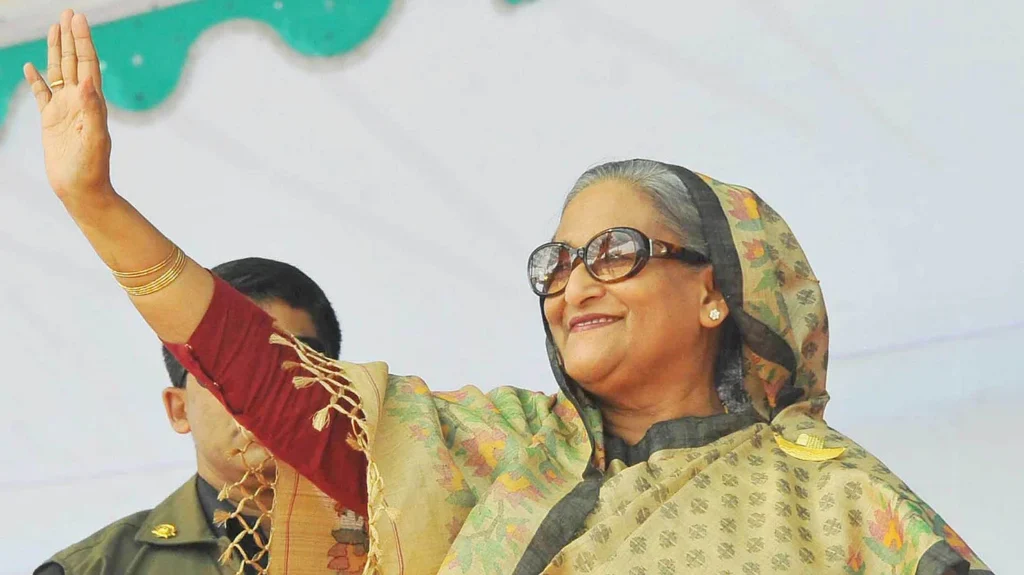
Sheikh Hasina, in her enduring capacity as President of the Awami League—the nation’s oldest, largest, and founding political party—stands at the centre of this unfolding political tableau. The Yunus-led administration, by this account, proscribed the party through an ordinance being in contravention of the constitutional guarantees of Bangladesh.
In the lead-up to the national polls of 12 February 2026, senior leaders of the BNP—including the incumbent Prime Minister Tarique Rahman and the present Law Minister, then serving as Attorney General—repeatedly affirmed that no political party would be banned. Yet, in a striking reversal upon assuming office on 17 February 2026, that position was abandoned, and the earlier ordinance was elevated into permanent law, thereby entrenching the prohibition.
Consequently, the parliamentary election of 12 February 2026 unfolded without the participation of the Awami League, effectively excluding the country’s largest political force from the electoral contest. This absence has been interpreted by its supporters as having shaped the outcome in favour of rival political currents. Many among the public hold the view that, had the Awami League been permitted to contest, it might have secured a commanding mandate, drawing upon its extensive record of development achieved over its sixteen-year tenure—progress often compared, by its proponents, to that of advanced Western nations and returned to power with landslide victory.
As a long-standing, keen field-level observer of politics since 1966, I personally visited nineteen polling centres on the national election day of 12 February 2026. By my considered estimation, voter turnout did not exceed twenty percent. To my profound astonishment, I further discovered that even at my own polling station, my vote had already been cast—apparently by an impostor.
The incumbent BNP government, which assumed office on 17 February 2026, is likewise portrayed as having come to power under the sway of one-sided directives from that same Western power—a pattern, in this telling, reminiscent of the earlier Yunus-led administration.
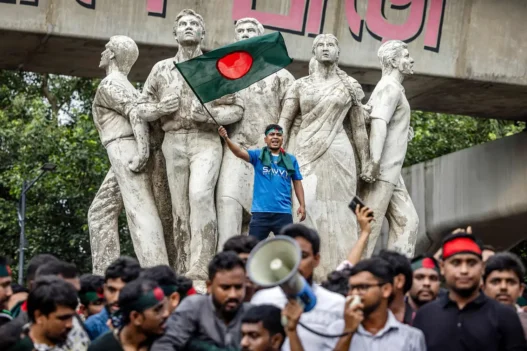
The July 2024 turmoil, as asserted here, was not an uprising or upheaval in any legitimate sense, despite its portrayal in sections of the media. Rather, it can be characterized as a calculated and mobilised terrorist assault upon the very foundations of Bangladesh—foundations secured through the immense sacrifice and bloodshed of 1971.
I stood as an immediate witness to these horrific attacks during July and August 2024, observing events at close quarters on the ground.
According to this interpretation, the events were orchestrated and financed through clandestine channels, drawing in elements from the margins of society, including impoverished street dwellers, slum inhabitants, and transient vagrants, who were mobilised under deceptive inducements by forces of both foreign and local described as hostile to Bangladesh’s sovereign ethos.
At the apex of this alleged design are identified external and internal actors, including a Western superpower said to be operating in concert with the ISI, select factions within military circles, Muhammad Yunus, Jamaat-e-Islami and similar extremist groups, other hardline ideological formations, as well as elements within the current governing arrangement.
These observations are grounded, as stated, in long-standing personal field-level political engagement and observation spanning from 1966 to the present, alongside an enduring affiliation and staunch support for the Awami League over the same period.
Although the Awami League commands the largest base of popular support in Bangladesh, my long-standing field-level experience suggests that its leadership, activists, supporters, and the wider public remain constrained from mobilising openly in the political landscape for several interrelated reasons:
1. The Awami League continues to remain formally proscribed, severely limiting its organisational visibility and operational space by both previous Yunus and present Tarique governments.
2. More than half a million individuals belong to Awami League have been detained without due legal process over a span of nearly two years. Within this context, it is further to be noted that many have died in custody under harsh and inhumane conditions, while others remain in hiding, enduring a life of severe deprivation and fear. A similar fate has befallen many senior journalists, who are languishing in detention.
3. It is further asserted that elements within the present Bangladesh Army and the RAB maintain a posture of pronounced hostility toward the Awami League. Even the emergence of spontaneous protest activity is met with severe repression, including arrests and custodial abuse.
4. It is my considered view that the Awami League does not seek to legitimize the so-called ban by submitting to judicial proceedings within Bangladesh. Rather, it is expected to elevate this ignoble and unlawful measure to the appropriate international fora, in order to challenge and ultimately free itself from what it regards as an illegitimate imposition.
5. Finally, it is contended that a major Western power continues to adopt an adversarial stance toward the Awami League, operating through discreet and indirect mechanisms driven by geopolitical considerations. Nevertheless, it is believed that if, at minimum, the conditions described in point (2) were to ease or shift toward neutrality, the Awami League could, in this assessment, reassert decisive political control of the entire Bangladesh within a remarkably short span—possibly within 7 days.
What, Then, Must the Awami League Do?
History alone shall judge whether the present trajectory proves tactical, transient, or tragically enduring.
Our griefs are vast—too vast for language to fully contain, too deep for lament to exhaust. Yet one truth stands stark and inescapable: the struggle confronting the Bangladesh Awami League has grown increasingly grave, complex, and formidable. What was once a contest with relatively contained political forces now appears, in this framing, as an encounter with far more powerful and entrenched global actors aligned with Western strategic interests.
In such a moment, prudence demands clarity and resolve. It is argued that the Awami League would be well advised to proceed with deliberate urgency in engaging one or two highly influential American lobbyists—individuals capable of navigating, and where necessary moderating, the intricate corridors of Washington’s policy establishment. Such engagement would pertain not only to the political positioning of Sheikh Hasina and the institutional future of the party, but also to the broader sovereign interests of Bangladesh itself.
In an age where political legitimacy is increasingly shaped within international policy ecosystems as much as within domestic electoral arenas, strategic external advocacy may prove indispensable in restoring balance and reshaping prevailing situations – moorages. Without such foresight, coordination, and calibrated engagement, the Awami League’s substantive re-entry into Bangladesh’s central political arena may risk remaining distant, uncertain, and tough.
It is, nonetheless, an outcome one would most earnestly hope to prevent.