Security, border stability and strategic cooperation took centre stage as Chinese President Xi Jinping held talks with Myanmar President Senior General Min Aung Hlaing at the Great Hall of the People in Beijing, signalling Beijing’s growing emphasis on stability in Myanmar amid ongoing conflict and uncertainty along the two countries’ shared frontier.
The meeting underscored the importance both governments attach to peace, security and law-and-order cooperation, with discussions ranging from border stability and the China-Myanmar Economic Corridor to the fight against telecom fraud, online gambling networks, narcotics trafficking and the reopening of key trade routes disrupted by instability.
Min Aung Hlaing is on a state visit to China from June 15 to 19, his second foreign trip since consolidating his hold on power following elections held in January.
The China visit comes just months after Min Aung Hlaing’s first overseas trip following the January elections, when he travelled to India to attend the BIMSTEC Summit in early April. The back-to-back engagements with two of Myanmar’s most influential neighbours underscore Naypyidaw’s efforts to strengthen regional partnerships amid continuing domestic conflict and growing geopolitical competition in the wider region.
Welcoming the Myanmar leader, Xi reaffirmed China’s long-standing position of non-interference in the internal affairs of other countries and reiterated Beijing’s support for Myanmar’s sovereignty, territorial integrity and national development efforts.
According to Chinese state media, Xi expressed support for Myanmar’s efforts to promote national development, strengthen security, maintain peace and stability, improve the socioeconomic well-being of its people and pursue a political path suited to its national conditions.
The Chinese President also emphasised the importance of cooperation between the two countries amid what he described as a complex international political environment. Burmese media reports said Xi highlighted the need to strengthen strategic trust, deepen bilateral cooperation, enhance security and rule-of-law collaboration and reinforce the position of China and Myanmar as reliable and trusted partners.
China also reaffirmed its support for Myanmar as an important member of ASEAN and signalled its willingness to continue providing assistance for the country’s development needs.
In remarks reported by Chinese state broadcaster CCTV, Xi said Beijing places high importance on relations with Naypyidaw as part of its broader diplomacy with neighbouring countries.
“I am willing to continue strengthening our leadership, carry forward the brotherly friendship between our two peoples, and deepen comprehensive strategic cooperation,” Xi told Min Aung Hlaing.
According to Chinese state media, Xi also stressed that stronger bilateral relations could make greater contributions to regional peace, stability and development.
For his part, Min Aung Hlaing said the primary purpose of his visit was to enhance cooperation across multiple sectors between the two countries. He highlighted Myanmar’s interest in expanding cooperation on national development, advancing the country’s peace process, increasing Chinese investment and promoting bilateral trade.
Security remained a recurring theme throughout the discussions.
Both leaders stressed the importance of ensuring stability along the China-Myanmar border and agreed on the need to maintain a secure environment for the successful implementation of the China-Myanmar Economic Corridor, a flagship project under China’s Belt and Road Initiative (BRI).
Min Aung Hlaing also briefed Xi on his government’s efforts to advance the National Ceasefire Agreement (NCA) and promote peace and stability within Myanmar, issues that Beijing has increasingly linked to the protection of its investments and cross-border interests.
The two sides further discussed urgent measures to combat telecom fraud and online gambling operations based in Myanmar, as well as strengthening cooperation in drug eradication efforts. Reopening border posts and restoring trade routes were also identified as key priorities requiring close coordination between the two governments.
The formal programme began with a state welcome ceremony at the Great Hall of the People.
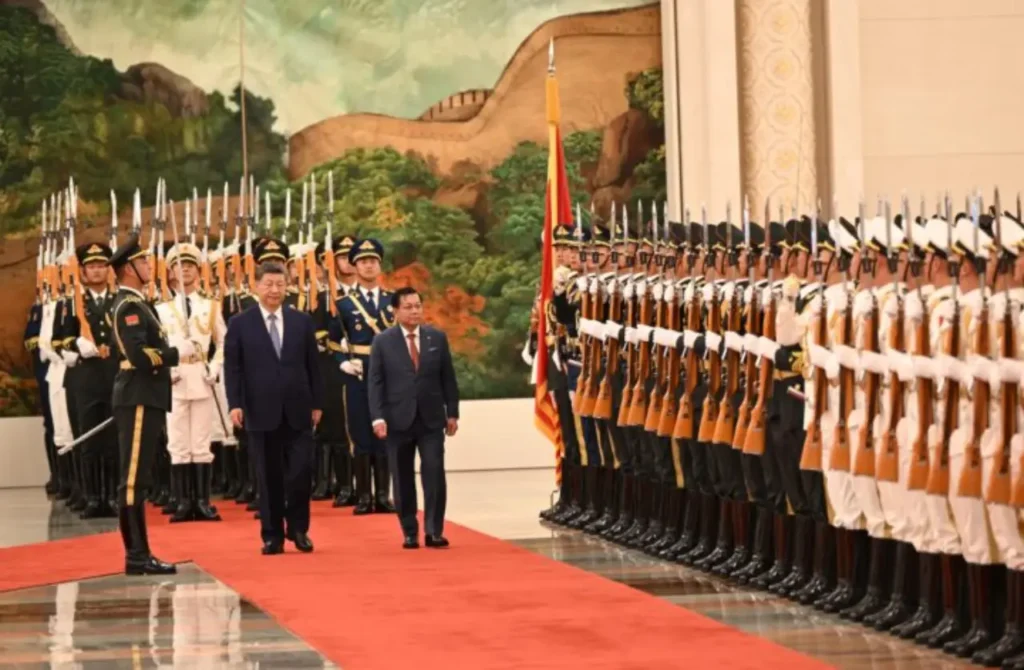
Upon arrival, Min Aung Hlaing was received at the entrance by a Guard of Honour from the Chinese People’s Liberation Army representing the Army, Navy and Air Force. A military band performed ceremonial honours while an artillery unit fired a 21-gun salute.
The two leaders inspected the Guard of Honour together and waved to children carrying miniature flags of China and Myanmar before proceeding to Fujian Hall for the official talks.
The discussions were subsequently expanded to include delegations from both countries.
Beyond security cooperation, the two leaders exchanged views on strengthening bilateral ties and expanding cooperation in a range of sectors, including space technology, energy, trade, agriculture, culture, religion and broader people-to-people exchanges.
Following the talks, officials from both countries participated in a document exchange ceremony.
In the presence of Xi and Min Aung Hlaing, officials signed 18 memorandums of understanding covering human resource development, agriculture, trade promotion, media cooperation, humanitarian initiatives, technology transfer and knowledge-sharing programmes.
Several agreements also focused on the joint promotion of China’s Global Security Initiative (GSI), Global Civilization Initiative (GCI) and Global Development Initiative (GDI), reflecting the widening scope of strategic engagement between the two countries.
The agreements underscored the central message emerging from the visit: that security, stability and economic cooperation are increasingly being treated as interconnected priorities in the evolving China-Myanmar relationship.
Xi later hosted a special luncheon in honour of Min Aung Hlaing and members of the Myanmar delegation, bringing to a close a day of meetings that repeatedly highlighted peace, border stability, security cooperation and long-term strategic partnership as the foundations of relations between the two neighbouring countries.