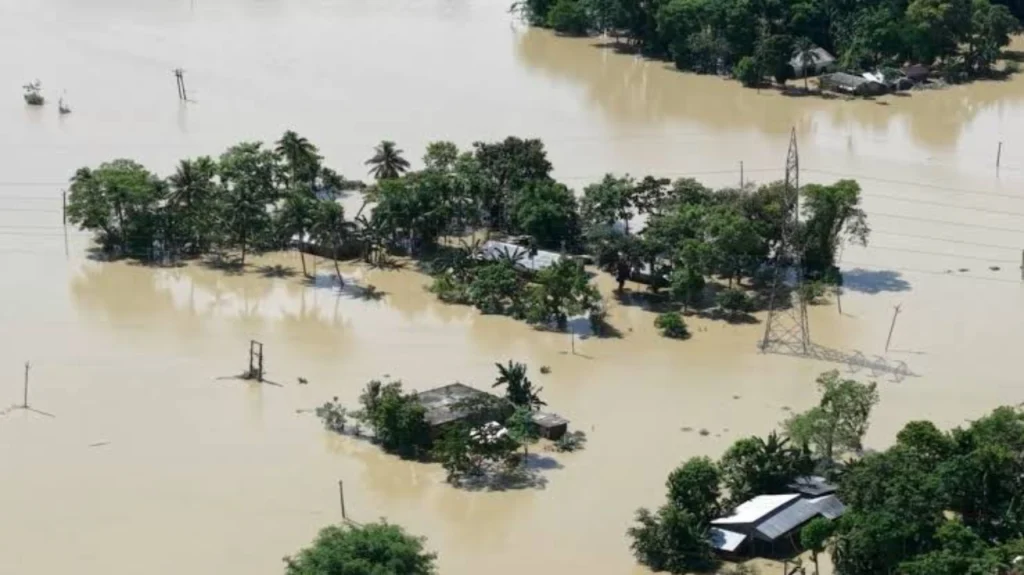
The flood situation in eastern Assam showed slight improvement on 26 July 2026 as the intense rainfall subsided across most parts of the State on Saturday. However, the death toll rose to 66 by Sunday morning, while hundreds of villages remained submerged.
According to the Assam State Disaster Management Authority (ASDMA), nearly seven lakh people across 12 districts have been affected by the current wave of floods. More than 35,000 hectares of agricultural land have been damaged, and over 25,000 people have taken shelter in hundreds of relief camps established by the district administrations.
Sivasagar district remains the worst affected, with around three lakh people impacted, followed by Charaideo and Jorhat. Other flood-hit districts include Golaghat, Dibrugarh, Hojai, Nagaon, Karbi Anglong, Sonitpur, Biswanath, Dhemaji and Kamrup, among others.
Prime Minister Narendra Modi spoke to Chief Minister Himanta Biswa Sarma to review the rescue and relief operations in the flood-affected areas. Expressing deep condolences over the loss of lives and property, the Prime Minister assured the Assam government of all possible support for relief, rehabilitation and rebuilding efforts.
President Draupadi Murmu also expressed her condolences over the devastation in Assam and prayed for the safety of those affected by the calamity. She further wished for the well-being of all personnel involved in rescue, relief and rehabilitation efforts, adding, “The nation stands in solidarity with the people of Assam.”
On the ground, personnel from the State Disaster Response Force (SDRF), National Disaster Response Force (NDRF), the Army, the Air Force, along with local administration officials and volunteers, continue round-the-clock rescue and relief operations.
Assam Governor Lakshman Prasad Acharya recently chaired a high-level review meeting with office-bearers of the Assam unit of the Indian Red Cross Society (IRCS) at Lok Bhavan to assess the ongoing humanitarian response for flood-affected people across the State.
Emphasising the need for a robust and proactive response, Governor Acharya urged all concerned agencies to further streamline their emergency response mechanisms. He also stressed the importance of preventive measures to avert possible outbreaks of water-borne and vector-borne diseases during the post-flood period.
Despite the extensive rescue efforts, thousands of affected families continue to face shortages of essential relief materials, including safe drinking water and healthcare services. Large-scale damage has also been reported to embankments, roads, bridges and other public infrastructure.
Meanwhile, a central team has arrived in Assam to assess the flood situation in the eastern districts. Union Home Minister Amit Shah had informed Chief Minister Sarma about the team’s visit during a recent conversation.
Union Minister Sarbananda Sonowal, while expressing concern over the calamity, said that Assam’s flood situation was discussed in detail during the latest Union Cabinet meeting chaired by Prime Minister Modi. He added that both the Centre and the Assam government are maintaining close coordination to deal with the crisis.
Chief Minister Sarma has directed State ministers Bimal Bora, Sushanta Borgohain, Pijush Hazarika, Keshab Mahanta and Ajanta Neog to oversee relief and rescue efforts in the affected areas.
Initially, it was believed that a cloudburst in the Naga Hills between 18 and 20 July had triggered the floods in Assam. However, Sarma later clarified that the India Meteorological Department had not confirmed the occurrence of any cloudburst in either Nagaland or Assam during that period.
He nevertheless stated that Mon, Mokokchung and Wokha districts of Nagaland, along with adjoining districts of Assam, had received unprecedented rainfall, causing rivers to swell and inundate downstream villages.