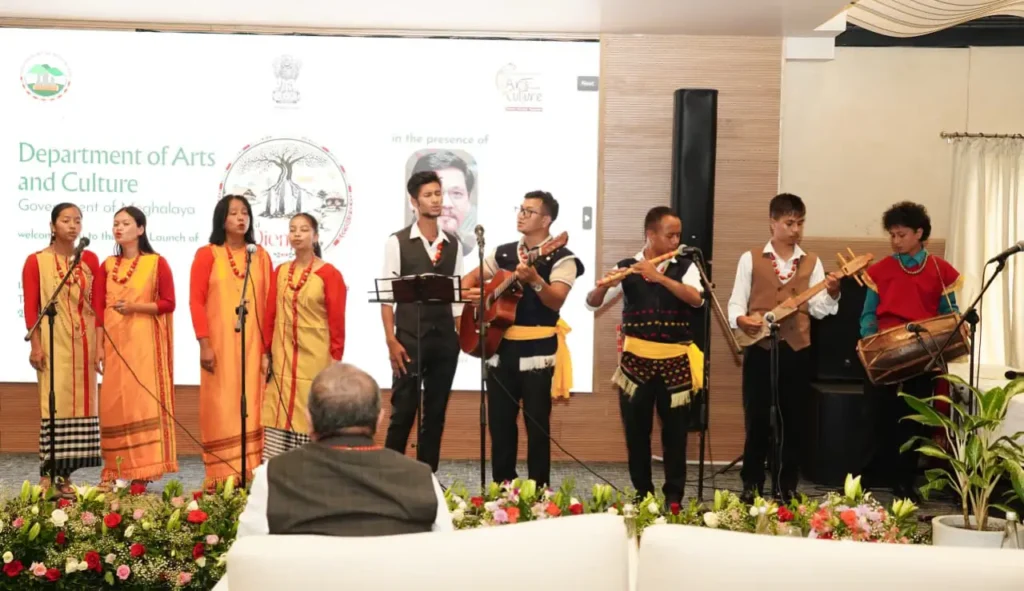
In a landmark step towards exploring the ancient historical lineage of Meghalaya’s indigenous populations, Chief Minister Conrad K Sangma unveiled ‘Ki Dienjat’, a state-backed research initiative to examine the socio-cultural ties between the Khasi-Jaintia tribes and Southeast Asia.
The launch ceremony was attended by Arts and Culture Minister Sanbor Shullai, Justice Hamarsan Singh Thangkhiew, Principal Secretary of Arts and Culture, members of the research delegation and senior departmental officials.
The project is intended to deepen understanding of ancestral history, which the Chief Minister said remains important for understanding contemporary identity and shaping the future.
Indigenous oral traditions and early colonial documentation have long contributed to the view among local historians that the Khasi and Jaintia people originated from territories encompassing present-day Cambodia and Laos. However, rigorous contemporary validation has remained limited.
Earlier academic efforts often faced difficulties because of inadequate international fieldwork funding, complex logistical and political hurdles, limited cross-border academic partnerships and insufficient institutional support.
To address these gaps, the state government has established a specialised interdisciplinary study group under the Department of Arts and Culture to undertake a systematic exploration of these ancestral pathways.
As part of the initiative, Sangma also launched the official Ki Dienjat e-Portal, a centralised digital repository for research data management, information access and multi-institutional collaboration.
The portal is expected to modernise the research process by reducing administrative costs and paper-based work, while also improving transparency and enabling real-time tracking. It will serve as a platform for scholars, institutions and indigenous communities to share information and contribute to collective understanding of the region’s heritage.
Sangma said the broader idea of researching tribal origins was initially envisioned by the late P A Sangma, who had strongly advocated scholarly research into the roots of the Garo people.
In recognition of his legacy, a parallel research project focusing on the Garo Hills is scheduled to be officially launched on September 1, 2026, coinciding with the birth anniversary of the former Lok Sabha Speaker.
The umbrella ‘Tracing the Roots’ initiative is a multidisciplinary venture combining oral histories, indigenous knowledge, linguistic profiling, historical analysis, archaeology and empirical scientific methods.
A multidisciplinary contingent of 75 scholars will undertake field research across Vietnam, Cambodia and Tibet to examine the historical migration trajectories of the Khasi, Jaintia and Garo communities.
The project is expected to produce an evidence-based historical record supported by digital archives, peer-reviewed publications and educational curricula.
The Chief Minister also cautioned that investigations into deep history could produce unexpected findings and therefore need to be approached with sensitivity to cultural concerns.
The project will seek greater participation from young researchers, while cooperation among local communities and national and international academic institutions will be encouraged.
At the launch, Sangma formally released the official project document and remotely inaugurated the newly designated Ki Dienjat Research Room at the Williamson Sangma State Museum in Shillong.
The initiative is being described as the first of its kind since Meghalaya was formed 54 years ago and is aimed at addressing longstanding questions surrounding origin, legacy and identity.
The historical connections between India and Southeast Asia, particularly the migration history of the Khasi and Jaintia people, have long attracted scholarly interest.
Earlier perspectives relied heavily on accounts by British administrators and missionaries. Modern linguistic studies, however, have identified clear links between the Khasi language and the Mon-Khmer language group.
Similarities in customs, lifestyle and physical traits have also been noted with Munda tribes, while oral traditions such as the story of the Seven Huts and Seven Horts continue to preserve cultural beliefs about the origins of the people.
To address existing gaps in historical knowledge, the government’s study team will undertake field research and work with local communities in places such as Cambodia, while collaborating with academic institutions around the world.
The broader objective is to preserve indigenous knowledge systems, document linguistic nuances and develop a scientific understanding of tribal roots that can contribute to future policy and discussions around social identity.
The initiative also builds on previous cultural-identity measures undertaken by the MDA Government. These include the creation of the official state logo depicting Meghalaya’s three hills, monoliths and Garo drum, the introduction of the state anthem and expansion of the Chief Minister Research Grant, which provides ₹3 lakh per scholar.
The government has also invested substantially in heritage infrastructure, including the ₹7-crore development of the Smit sacrificial ritual site.
With more than ₹9 crore approved for the Khasi and Jaintia study and a matching amount allocated for the Garo Hills research, the two projects together involve an investment of approximately ₹20 crore over 18 months.
The initiative is intended to go beyond academic publications. Its findings could support cultural exchanges, artistic and cinematic projects, museum collections and cultural tourism.
One such proposed initiative is the planned 90-acre traditional tribal village at Rongjeng for the Me’gong Festival.
Genetic research will also form part of the study. Specialists have presented DNA mapping indicating distinct genetic markers in up to 76 per cent of the local population compared with other regional groups.
These findings will be examined alongside folklore, music and material culture to develop a more comprehensive historical narrative.
Supported by digital portals and social media integration, the government also hopes to involve young people directly in the initiative and strengthen their understanding and appreciation of Meghalaya’s heritage.