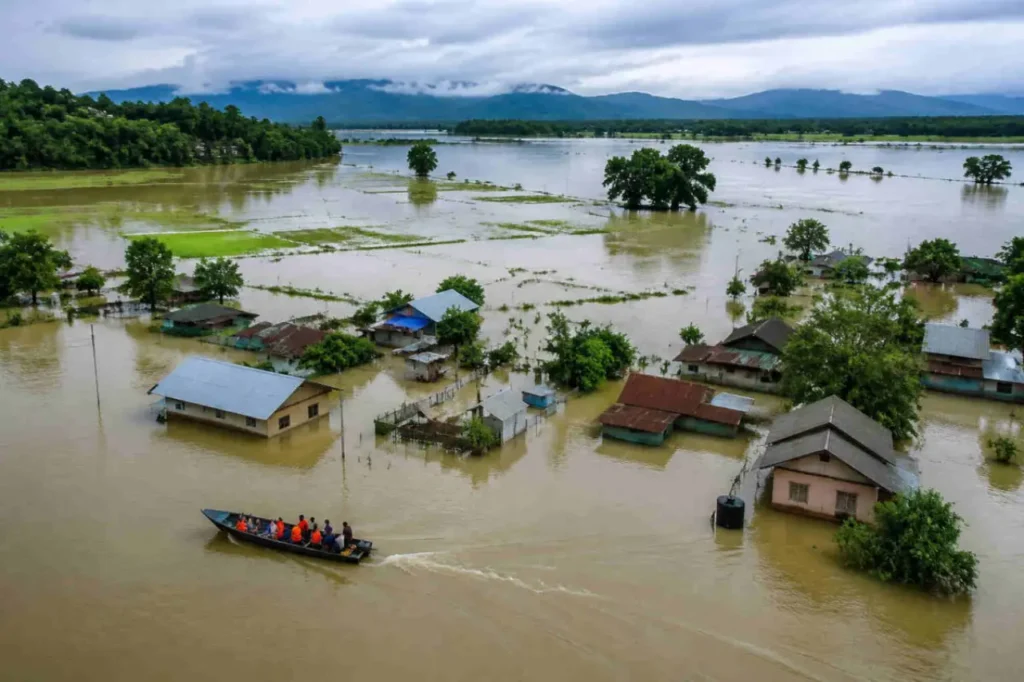
A sudden and powerful flash flood surged into the Bhote Koshi (Bhotekoshi) River from the Tibetan side of the Nepal-China border early Wednesday morning, August 26, 2026. The torrent devastated border settlements in Rasuwa district, particularly Timure (Timburei) and Syabrubesi (Syapru Besi), before racing downstream into the Trishuli River system.
The flood entered Nepal around 9 a.m. local time. Local rainfall in Rasuwa was light and insufficient to explain the surge, according to Nepal’s Department of Hydrology and Meteorology. Officials are investigating a glacial lake outburst flood (GLOF) in Tibet as the likely cause. Authorities are examining satellite imagery and coordinating with Chinese counterparts. Minister for Science, Technology and Innovation Mahabir Pun confirmed that the flood resulted from the bursting of a glacial lake in Tibet.
A similar event on the same river in 2025, triggered by the drainage of a supraglacial lake, killed nine people, left 24 missing, and destroyed the Friendship Bridge linking Nepal and China. That earlier flood disrupted trade for months.
The speed and volume of the water amplified the destruction. In Rasuwa, the Timure market area, Rasuwagadhi customs facilities, and surrounding settlements suffered severe damage. Vehicles, goods, and structures were swept away, and a recently constructed bridge was destroyed. Nine Armed Police Force personnel stationed at a Timure border outpost were reported missing. At least seven injured people were rescued by military helicopter and taken for treatment.
Downstream in Nuwakot, around 60 houses near Trishuli Bazaar were swept away, along with two concrete bridges over the Trishuli River. The Trishuli and Devighat hydropower projects sustained damage, as did parts of a solar power plant. Preliminary assessments indicated roughly 200 megawatts of hydropower capacity completely damaged, with multiple projects affected along the corridor.
Connectivity has been severely disrupted. Major bridges in the flood-hit region, including around Trishuli Bazaar and areas extending toward Dhading, were ravaged. This raises concerns about access and mobility in the coming days and months. Authorities issued high-alert warnings for riverside communities in Rasuwa, Nuwakot, Dhading, Gorkha, and Chitwan. High waters were projected to reach the Marshyangdi confluence at Mugling. Residents were urged to move to higher ground immediately, and the Prithvi Highway and other riverside corridors faced temporary restrictions.
In Nuwakot, early warnings and evacuations appear to have limited human casualties so far, though detailed damage assessments continue. Prime Minister Balendra Shah mobilized the Nepali Army, Armed Police Force, Nepal Police, and the National Disaster Risk Reduction and Management Authority. Helicopters—both military and private—were deployed for search, rescue, and relief, with medical teams and additional resources sent to the area. The government activated emergency mechanisms and arranged necessary budgets for disaster response.
The devastation has been vividly captured in videos shared on social media, particularly on X, as the flood swept through Rasuwa. People can be seen running for their lives as a massive wall of water tears through homes, bridges, roads and buildings. The footage captures the panic and helplessness of people watching familiar surroundings being destroyed within moments, offering a stark human glimpse of a disaster that struck with little warning.
A horrific scene of severe flooding at the Rasuwagadhi border point on the Nepal-Tibet border.
The strong currents wreaked havoc across the area, leaving 400 pilgrims and 105 Indian tourists also missing in the Nepal floods.#NepalFloods #Nepal #Rasuwa #FlashFlood #Floods pic.twitter.com/dwAX12Gj7l— Ravi Pandey🇮🇳 (@ravipandey2643) August 26, 2026
These visuals from the floods in Rasuwa, Nepal are absolutely horrific. The scale of the destruction looks unreal, almost like a scene from a disaster movie.The entire Himalayan belt needs to seriously work on better early warning systems for such flash floods. Prayers for… pic.twitter.com/7iiupXXIzT
— Nikhil saini (@iNikhilsaini) August 26, 2026
Nepal stands on the frontline of climate change impacts in the Himalayas. The country’s major river systems, many originating in Tibet and fed by glacial lakes, have repeatedly produced destructive floods. These events disrupt livelihoods, damage critical infrastructure, and impose heavy economic and social costs. Hydropower, a cornerstone of Nepal’s development aspirations, is particularly exposed.
The rapid onset of this flood—captured in video reports from Rasuwa showing urgency and helplessness—underscores the challenge of translating geographic vulnerability into effective preparedness. Questions remain about early warning arrangements for upstream events originating in Tibet. Once the flood entered Nepal, the Flood Forecasting Division and local administrations issued alerts, used SMS and phone notifications, and coordinated evacuations that appear to have reduced downstream losses in some areas.
Cross-border monitoring of glacial lakes and real-time data sharing remain areas where stronger mechanisms could provide critical lead time. Nepal’s rivers and valleys are not only economic arteries but also deeply intertwined with the country’s social, spiritual, and cultural life. Repeated calamities of this scale compound obstacles to growth, stability, and resilience.
Today, a flash flood has swept through markets, settlements, and hydropower projects along the Bhotekoshi River in Timure and Syabrubesi, Gosainkunda Rural Municipality, Rasuwa District, Bagmati Province, Nepal. pic.twitter.com/DWVsGQpRzV
— Weather Monitor (@WeatherMonitors) August 26, 2026
As search and rescue operations continue and the full extent of casualties and losses becomes clearer, the event serves as a stark reminder of the intensifying risks facing Himalayan communities. Strengthened trans boundary cooperation on glacial monitoring, investment in robust early warning systems, climate-resilient infrastructure, and community preparedness will be essential. Officials continue to urge caution along riverbanks as waters move downstream.