The Assam government’s plan to notify a site-specific eco-sensitive zone (ESZ) around Kaziranga National Park and Tiger Reserve has ignited heated debate across mainstream and social media. The proposal would replace the existing 10 km default buffer with a narrower zone extending just one to three kilometers from the park’s boundary.
The move complies with directives from the Supreme Court of India. Even so, it has drawn protests from opposition parties and wildlife experts since being announced.
Kaziranga, a UNESCO World Heritage Site in eastern Assam, has never had its ESZ formally notified, meaning the default 10 km buffer currently applies. The park is home to over 2,610 greater one-horned rhinoceros — nearly 70% of the species’ global population — along with wetlands, grasslands, and semi-evergreen forests shaped by the annual floodwaters of the Brahmaputra.
The debate intensified after Dispur announced plans to approach the Union government in New Delhi to reduce the Kaziranga ESZ buffer to a minimum of one km. Buffer zones around protected areas typically restrict major construction, urban expansion, and mining activities, since such interventions can worsen human-wildlife conflict.
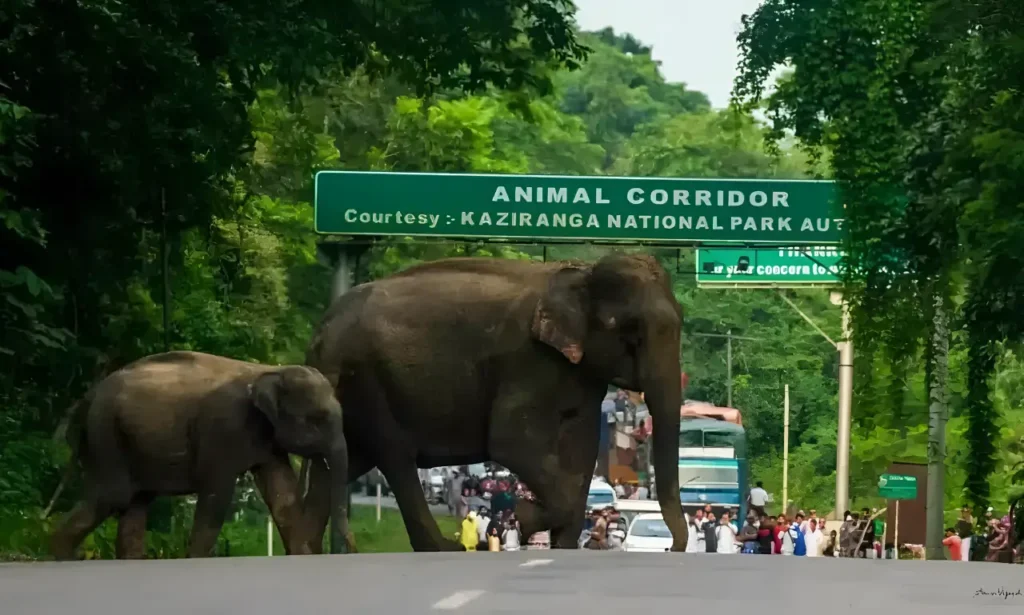
Kaziranga has no fencing or concrete boundary, and wildlife frequently crosses into the buffer zone. During monsoon floods, animals often cross National Highway-715 (formerly NH-37) to reach the Karbi Anglong hills.
Opposition parties and environmental groups have strongly criticized the proposal to shrink the zone below the default 10 km, warning it could undermine wildlife protection efforts. Assam Congress chief Gaurav Gogoi argued that a reduced buffer would deprive wildlife of necessary protection. Leaders from the Communist Party of India also opposed the move and demanded its withdrawal.
Chief Minister Himanta Biswa Sarma, however, has strongly defended the proposal, asserting that it complies with the Supreme Court’s directives. He noted that the apex court’s guidelines specify an ESZ of at least one km, extendable to three km depending on circumstances, and pointed out that no forest reserve anywhere in the world maintains a 10 km surrounding ESZ.
Sarma clarified that an ESZ does not mean a ban on tourism infrastructure, but rather a framework to regulate activities like mining, chemical processing, and other polluting industries that could harm a protected area’s ecological integrity. He reiterated that Kaziranga’s existing 10 km buffer will remain in force until the government formally notifies the new ESZ limit.
BJP state president Dilip Saikia and state minister Pijush Hazarika have echoed this assurance, saying the new ESZ notification will not dilute environmental protection efforts around Kaziranga. Criticizing Congress leaders for opposing the move, they pointed to the loss of over 235 rhinos during the tenure of then state forest minister Rakibul Hussain, and accused the opposition of politicizing the issue for electoral gains.
Many local residents have also voiced support for the site-specific buffer zone. They argue that villages surrounding Kaziranga face significant developmental challenges that limit livelihood opportunities.
Several demonstrations have been organized in support of reducing the ESZ limit, with locals insisting that development and conservation need not be at odds, but can coexist. The largest of these, held at Biswanath Ghat on August 21, drew thousands who argued that conservation measures should not come at the cost of local livelihoods.
Protesters have called for a comprehensive environmental impact assessment before the new ESZ perimeter is implemented. They maintain that surrounding communities — who have long served as key stakeholders in protecting Kaziranga’s wildlife — must be central to any policy decision on the park’s future.