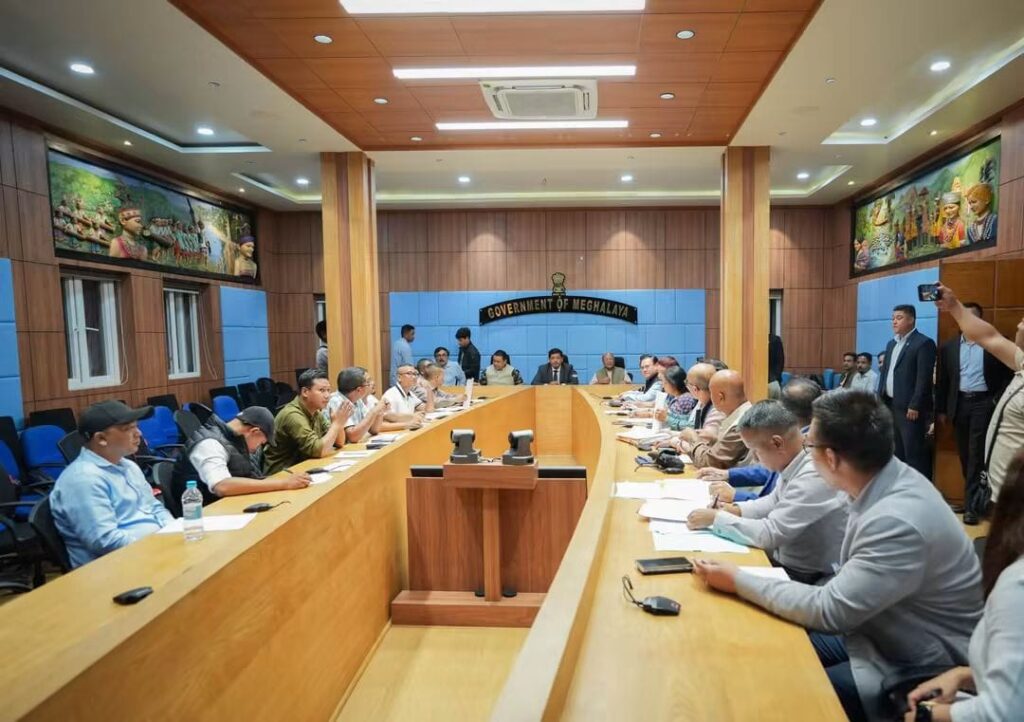
A high-level meeting chaired by Meghalaya Chief Minister Conrad K. Sangma, along with Deputy Chief Ministers Sniawbhalang Dhar and Prestone Tynsong, has resolved key points of contention with the Khasi Students’ Union (KSU).
The talks covered environmental disputes, migrant registration, recruitment transparency, and institutional governance, producing concrete next steps on all fronts.
Addressing controversy over the recent public hearing for the proposed Shree Cement project in East Jaintia Hills, the state government announced an independent Fact-Finding Committee. The panel will be led by a senior government official with no connection to the local district administration.
Neither the District Magistrate nor the Superintendent of Police will be involved. The committee will probe procedural lapses during the hearing, stakeholder participation, and environmental concerns affecting surrounding agricultural land.
Former KSU President Lambokstarwell Marngar said the union had demanded an immediate freeze on project operations. The Chief Minister confirmed that all construction and company activity will remain suspended until the committee submits its final report.
On implementation of the Meghalaya Residents Safety and Security Act (MRSSA), 2016, and its entry-exit facilitation centers, the government laid out clear timelines. At Umling check gate — earlier used as a COVID-19 screening hub and later criticized over food court plans — a 1,000–2,000 sq. ft. facilitation center will be built.
Following a joint inspection by the district administration and KSU representatives, the work is expected to finish in two to three months, with the center operational before Christmas.
For border check gates such as Ratacherra and Atiabari, land acquisition remains a challenge, but officials expect to secure the required land within three to four months.
To track residents across roughly 7,000 villages statewide, the government is also developing a mobile app for automated document scanning and centralized verification.
Under the Meghalaya Identification, Registration, Safety and Security of Migrant Workers Act, 2020, the government approved stronger enforcement rules for non-local workers entering the state. The updated rules link into the Crime and Criminal Tracking Network & Systems (CCTNS), a nationwide criminal database, letting local police and District Superintendents of Police run rapid digital background checks.
Training for inspecting officers is nearly complete, and the stricter verification norms are expected to take full effect within a month.
On the long-pending governance and employment issues at NEIGRIHMS, Chief Minister Sangma confirmed that KSU’s memorandum has been formally forwarded to the central government. The state will help arrange a direct meeting between union leaders and the Union Health Minister in New Delhi, and will provide logistical support for local examination infrastructure.
The government also outlined structural changes to improve fairness in the Meghalaya Public Service Commission (MPSC) and District Selection Committee (DSC) processes. Personal interviews for Group D posts have already been scrapped, and viva-voce tests for non-technical Group C posts will be phased out entirely from January 1, 2027.
Of 23 recommendations made by the 2024 MPSC Reform Committee, 19 have already been implemented — close to 70% alignment with KSU’s demands.
On KSU’s demand to restrict MPSC exam eligibility to state residents only, the government said legal teams are examining ways to make the policy withstand judicial scrutiny, with further talks scheduled under Deputy CM Prestone Tynsong.
Marngar also called on the government to take a firm, unified stand against uranium mining by moving an official resolution in the Meghalaya Legislative Assembly reflecting public sentiment.
On union members detained during past agitations, KSU leadership said its focus remains on resolving substantive public issues through engagement, rather than seeking legal immunity for activists — leaving judicial matters to the state’s discretion while pressing for prompt implementation of the agreed reforms.
Notably, the meeting made no mention of the violence that broke out during a recent KSU rally. Nor was there any reference to the desecration of statues of national icons Netaji Subhas Chandra Bose and Swami Vivekananda, both of which have drawn wide condemnation in the weeks since.
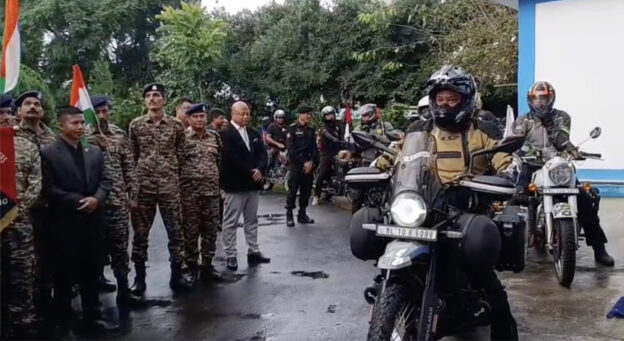
Separately, Meghalaya police arrested a fourth KSU leader in connection with the August 19 black-flag bike rally violence. This comes even as Chief Minister Sangma assured the Assembly and citizens of firm action against those responsible.
Jeremiah Pohthmi, the KSU’s assistant organising secretary, was arrested from Nongmensong locality on Sunday night. East Khasi Hills SP Vivek Syiem said police produced him before the court on Monday and obtained three days of custody.
Investigators have so far identified five masked individuals involved in the attacks, particularly on Assam-registered vehicles. Pohthmi is alleged to be one of them.
Pohthmi’s arrest follows the detention of three senior KSU office-bearers — president Raymond Kharjana, vice-president Pynkmenlang Sanmiet and general secretary Reuben Najiar. All three were held on the night of the violence, under various sections of the Bharatiya Nyaya Sanhita and the Meghalaya Maintenance of Public Order Act.
Making a suo-motu statement on the opening day of the Autumn Session on Monday, Sangma said the government had taken strong note of the “unfortunate incident” and would leave no stone unturned to bring the miscreants to justice.
The rally had been organised with the approval of the East Khasi Hills Deputy Commissioner and an undertaking from the KSU that it would remain peaceful. Yet some participants allegedly torched two vehicles and damaged 31 vehicles in all — including eight bearing Assam registration numbers — and attacked innocent bystanders.