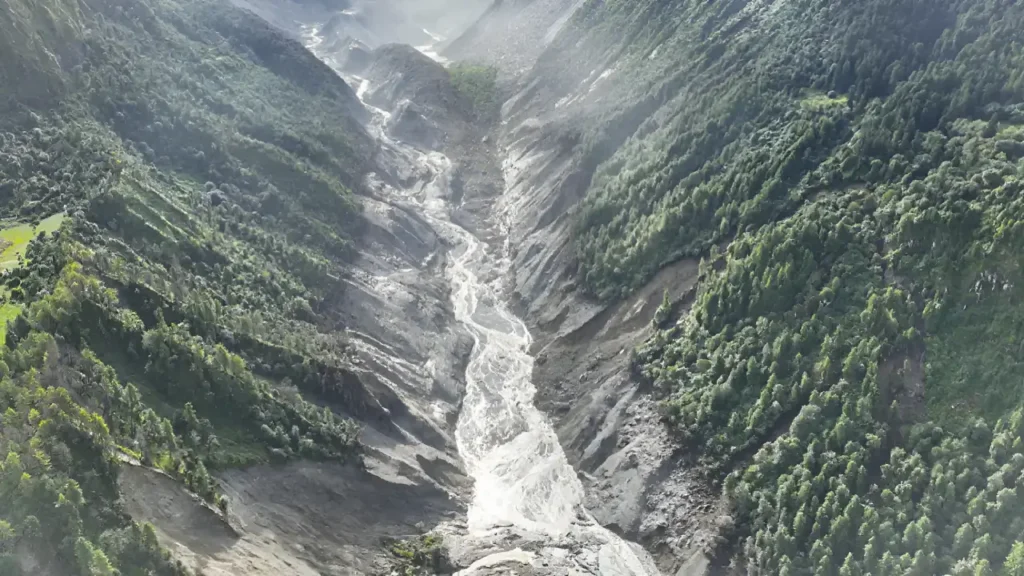
At 8:40 on Wednesday morning, a wall of water, ice and debris that had built up somewhere in the mountains of Tibet crossed into Nepal at Rasuwagadhi. No alarm preceded it. No message crossed the border to say it was coming. Nepali authorities on the ground had no idea the Bhotekoshi River was about to become a lethal weapon.
Sixteen minutes later, at 8:56 am, word finally reached the District Administration Office in Rasuwa, and from there, the National Disaster Risk Reduction and Management Authority (NDRRMA) and the Department of Hydrology and Meteorology. By then the flood, moving at a speed that stunned even hydrologists, had already covered the roughly 14 kilometres to Syaphrubesi in under ten minutes, according to the department’s own account, and was tearing into markets, hydropower substations, hotels and homes, sweeping away whatever stood in its way.
The first SMS warnings to riverbank communities went out just before 9 am. For the upper reaches of Rasuwa, they came too late to matter. It would take until 1:35 pm — nearly five hours after the flood entered Nepal — for the Department of Hydrology and Meteorology to post publicly on its “Nepal Flood Information” Facebook page that, according to information received from China, the lake blocking the river upstream had still not fully drained and the danger along the Bhotekoshi and Trishuli was far from over.
By Friday, the toll was already staggering. By Friday morning (10 am), as many as 469 bodies had been recovered — 123 in Rasuwa, 37 in Nuwakot, 33 in Dhading, 44 in Gorkha, 28 in Tanahun, 171 in Chitwan, 110 in Nawalparasi East and 27 in Nawalparasi West, according to Nepal Police. Separately, the NDRRMA put the number of people out of contact at 2,381 including 28 Nepal Police personnel, 44 Nepal Army soldiers, 15 staff of the Rasuwa customs office and 13 Armed Police personnel, 579 tourists and the general public. Dozens of the injured are being treated in Kathmandu’s hospitals. Among the missing were foreign pilgrims en route to Gosaikunda and to Kailash Mansarovar in Tibet, a reminder that this was never only a Nepali tragedy, or only a bilateral one.
What makes the sixteen minutes so damning is the fact that Nepal had been here before. A flood originating on the Tibetan side of this same border devastated the Rasuwagadhi area last year, destroying the Nepal-China Friendship Bridge and killing and disappearing dozens on both sides. In its aftermath, Nepal and China reached an understanding to share cross-border information on floods and landslides in real time, and to flag the risk of glacial lake outburst floods (GLOFs) before they became disasters. It was, on paper, exactly the right lesson learned.
But an understanding is not a system, and a verbal commitment between officials is not a warning that reaches a hydrologist’s desk at the moment it is needed. That agreement was never converted into a signed, binding mechanism. Nepal’s foreign minister raised it again during a visit to China in May. Still nothing was signed. Fourteen months after the first flood, when the second one came, Nepal’s Department of Hydrology and Meteorology had no advance word from across the border, only the flood itself, arriving unannounced at Rasuwagadhi.
“If we had known the flood was on its way from the Tibetan side, we could have reduced the human toll,” says environmental scientist and international researcher at the International Water Management Institute, Dr Santosh Nepal, describing how the absence of any cross-border information exchange delayed Nepal’s own warning system by precious minutes that, on a river moving this fast, were the only minutes that mattered. Four hydrological monitoring stations along the flood’s path – at Bhotekoshi and Syaphrubesi in Rasuwa, Betrawati in Nuwakot, and Malekhu in Dhading – were themselves swept away by the water they were meant to be measuring.
Why this cannot stay a two-country conversation
It is tempting, and not entirely wrong, to read this as a failure of Nepal-China diplomacy: an agreement discussed, delayed, and left unsigned while the mountains kept moving. But that framing is too narrow, and Nepal’s own political and royal establishment, not always aligned on much else, seem to have arrived at the same conclusion within hours of the disaster.
Former King Gyanendra Shah, in his condolence message issued Wednesday through the Nirmal Niwas Press Secretariat, went beyond the customary words of grief, suggesting that natural disasters in neighbouring, border-sharing countries inevitably affect one another, necessitating a tri-national mechanism in this case in particular. The former monarch meant that the three countries – Nepal, China and India – should stop treating this as a matter of separate national efforts and instead work through a joint trilateral mechanism to minimise such damage.
Last year in Nepal’s Parliament, Nepali Congress leader and MP Bishwa Prakash Sharma made a structurally identical argument: that Himalayan glacial lakes in dangerous condition, if they burst, can send their consequences as far as India, and that a district-level information channel between Nepal and China, however well-intentioned, “is good, but it is not enough.”
Environmental scientist Nepal echoes the same concern. “Although the destructive effects of such natural calamities have rarely reached India so far, they will in the future, due to climate change which is bound to cause cascading disasters with one disaster amplifying the other,” he says, “India is also a downstream stakeholder. So it must be included in the tri-national mechanism which would make real time data sharing among the three countries possible.”
The reasoning is simple, and it is worth being blunt about it: this river system does not respect borders, and neither should the mechanism meant to protect the people living along it. The International Centre for Integrated Mountain Development has mapped 47 potentially dangerous glacial lakes across the region — 25 in Tibet, 21 in Nepal, and one in India’s Sikkim, where an almost identical disaster killed at least 60 people in 2023. India’s own early-warning pilot at Lhonak Lake was delayed by a year and began mere weeks before that flood struck. Every one of these countries has now separately learned the same lesson — too late, and alone. A trilateral mechanism would mean they stop learning it in isolation and start learning it together, before the next disaster rather than after it.
It is worth being precise about what Nepal’s political class actually wants, because the issue was raised this week in an all-party meeting. Eight political parties, at the meeting convened by Rastriya Swatantra Party chair Rabi Lamichhane and signed by Nepali Congress President Gagan Thapa among others, called specifically for high-level diplomatic engagement, involving both India and China and to build a joint scientific mechanism for cross-border risk assessment and a stronger, real-time early warning system. The RPP’s Rajendra Lingden and the UML’s Shankar Pokharel also raised the issue of a tri-lateral mechanism involving Nepal, India and China, although other leaders stressed on a bilateral mechanism between Nepal and China.
Both readings point to the same underlying truth: whatever institutional architecture exists today is inadequate, whether measured against two countries or three. But the trilateral framing is the more complete one, because it acknowledges what the bilateral approach cannot: that the river’s threat does not stop at the Nepal-China border, and that India, with its own dangerous lakes, its own citizens among the missing this week, and its own delayed early-warning systems, has as much stake in a shared alarm as Nepal does.
“We do receive information from China from time to time but this time I think they themselves were surprised by the disaster. For example a while ago today itself, the Rasuwa District Administration Office received information from the Chinese side that the lake had not completely drained on Wednesday burst again, raising flood risks once again. Since the information was shared on time, many lives could be saved,” observes Sudeep Thakuri, Assistant Professor at the Department of Environmental Science at Tribhuvan University.
Thakuri says that although the issue of regional cooperation in this sector has long been talked about, it has not materialized so far. “Nepal should make diplomatic efforts at the political level and the three countries should join hands to face similar disasters in the future. Rather than a bilateral mechanism, it would be better if we had a multilateral mechanism in place,” notes Thakuri.
What “too late” actually costs
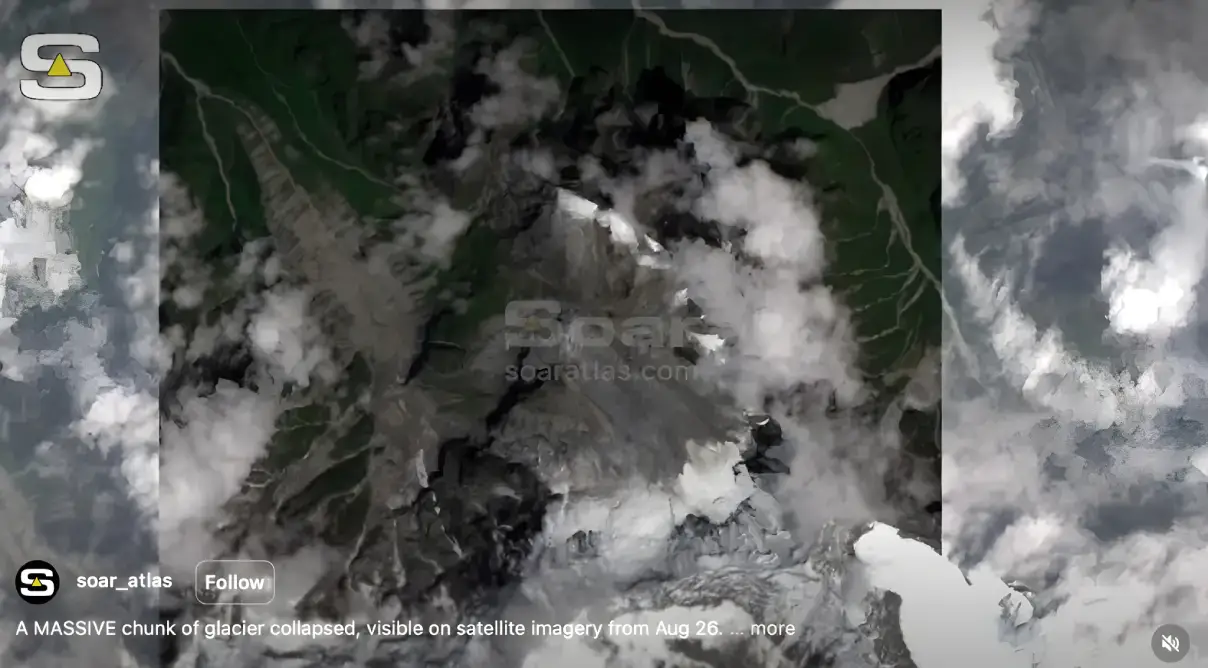
There is also a harder truth buried in the reporting from Wednesday, one that a trilateral mechanism alone will not fully solve: even where China and Nepal do have a functioning warning system — and one exists, and has worked before — it is built to watch the border, not the mountainsides on either side of it. This flood, by several early accounts, may have originated from an ice-rock avalanche rather than a classic glacial lake outburst, the kind of trigger that can escape even a well-designed cross-border sensor network. A signed agreement is not, by itself, a sensor on every slope.
But that is an argument for building a better system, not for abandoning the effort to build one. The sixteen minutes between the flood crossing into Nepal and the first word reaching Kathmandu were not lost to bad luck. They were lost to the absence of infrastructure and diplomacy that should have existed after the first flood, and certainly should exist now, after the second. Four monitoring stations gone. Nearly 500 bodies recovered by Friday noon, with over 2,000 people unaccounted for. Tourists from a dozen countries missing on trails and pilgrimage routes that were never warned in time.
Nepal cannot move its geography. It will always sit downstream of Tibet’s glaciers, and it will always share its own rivers with India further south. What it can do — what a former king, a former MP, other politicians and the country’s own hydrologists are now saying in near-identical language — is insist that the next flood, wherever it originates, does not again have to travel sixteen unannounced minutes before anyone downstream knows it is coming. A trilateral mechanism will not stop the glaciers from breaking. It can stop the silence that follows when they do.