When the Bhotekoshi River tore through Rasuwa and Nuwakot on August 26 morning, it did not just destroy bridges, roads and homes. It sealed men and women alive inside the very tunnels that were supposed to be generating the country’s electricity.
Ten days later, on September 4, two of them — a mechanical foreman from Saptari and a mechanical supervisor from Kathmandu — were still being pulled out alive, blinking into the daylight after an ordeal that even the soldiers who found them are struggling to describe as anything other than miraculous.
The flood was one of the most destructive in Nepal’s recent memory, a glacial-lake-triggered surge that thundered down from the high Himalaya and slammed into a river corridor dense with hydropower construction.
Upper Trishuli-1, Upper Trishuli-3A, Upper Trishuli-3B, Rasuwagadhi, Mailung, Langtang Khola, Devighat, the Trishuli plant and the Nuwakot Saurya solar-hydro complex all sat in its path.
Workers on shift, engineers doing rounds, and labourers housed near the intake sites had nowhere to run when the water and debris arrived. Many were swept away instantly. Others managed to scramble into the tunnels themselves, only for the tunnels to become traps — flooded, blocked by silt and rock, and sealed at the mouth by collapsed headworks.
In the initial hours and days after the flood, the priority was simple: get out everyone who could still be reached. The Nepali Army took command of a joint operation that eventually pulled in the Nepal Police, the Armed Police Force, and — as the scale of the disaster became clear — foreign specialists as well.
The early numbers were staggering. Within the first seventy-two hours, close to 280 people were rescued directly from hydropower project areas, according to figures later compiled and published by Gorkhapatra, the government-run vernacular daily.
Upper Trishuli-3A alone accounted for the largest share of that number — 221 people brought out safely — while Upper Trishuli-1 yielded 33, Rasuwagadhi two, Upper Trishuli-3B two, Mailung nine, Nuwakot Saurya four, the Trishuli plant three, and Devighat five.
These were the rescues carried out in the immediate chaos, often by helicopter, as the Army raced to reach isolated workers before the rivers rose again or the weakened structures gave way entirely.
By August 29, that early tally had already been overtaken. Local news portals reported that Army helicopters had lifted 208 people, including 38 Chinese and five Indian nationals, out of the Trishuli-3 tunnel area in a single day’s operation.
It was a reminder that Nepal’s hydropower sites, built with international financing and expertise, had also trapped a genuinely international workforce.
The same day, some media reports put the cumulative rescue count at 361, with fresh names added from Langtang Khola (18 people) and Upper Trishuli-3B (91 people).
Independent Power Producers’ Association Nepal (IPPAN), tracking the toll on its member projects, confirmed that 898 people linked to hydropower sites remained unaccounted for even as the rescues mounted — a grim counterweight to every survivor pulled free.
Once the people near the surface — those in camps, guardhouses and accessible stretches of tunnel — had been evacuated, the operation entered a far harder phase.
What remained were workers believed to be trapped deep inside tunnels that were flooded, choked with mud, or physically blocked by collapsed rock and twisted machinery. This is where the story shifts from evacuation to true rescue — from lifting people to safety to digging, blasting and pumping a path to reach them.
At Upper Trishuli-3A, rescue teams located what they called the tunnel’s “crown head” — an access point above the main flooded passage — by August 30, and began pumping oxygen inside through a compressor, working on the assumption that anyone alive within would need it.
According to sources at the Nepali Army’s Directorate of Public Relations, a joint Army-led team, working under military command with foreign technical experts, had by August 31 spent three continuous days focused specifically on the Trishuli-3B tunnel.
Meanwhile, a body was recovered from roughly 300 metres inside the Upper Trishuli-1 tunnel — grim evidence of how far into these structures the search parties were being forced to go.
The technical difficulty of that search cannot be overstated. Tunnels built for hydropower intakes are narrow, dark, and — after a flood of this scale — filled with a mixture of water, silt and debris that can be metres deep.
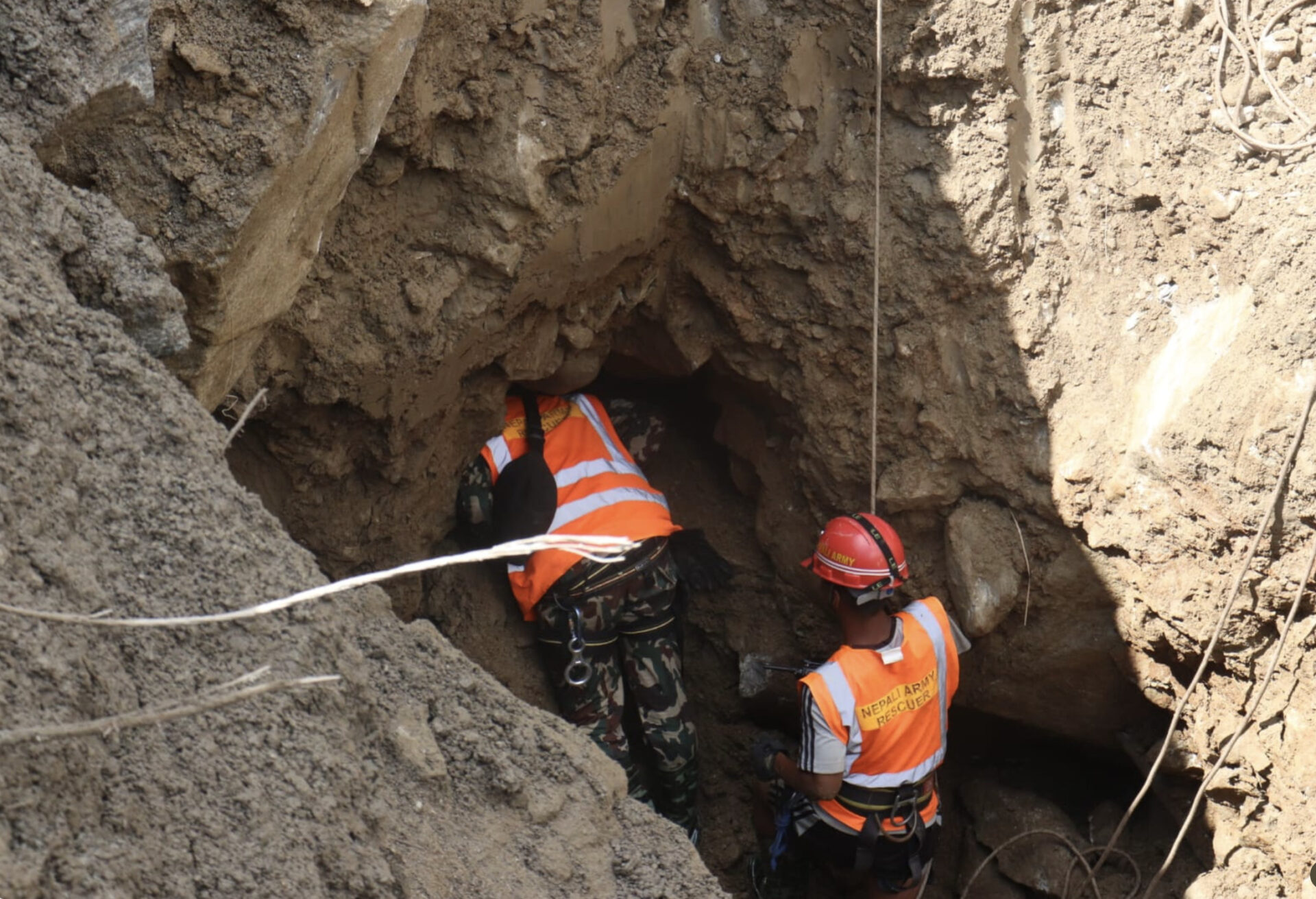
Rescuers had to conduct reconnaissance sweeps, use blasting to open collapsed sections, drill new access holes where the original tunnel mouth was unusable, and physically clear sludge by hand and machine before they could even confirm whether anyone was alive inside, let alone bring them out.
By early September, the Ministry of Energy, Water Resources and Irrigation confirmed that a combined team of Nepali Army personnel, Indian Army soldiers and South Korean specialists — later joined by Chinese experts — was working around the clock inside the Trishuli-3A tunnel.
They alternated between reconnaissance, blasting, drilling and silt removal, in an effort measured in metres per day rather than hours.
Nepal did not attempt this alone. The government brought in expert teams from China specifically to assist with the tunnel search, the Energy Ministry confirmed, acknowledging that the scale and technical complexity of the operation exceeded what domestic capacity could handle on its own.
It was an unusual moment of multinational cooperation forged entirely out of necessity: soldiers, engineers and disaster-management officials from four countries working side by side inside a collapsed Himalayan tunnel, united by nothing more than the hope that someone might still be breathing on the other side of the rubble.
By the time September 4 arrived, hope for anyone still trapped inside Trishuli-3A had begun to fade. It had been ten days.
Ten days without confirmed contact, ten days of blasting and drilling with no answer from inside, ten days in which the official death toll climbed past 900 and the missing count — staggeringly — still stood above four thousand.
Then, early Friday morning (September 4), the rescue team picked up something they had almost stopped hoping for: the sound of a human voice from deep inside the tunnel.
Member of Parliament and engineer Shreeram Neupane, who had been closely tracking the technical side of the operation, told reporters that the joint Nepali Army-led team had detected signs of life and moved immediately to extract the source.
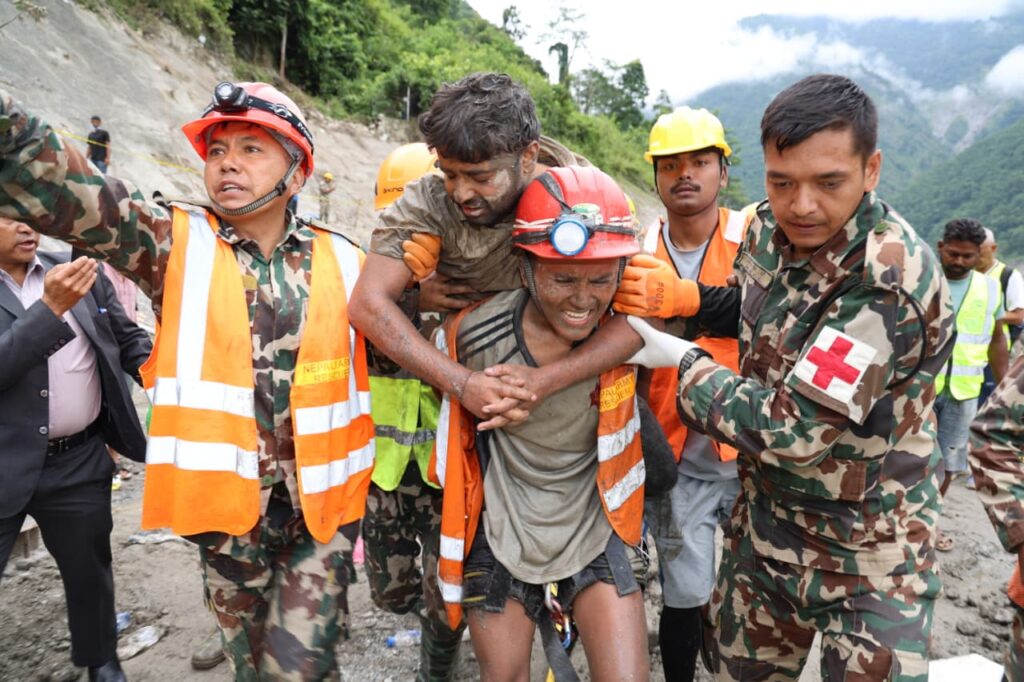
The first man out was Sanjay Sah, a mechanical foreman from Tilathi in Saptari district, pulled from the tunnel alive as the news broke in real time across Nepali newsrooms.
Word had barely gone out when a second announcement followed: a colleague of his, Kabir Maharjan, a mechanical supervisor from Kathmandu, had also been found alive and was being brought out through the same painstaking process. They had been trapped 170 meters inside the tunnel.
Ten days trapped inside a collapsed, flooded hydropower tunnel, with no light, no confirmed food or water supply reaching them, and no way of knowing whether anyone outside even knew they were alive — and both men walked away from it breathing.
Rescue officials and disaster-management authorities were careful, even in their relief, not to overstate the men’s condition. Maharjan, in particular, was reported to be in a serious state; he was flown immediately to Chhauni in Kathmandu and admitted to the intensive care unit of Birendra Military Hospital for urgent treatment.
Sah’s condition, by contrast, was described as comparatively stable.
The National Disaster Risk Reduction and Management Authority (NDRRMA) confirmed the rescue in its regular briefing, with spokesperson Shanti Mahat crediting the extraction to the sustained joint operation between the Nepali Army, Nepal Police and Armed Police Force.
For the men and women who had spent ten days digging, blasting and pumping air into a tunnel with no guarantee that anyone remained alive inside it, the moment Sah and Maharjan emerged was the answer to a question they had refused to stop asking.
Even as Kathmandu absorbed the news of the two survivors, officials were careful to stress that the operation inside Trishuli-3A tunnel was continuing.
Engineers and search personnel said there were indications that other people might still be inside, and the joint Nepal-India-Korea-China team resumed its reconnaissance, blasting and mud-clearing work within hours of Sah and Maharjan’s rescue.
Nationwide, the NDRRMA’s broader figures put the scale of what the rescuers have been up against into perspective: more than 11,000 people rescued across all flood-affected areas by air and by land, over 7,570 homes fully destroyed, more than 32,000 people affected, and 783 megawatts of power generation capacity knocked offline across thirteen hydropower projects in the disaster zone.
Nearly 1,000 bodies had been recovered and identified through DNA sampling by 4 September, with thousands still listed as missing.
Against that scale of loss, the rescue of Sanjay Sah and Kabir Maharjan stands out precisely because it defied the arithmetic of disaster. It was not luck alone that brought them out alive after ten days in the dark — it was the refusal of soldiers, police officers, and foreign specialists to stop digging toward a sound they were not even certain they had heard.
“We had lost all hopes. But today when we got the news of his rescue, our entire family cried. These were the tears of extreme happiness,” Maharjan’s wife told reporters on the premises of the army hospital at Kathmandu’s Chhauni.
As the search inside Trishuli-3A continues, that same determination is, for now, the only thing standing between the tunnel’s remaining silence and the possibility of one more miracle.
But miracles, in this case, had required something more tangible: persistence, engineering, courage, organisation and the willingness of hundreds of rescuers to repeatedly enter places from which they could not be certain they would return safely.