The mist that rolls down the Trishuli valley each morning no longer looks like weather to the flood victims camped in Nuwakot’s holding centres. It looks like a held breath. Thirteen days after the Bhotekoshi River tore through Rasuwa and cascaded downstream into Nuwakot, Dhading, Gorkha, Tanahun, Chitwan and both Nawalparasi districts, the search for the missing has not stopped. But for thousands of survivors, the disaster has entered a slower, grimmer phase: the long wait to find out who is coming home, and who is not.
On August 26, an ice-and-rock avalanche tore loose above the Lhende River near the China-Nepal border, roughly 20 kilometres upstream of Rasuwagadhi. What followed was catastrophic. Villages, hydropower tunnels, bridges and stretches of highway were swept away within hours.
Nearly two weeks later, the numbers coming out of the National Disaster Risk Reduction and Management Authority (NDRRMA) still read like a wound that refuses to close: 1,355 bodies recovered, only 98 of them formally identified and returned to grieving families; nearly 4,996 people still unaccounted for; 13,396 rescued alive; 6,672 treated for injuries. Of the dead, Rasuwa and Nuwakot together account for 366 confirmed bodies, while the swollen Trishuli carried casualties as far as Chitwan, where 363 bodies have been recovered — a grim reminder that a flood does not respect district boundaries.
Nearly every survivor has walked away with nothing at all. Hundreds who once counted themselves comfortable — landowners, shopkeepers, traders, farmers with herds and vehicles to their name — have been reduced overnight to people with only the clothes they fled in, the flood having taken their houses, their farmland, their livestock and their vehicles, and in the cruelest cases, the very people they loved.
The search that won’t end
Thirteen days after a wall of water tore through Nepal’s northern river valleys, the disaster has entered a different, more difficult phase. The helicopters still fly. Soldiers still crawl into tunnels. Police teams still search riverbanks and debris fields. Families still wait for names that may never appear on a list.
Fourteen days in, search and rescue is no longer a race against the clock in the way it was in the first 72 hours — it has become something closer to an act of endurance. “Nepal Army units, backed by international rescue teams from India, South Korea, and China are still working inside the collapsed and flooded tunnels of hydropower projects in Rasuwa and Nuwakot, where the missing include workers unaccounted for since the first hours of the disaster,” a colonel at the army barracks at Trishuli, told The Border Lens on Monday.
He described conditions inside those tunnels as extremely hazardous — some passages still filled with silt and debris, others structurally unstable — meaning that even now, progress is measured in metres, not kilometres.
Helicopters remain the backbone of the operation. With Rasuwa’s main highways obstructed and 41 motorable bridges entirely washed away — with four more damaged — much of the district is still reachable only by air.
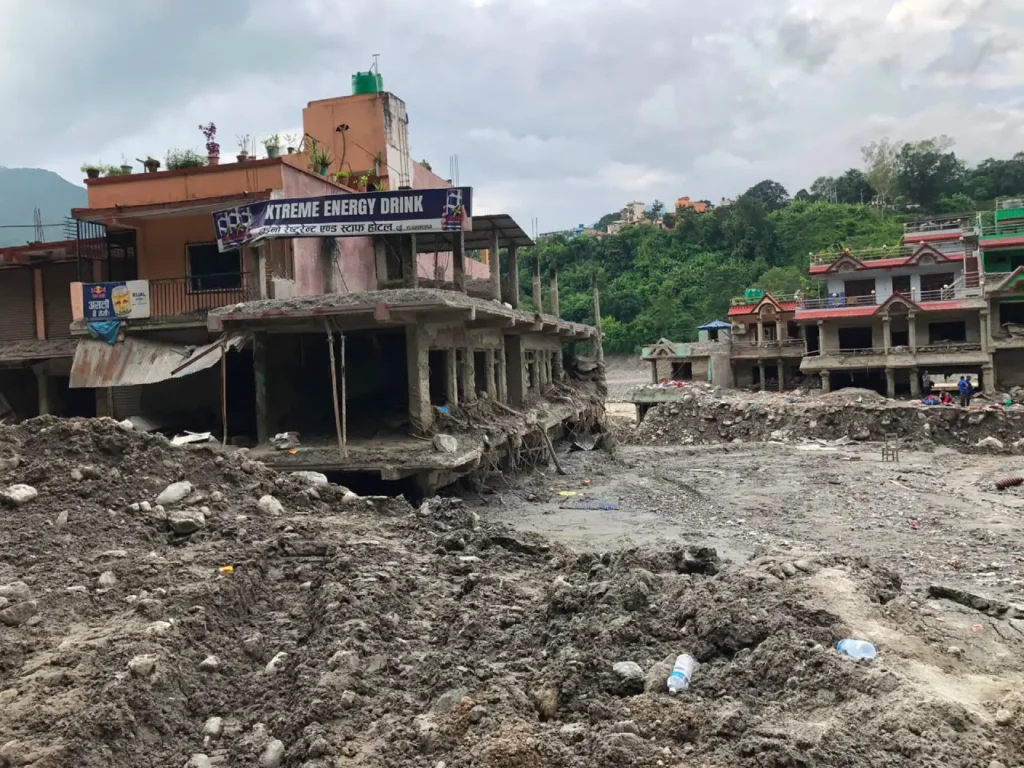
Remnants of the Trishuli bazaar after the floods
“Some 200 flights are being conducted every day by the army and private airlines between Nuwakot and Rasua since the disaster. We have flown in machinery, repair parts and rescue equipment piece by piece, because the roads that would normally carry heavy equipment simply no longer exist,” Colonel Jhabindra Reshmi Magar told The Borderlens.
More than 21,400 security personnel are currently deployed across the affected districts: over 9,200 from the Nepali Army, nearly 7,900 from Nepal Police, and just over 4,200 from the Armed Police Force — an operation now running on its second week without pause.
In Nuwakot, mainly four municipalities were affected – Belkot Gadhi, Bidur, Tarakeshwar and Kispang. “The flood swept away 15 motorable bridges, 9 suspension bridges, and destroyed the offices of 8 banks and financial institutions in Nuwakot alone.
As of Monday, over 3300 people have been rescued alive while 197 bodies have been recovered in Nuwakot alone,” Deputy Superintendent of Police (DSP) of the District Police Office, Nuwakot, Ekbal Hawari, told The Borderlens.
There have been small, hard-won victories. The Prithvi Highway’s Galchhi–Malekhu stretch, a 13-kilometre section that had been buried under thick mudslide debris, has been fully cleared and reopened, along with an alternate route toward Dhadingbesi — a lifeline that finally lets relief convoys move by road rather than exclusively by air. But for the upper reaches of Rasuwa, where entire settlements remain cut off, that relief has not yet arrived.
Along the Trishuli corridor, places such as Betrawati, Bidur and Devighat were struck by the force of the flooding. Homes disappeared, bridges were damaged and livelihoods tied to the river and roads were shattered.
Yet Nuwakot has also become a landscape of improbable survival. One of the most striking stories involved 64-year-old Chandika Shrestha, who disappeared for eight days. Her family, believing she had died, performed symbolic funeral rites using a body made from kush (sacred grass) — only for Shrestha to be found alive on the eleventh day.
The story carries something larger than the miracle itself. It explains why rescue teams have refused to stop looking. In a disaster where so many people disappeared within minutes, the boundary between hope and mourning has become extraordinarily thin.
Life in the holding centres
If the tunnels are where the search continues, the holding centres are where survival is now being managed. Nuwakot alone is running some 25 holding centres in different municipalities sheltering some 2,650 displaced people. Across all three worst-hit districts, over 3,500 people are currently living in some 40 such centres including 669 in Rasuwa, 2,651 in Nuwakot, and 213 in Dhading.
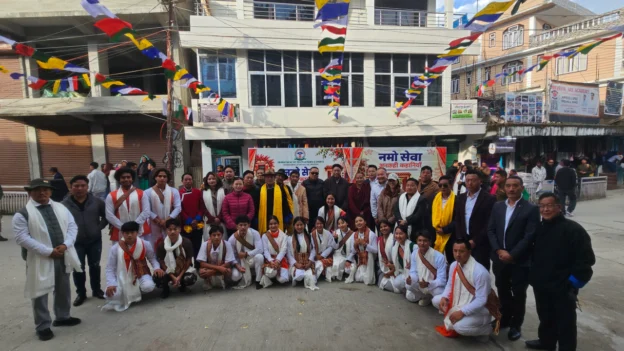
These are not places built for comfort. They are schools, community halls and open grounds pressed into emergency service — like the temporary centre set up at United Basic School at Battar, Bidur Municipality-4, in Nuwakot, where families who fled with almost nothing are now sleeping in classrooms. Managed by the Lions Club of Nuwakot Adarsha, this holding centre shelters 90 flood victims, according to the club’s President Bishnu Bhushan Chitrakar.
“Most of the flood victims taking shelter here are from Uttargaya Rural Muicipality-5, Rasuwa district. We provide food four times a day. But this is temporary arrangement. The school has already sent us a notice to vacate the school so that teaching and learning can resume here,” said Chitrakar.
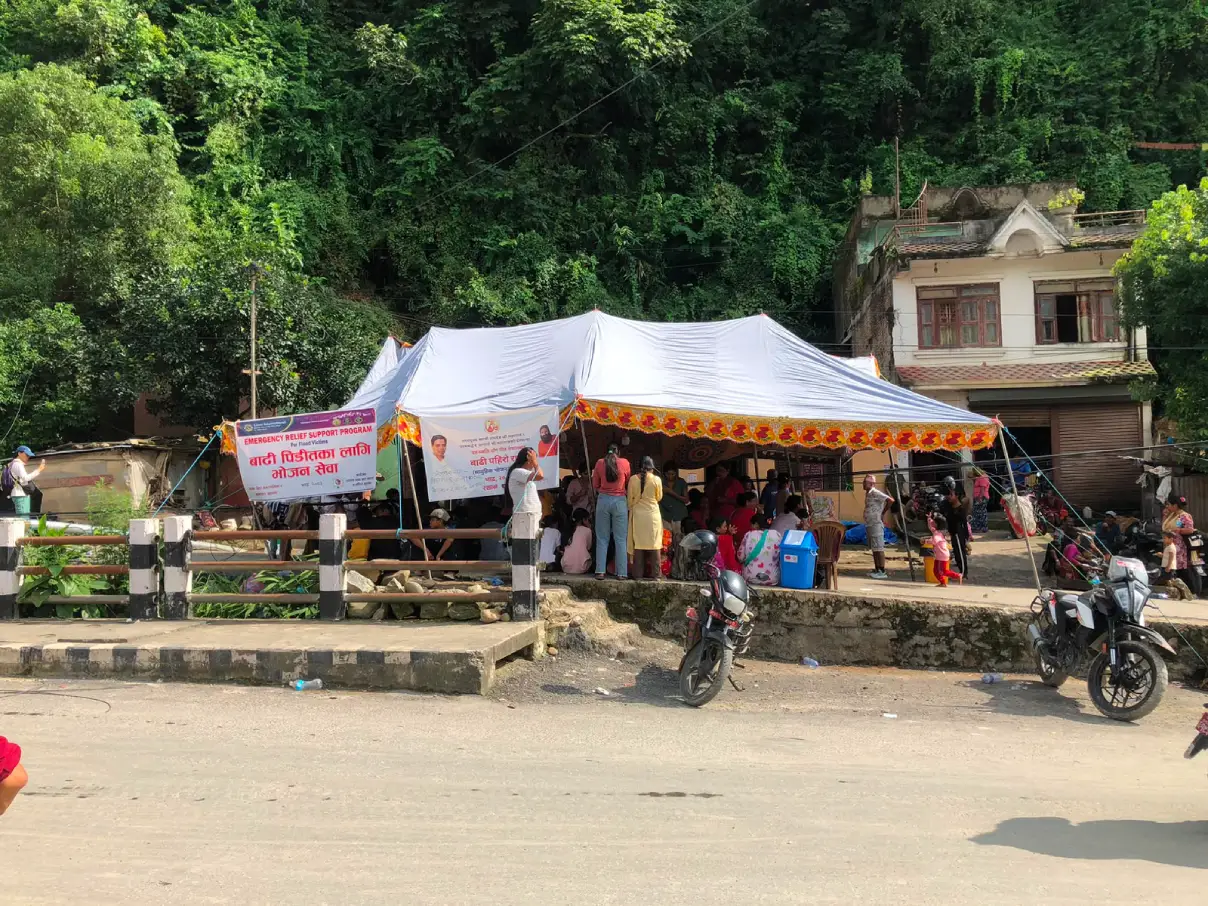
“I don’t know what I should say. More than 300 people are missing from Khalte where we used to live in Rasuwa. We have lost everything. At least we are getting food and shelter at this holding center. This is temporary, a quick fix. The state must find a sustainable solution to our problems,” remarked 35-year-old Wangde Ghale from Khalte, Uttargaya-5, Rasuwa district.
District officials in Nuwakot have adopted what they call a “one-door” system: relief material pouring in from dozens of donors — government agencies, international NGOs, political parties, student unions, even a motorcycle club — is funnelled through the District Disaster Management Committee and redistributed according to need, rather than left to arrive haphazardly.
Chief District Officer Shambhu Prasad Regmi, who coordinates the effort, said that whatever cannot reach a settlement by road is sent onward by helicopter.
“There is no dearth of relief. But relief distribution has become a bit difficult as all bridges connecting settlements across the river have been swept away. To address this, a tuin (improvised cable-crossing) has been installed, relief is also being provided through helicopters,” he said.
“I lost my father- and mother-in-law. Somehow I, my husband and our child survived. But we have nothing left. The flood took everything away from us – farmland, livestock, everything,” lamented Aiti Maya Tamang from Uttargaya-1, Rasuwa, who is taking shelter at the holding center set up at the Taekwando Covered Hall at Nagtari, Bidur Municipality-2, Nuwakot.
At this holding center, 166 people including 66 children are taking shelter. Most of them are from Rasuwa.
“We don’t have anywhere to go if we are asked to vacate this holding center. The government must give us land to build our new homes where we can live,” demanded Pemba Tamang of Uttarrgaya-1.
A response built from many hands
The federal government in Kathmandu is coordinating relief collection and distribution with provincial and local governments, with NDRRMA tracking need and supply district by district. But threaded through every field report from Rasuwa and Nuwakot this week is evidence of a much wider, improvised coalition of helpers.
There is no single image that captures what this disaster has done to Rasuwa, Nuwakot and the districts downstream — only an accumulation of them. A tunnel in Rasuwa where rescue workers from three countries are still, after 14 days, searching for hydropower workers who never came out. A classroom-turned-shelter where a district officer keeps a mental ledger of which family needs blankets and which needs medicine. A highway, buried and now cleared, carrying the first relief trucks in nearly two weeks. A motorcycle club, unasked, showing up with supplies anyway.
The scale of the government response has grown considerably since the first chaotic hours. The Nepal Army, Armed Police Force and Nepal Police have been deployed for search and rescue, evacuation, security, debris clearance and logistics. Helicopters have been used to evacuate stranded residents and deliver food and other essentials to areas cut off by damaged roads.
The government has also accepted a $5 million grant from the Asian Development Bank for the flood response and announced relief, tax and customs concessions intended to help affected businesses and industries recover.
But government presence has not always felt equally strong everywhere. Earlier reporting from affected areas recorded complaints from survivors that state assistance was slow or insufficient, particularly where roads had been destroyed. That tension — between an enormous official response and the experience of individual families still waiting for help — may become one of the defining questions of the recovery.
The response is not being carried by the state alone. International humanitarian organisations moved early and kept moving. The World Food Programme has supported emergency food assistance, while World Vision International Nepal has mounted an emergency response focused on Rasuwa and Nuwakot.
A flood survivor narrates her woes
Oxfam has been delivering water, sanitation and hygiene support across Rasuwa, Dhading and Nuwakot, and has pre-positioned close to Rs 16 million worth of emergency shelter and kitchen materials, ready to deploy as needs are identified. Save the Children has already distributed 200 units of non-food relief in Nuwakot. DanChurchAid (DCA) Nepal shipped gumboots, pickaxes, shovels, gloves and masks — unglamorous but essential tools for people digging through mud to find what’s left of their homes — into Dhading.
The International Federation of Red Cross and Red Crescent Societies released roughly USD 1.2 million in emergency funding to the Nepal Red Cross Society, money intended to get response work moving before larger, slower funding streams arrive. Foreign governments, India prominent among them, have sent aircraft loaded with tents, blankets, hygiene kits, solar lighting and medicine — a reminder that this disaster, which began with an avalanche near an international border, has drawn an international response.
Private companies and hydropower developers have contributed to relief funds. Banks and other businesses have offered financial support, while political parties and civic groups have mobilised money, supplies and volunteers.
Then there is the response that no ministry organised and no INGO or company funded: ordinary Nepalis showing up. Student wings have sent teams with relief supplies into Rasuwa after finishing distributions in Nuwakot. Truckloads of clothes, rice, lentils, fruit, vegetables and medicine are being carried to Nuwakot.
A civic collective calling itself the National Gen Z-Citizens Campaign organised its own independent collection drive. And in a detail that says something about how this crisis has pulled in every corner of civil society, members of the Yamaha Blue Streaks motorcycle community rode into Nuwakot with humanitarian supplies, unloading them at the same makeshift holding centre sheltering families who had lost everything days earlier.
Nepal’s response has shown the strength of its security forces, local governments, humanitarian agencies, private sector and ordinary citizens. It has also exposed the limits of a response when roads disappear, mountains become unstable and thousands of people are scattered across difficult terrain.
For those who survived, the greatest act of rescue may now be the one that lasts longest: ensuring that they are not forgotten once the helicopters stop circling. Because for a family standing beside the ruins of its home, survival is only the first chapter.
The real question is how to begin again.