Manipur’s porous 398-km border with Myanmar has emerged as a major security challenge as cross-border movement, refugee inflows and allegations of armed-group activity complicate the state’s prolonged ethnic conflict.
The frontier, which runs through five hill districts — Churachandpur, Chandel, Tengnoupal, Kamjong and Ukhrul — is largely hilly and forested, with several stretches yet to be fenced. Security agencies have flagged concerns over the movement of insurgents, illegal firearms and narcotics, while the influx of people fleeing Myanmar’s civil war has placed additional pressure on border communities.
The latest Naga-Kuki-Zo clashes have brought the border’s vulnerabilities into sharper focus. Naga organisations have accused Kuki armed groups, including the Myanmar-based Kuki National Army-Burma (KNA-B), of involvement in attacks on Naga villages. Kuki-Zo organisations, in turn, have blamed the Isak-Muivah faction of the National Socialist Council of Nagalim (NSCN-IM) and other Naga armed elements for attacks on their communities.
These are competing allegations. The KNA-B has denied an operational presence in India and accused authorities of scapegoating it. Manipur Police has also said an intelligence report alleging that more than 900 trained Kuki militants had infiltrated from Myanmar to attack Meiteis could not be substantiated on the ground.
The claims have not established a wider foreign hand in Manipur’s violence. The conflict continues to be driven by unresolved ethnic, territorial and political disputes, with the Myanmar frontier adding a cross-border dimension that makes the security situation harder to manage.
A long and difficult frontier
Manipur’s international boundary extends from the southern hills adjoining Myanmar’s Chin State to the eastern and north-eastern districts bordering Sagaing Region. The difficult terrain, dense forest cover, remote settlements and limited surveillance make continuous monitoring difficult.
Moreh, in Tengnoupal district, is the state’s principal land customs and immigration point, opposite Tamu in Myanmar’s Sagaing Region. The Moreh-Tamu corridor is a major commercial gateway, with Gate No. 1 used for regulated trade and Gate No. 2 located near Namphalong, a commercial hub on the Myanmar side.
The sector is also a focus of border security measures. Fencing has been reported near Kwatha, between border pillars 79 and 81, while the Moreh stretch between pillars 75 and 79 has been identified as particularly sensitive.
Further north, Chandel district includes the Molcham sector, between border pillars 64 and 68, and Choro Khunou, between pillars 88 and 95. These areas have figured in reporting on border alignment and fencing.
Kamjong shares 109 km of the international boundary, the largest share for any single district reported by the Manipur government. The Chassad-Kamjong belt has been described as a route used by insurgents. Villages including Chassad, Kamjong, Grihang, Ningchao, Nampisha, Phaikoh, Chrokhurnao and Aishi lie close to the frontier.
Aishi, about 1.5 km from Myanmar’s Molvailuk village, has been reported as a point used by insurgents to enter India and retreat across the border. However, the available material does not establish the current extent of such movement.
In Ukhrul district, the Chingai, Ukhrul and Kasom Khullen areas adjoin remote border terrain. To the south, Churachandpur shares the frontier with Myanmar’s Chin State through the Singhat and Thanlon areas, with Behiang an important border point.
The sensitive stretches identified in the material include Moreh-Kwatha in Tengnoupal, Molcham and Choro Khunou in Chandel, Chassad-Kamjong-Aishi in Kamjong, and Behiang in Churachandpur.
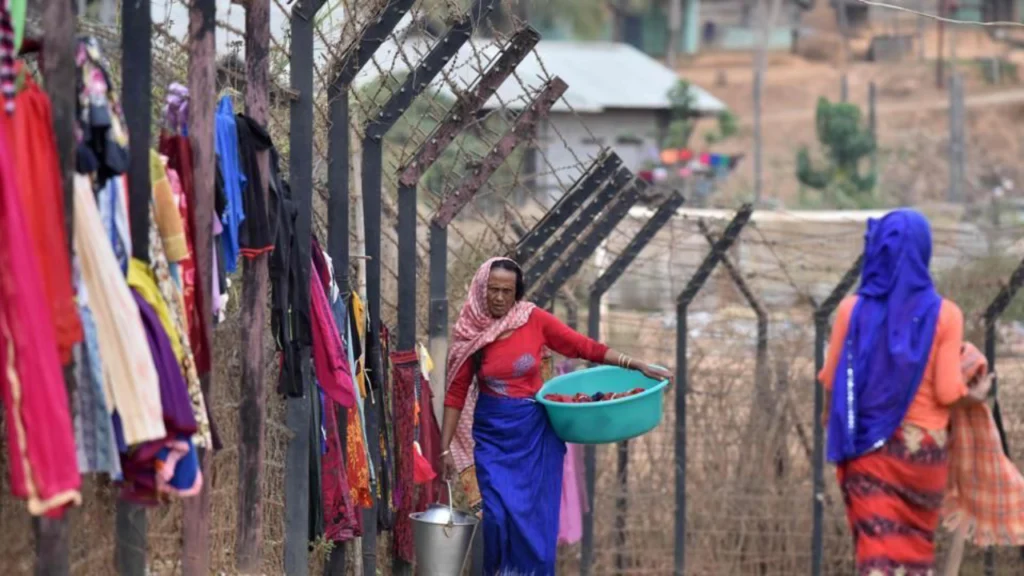
The challenge is not simply the absence of fencing. The frontier passes through inhabited areas where families, traders and communities have long-standing links across the international boundary. This makes enforcement more complex than securing an uninhabited border.
Fencing remains incomplete
The Centre is fencing the entire 1,643-km India-Myanmar border, which runs through Arunachal Pradesh, Nagaland, Manipur and Mizoram. Manipur accounts for 398 km of the boundary, between border pillars 32 and 130.
As of September 2026, about 55 km of Manipur’s border had been fenced, according to Home Minister Govindas Konthoujam’s statement in the state Assembly. The government has set 2028 as the target for completing the project.
Work is under way on another 80-km stretch, while a 9.2-km section in the Moreh sector, along with a parallel patrolling road, has been completed. The Centre has also approved hybrid surveillance system pilot projects covering about 1 km each in Manipur and Arunachal Pradesh, as well as fencing work along nearly 20 km in Manipur.
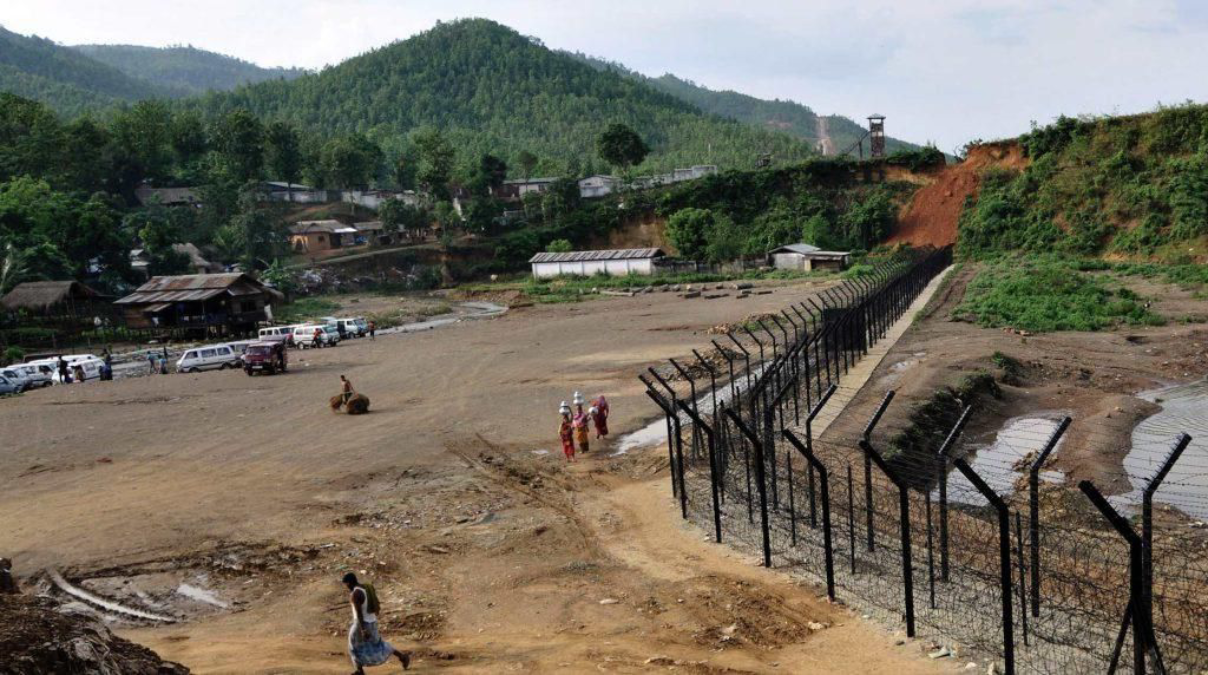
The project has faced delays because of the difficulty of transporting construction material through hilly and remote areas. Land acquisition and compensation disputes have also held up work in parts of Churachandpur district, including the stretch between border pillars 43 and 47.
The effectiveness of fencing will depend on more than the physical barrier itself. Patrol roads, surveillance systems, adequate security posts and effective checks at designated crossings will also be needed to restrict unauthorised movement.
The Assam Rifles is the primary border-guarding force and conducts patrols and counter-insurgency operations along the frontier. Its responsibilities include checking illegal immigration, smuggling and cross-border crime. The force operates forward posts and check posts, including at Khudengthabi in Tengnoupal district.
At Moreh, the Integrated Check Post regulates the movement of people and goods. Customs, immigration officials, the state police and district administration also play roles in border management, while the Army supports the broader security arrangement in sensitive areas.
The Assam Rifles has been designated as the issuing authority for QR-code-enabled border passes and conducts the first layer of security verification for people entering India from Myanmar. Of the 43 designated crossing points along the international border, 22 are functional, including 10 in Manipur.
End of the Free Movement Regime
The Centre’s decision to scrap the Free Movement Regime (FMR) marked a major shift in border policy.
The FMR, which had been in force since 1950, allowed people living within 16 km on either side of the India-Myanmar border to travel up to 16 km into the neighbouring country without a passport or visa. The arrangement reflected the ethnic, familial, cultural and economic ties of communities living along the frontier.
On February 8, 2024, Union Home Minister Amit Shah announced that the Ministry of Home Affairs had decided to scrap the regime to strengthen internal security and maintain the demographic structure of northeastern states bordering Myanmar.
The Centre argued that the arrangement had been misused for illegal immigration, narcotics trafficking and the movement of insurgent groups. The FMR has since been replaced by a system of regulated movement involving biometric identification and QR-coded border passes.
The change is intended to restrict movement to designated and monitored crossing points. However, it also affects communities with established links across the border, making implementation a sensitive issue in areas where the frontier cuts across traditional social and economic networks.
Refugee inflows add to pressure
Myanmar’s military coup in February 2021 and the ensuing conflict have pushed thousands of people into Manipur, many of them from Chin-Kuki-Zo communities.
Refugees have continued to enter border areas in batches, including since January 9, 2026, amid reports of Myanmar military airstrikes and fighting. Reports published by mid-2026 estimated that around 6,000 people had entered Manipur since November 2023.
The figures reported by different sources vary. The Manipur government has said at least 8,000 Myanmar nationals took shelter in Tengnoupal, Chandel, Churachandpur and Kamjong districts after the 2021 coup, with biometric details recorded for most of them.
A report published by The Week on April 12, 2024, said 6,973 Myanmar immigrants had entered Manipur illegally. Of them, 652 had been pushed back, 12 were in judicial custody or children’s homes, and 6,309 were staying in temporary shelters near the border.
Former Chief Minister N. Biren Singh said in August 2024 that 10,675 illegal immigrants had been detected over the preceding five years. The figure included people from Myanmar, Bangladesh, Norway, China and Nepal. Separate reports on biometric identification drives cited 5,457 people detected in Kamjong, 1,165 in Chandel and 1,147 in Tengnoupal.
These figures relate to different periods and categories and should not be treated as a single, reconciled count. Nor do they, by themselves, establish the extent to which cross-border migration has changed the state’s ethnic composition.
The government has cited the emergence of 996 new villages after 2006 as a concern linked to alleged illegal immigration. A Manipur Assembly resolution also cited population growth of 153.3% in the hill districts between 1971 and 2001 and 250.9% between 2001 and 2011, compared with 94.8% and 125.4%, respectively, in the valley.
However, population growth alone does not establish illegal immigration. Natural increase, internal migration, changes in settlement patterns, enumeration and the reclassification of villages may also affect the figures. A comprehensive, publicly available post-2011 ethnic census or citizenship verification exercise has not settled the dispute.
The demographic question remains politically contentious, with Meitei and Naga groups calling for an exercise to identify citizens and verify migration, while Kuki-Zo groups have raised concerns over the possibility of arbitrary exclusion.
Border violence sharpens ethnic fault lines
The frontier has become a flashpoint amid a deterioration in relations between Naga and Kuki-Zo communities.
The latest round of Naga-Kuki-Zo violence began in February 2026 in Litan, Ukhrul district, following a local altercation. It later spread to Kamjong, Kangpokpi, Tamenglong, Noney and parts of Senapati district. The immediate incidents have unfolded against a backdrop of territorial disputes, the Kuki-Zo demand for a separate political arrangement, the legacy of the Naga-Kuki clashes of the 1990s and the activities of armed groups and village volunteers.
Accounts of the death toll differ. One account puts the number killed since February at least 22 Nagas and 32 Kuki-Zo people by mid-October. Another compilation, covering early February to October 11, records 37 Naga and 36 Kuki-Zo deaths among the conflict fatalities. There is no comprehensive total for those wounded or the houses destroyed.
The violence has included arson, shootings and displacement. In May, coordinated attacks were reported on Choro, Namlee and Wanglee villages along the border. In October, at least 15 houses belonging to Kuki residents were reportedly burnt in Chassad, Kamjong, while a Kuki civilian was killed and four others injured in a gun attack earlier that day. Later reports put the number of houses burnt in fresh violence involving both communities at 28.
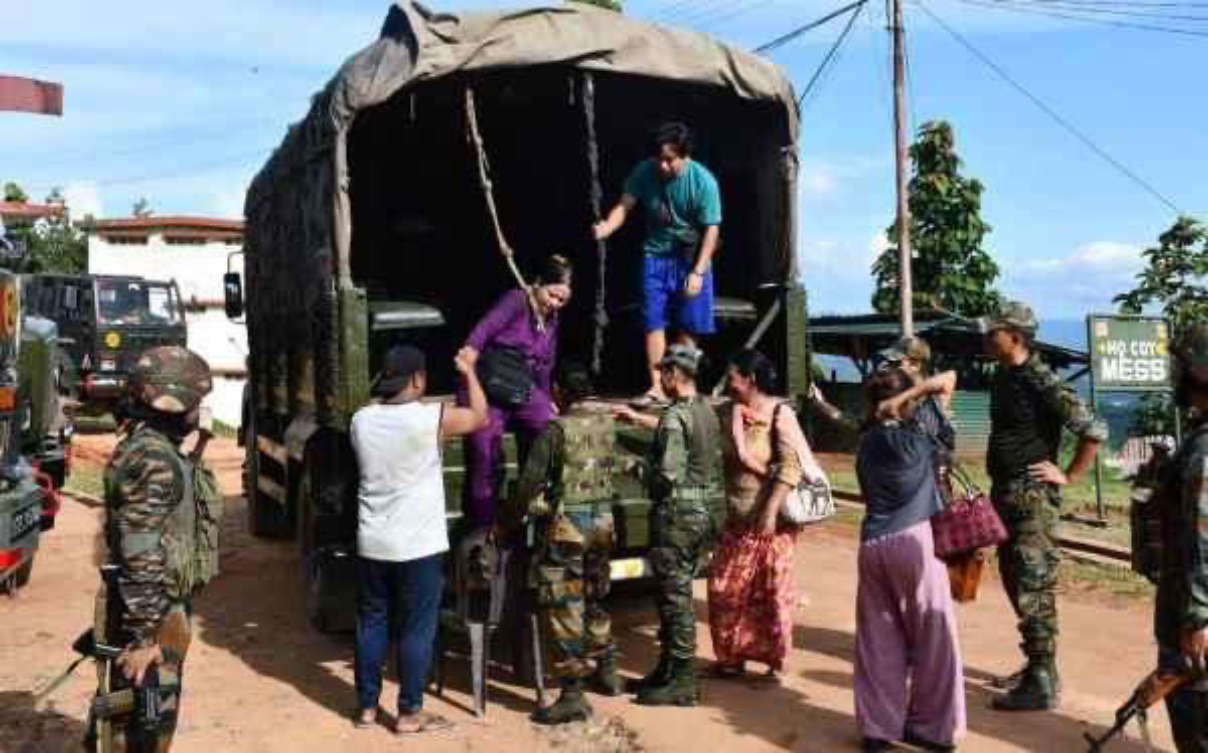
Other incidents have contributed to the displacement. At least 41 Naga houses, including churches, were reportedly burnt in Makui, Kangpokpi, in late September. Reports also cited 13 abandoned Naga houses in Pilong and Skipe, nine houses destroyed in one Kamjong incident and 24 houses burnt in a Kuki village in Noney in July. In mid-October, reports said more than 30 Kuki houses had been burnt in Chassad.
An early October memorandum said more than 200 Naga households had been displaced from eight villages in Noney, Tamenglong and Kangpokpi. In the latest incidents, women, children and older residents have reportedly fled to forests and Army camps.
The United Naga Council has condemned what it described as “ongoing, coordinated, and premeditated attacks on Naga villages and the brutal killing of innocent Naga civilians by armed Kuki militants”. It highlighted the Makui Ashang incident in Kangpokpi, in which four Naga lives were lost, including the reported beheading of civilian Ajinbou Ringkangmai, and two others were injured. The Council demanded arrests, prosecution, stronger security and an investigation into the role of security forces.
Kuki-Zo organisations have accused Naga armed groups, particularly NSCN-IM and the Zeliangrong United Front (K), of attacks on their villages. The Kuki-Zo Council has demanded an independent probe and protection for civilians, while the Kuki Inpi Manipur has blamed the state and Central governments for failing to maintain law and order. Other Kuki-Zo bodies have called for central forces, uninterrupted supplies and prosecution of those responsible.Meitei civil society groups have also condemned civilian killings and arson and called for stronger action against armed groups. The Meitei Alliance has alleged KNA-B involvement in some cross-border attacks and demanded an investigation into security lapses.
The Coordinating Committee on Manipur Integrity has framed the clashes within the wider problems of insurgency, territorial claims and the Centre’s handling of armed groups under the Suspension of Operations agreement.
These rival accusations underline the difficulty of establishing responsibility for individual attacks. They also show how the border’s security problems intersect with disputes over land, political representation and the presence of armed groups.
A wider conflict remains unresolved
The Naga-Kuki-Zo clashes are unfolding alongside the unresolved Meitei-Kuki-Zo conflict that began in May 2023. Although direct fighting between Meiteis and Kuki-Zos had eased in recent months, as reported by Reuters, the October 19 killing of three Meitei men collecting firewood near Nongsum Hills in Imphal East, and the injury of three others, has revived fears of a fresh confrontation. Police and local accounts attributed the attack to suspected Kuki militants.
Nearly 100 people were killed in more than 300 incidents across Manipur between January 1 and October 10, according to ACLED figures cited by NDTV. A Manipur Home Department report tabled in the Assembly said 28,899 internally displaced people were living in relief camps and temporary shelters in September 2026. Wider estimates put the number displaced since May 2023 at more than 60,000.
The political dispute over the Kuki-Zo demand for a separate Union Territory with a legislature remains unresolved. Supporters argue that a separate arrangement is necessary for security and self-government after the killings, displacement and destruction of homes since 2023. Naga organisations oppose territorial arrangements they believe could affect their ancestral lands, while Meitei groups oppose the division of Manipur.
The Centre has not accepted the demand. The overlapping claims make any territorial settlement difficult and reinforce the need for a broader political process involving Meitei, Naga and Kuki-Zo stakeholders.
The BJP-led state government and the Centre have faced criticism over their handling of the violence. Congress leaders have accused them of failing to protect civilians and demanded the Chief Minister’s resignation and President’s Rule. These are political allegations; there is no credible public evidence that the BJP or RSS directly organised or participated in the recent Naga-Kuki clashes.
The immediate challenge is to prevent further attacks, protect civilians and establish accountability for killings and arson. But security action alone is unlikely to resolve the underlying disputes.
Manipur’s Myanmar border is not the sole cause of the state’s crisis, nor do allegations of cross-border involvement prove that outside actors are directing the violence. Nevertheless, the frontier’s incomplete fencing, difficult terrain, refugee movement and alleged armed-group routes add a significant layer to an already complex conflict.
The Centre’s response — fencing, surveillance and regulated border passes — is intended to restrict unauthorised movement. Its effectiveness will depend on completing the infrastructure, maintaining surveillance, strengthening coordination among security agencies and addressing the needs of border communities.
Ultimately, the border question cannot be separated from Manipur’s wider political crisis. Unless security concerns are addressed alongside competing territorial claims, displacement and the unresolved demands of the state’s communities, the hill districts along the Myanmar frontier will remain vulnerable to renewed violence.