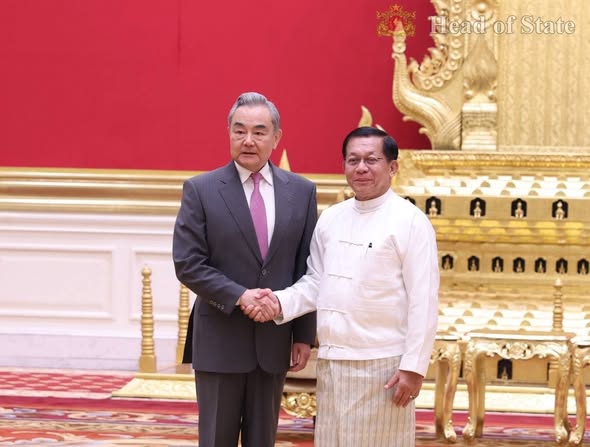
China has sent one of its clearest signals yet of support for Myanmar’s newly installed leadership, with Foreign Minister Wang Yi arriving in Naypyitaw on April 25. The visit marks the first by a senior Chinese political figure since Min Aung Hlaing assumed the presidency, underscoring Beijing’s intent to stand firmly behind the new administration at a time of deep international scepticism.
The timing is significant. Myanmar’s January 2026 elections were widely dismissed by Western governments and the opposition National Unity Government as a “sham.” China, however, took a markedly different stance. Even before the polls, Beijing had expressed support for the electoral process, framing it as a step toward stabilisation and a pathway to resolving the country’s protracted conflict. Wang Yi’s visit effectively formalises that endorsement, positioning China as the regime’s most consequential international backer.
State media in Myanmar described the visit as a reaffirmation of the long-standing “Pauk-Phaw” relationship, highlighting a shared vision of building a “community with a shared future.” Meetings between Wang Yi and Foreign Minister U Tin Maung Swe focused on strengthening bilateral ties, expanding cooperation, and enhancing coordination in regional and international forums. Both sides emphasised “mutual support” and a commitment to deepening practical engagement across sectors.
A key theme in the discussions was Myanmar’s relationship with the Association of Southeast Asian Nations (ASEAN). While ASEAN as a bloc has not endorsed the elections, individual member states have begun cautiously re-engaging. Thailand has taken a particularly proactive role, positioning itself as a bridge to help normalise Myanmar’s ties with the grouping.
This shift was evident in the April 22 visit by Thailand’s Deputy Prime Minister and Foreign Minister, Sihasak Phuangketkeow, to Naypyitaw. As the first high-level ASEAN outreach since the new government took office, the visit carried both symbolic and strategic weight, hinting at a gradual recalibration in how regional actors engage with Myanmar despite lingering concerns over legitimacy.
Thailand, alongside China, is also emerging as an important facilitator in Myanmar’s fragile peace process. Efforts are underway to revive dialogue under the National Ceasefire Agreement framework, even as key ethnic armed organisations such as the Karen National Union and the Chin National Front continue to reject recent overtures from the government.
Against this backdrop, Wang Yi’s visit takes on deeper significance. It reflects not just diplomatic engagement, but China’s broader strategic calculus in Myanmar—a country that sits at the crossroads of South and Southeast Asia and is central to Beijing’s regional ambitions.
China is Myanmar’s largest trading partner and one of its most significant investors, with interests spanning infrastructure, energy, and natural resources. At the heart of this engagement lies the China–Myanmar Economic Corridor, a flagship component of the Belt and Road Initiative that seeks to connect China’s landlocked Yunnan province to the Indian Ocean.
This corridor includes high-value projects such as the Kyaukphyu deep-sea port in Rakhine State and a network of oil and gas pipelines running from the Bay of Bengal into China’s interior. These pipelines are strategically crucial, allowing Beijing to bypass the vulnerable Malacca Strait while securing long-term energy supplies.
Beyond infrastructure, Chinese investments are deeply embedded in Myanmar’s resource-rich border regions, particularly in Kachin and Shan states. Mining operations, cross-border trade networks, and energy projects have made these critical to China’s economic footprint. At the same time, instability in these areas poses direct risks to Chinese assets, making political stability in Myanmar an overriding priority for Beijing.
This helps explain the strong emphasis during Wang Yi’s meetings on border stability, security cooperation, and tackling cross-border crime, including online scam networks. Both sides reiterated their commitment to maintaining peace along the shared frontier—an issue of immediate concern for China given the spillover risks of Myanmar’s internal conflict.
Wang Yi also reaffirmed China’s support for Myanmar’s peace process, describing Beijing as a “reliable neighbour.” In return, Myanmar reiterated its adherence to the “One China Policy” and expressed support for broader Chinese global initiatives, signalling a deepening alignment that extends beyond bilateral ties.
For Min Aung Hlaing, the visit carries both symbolic and practical importance. Facing international isolation and persistent internal resistance, his administration relies heavily on China for diplomatic legitimacy, economic support, and progress on development projects.
For Beijing, the relationship is equally consequential. Myanmar offers strategic access to the Indian Ocean, a corridor for energy security, and a buffer along China’s southwestern frontier. Even amid ongoing conflict and political uncertainty, China appears determined to deepen its engagement rather than retreat.
The visit, therefore, reflects a carefully calibrated partnership—one rooted not in ideology, but in mutual necessity. As Western influence remains limited and ASEAN continues to tread cautiously, China is steadily consolidating its role as the central external actor shaping Myanmar’s trajectory.