The latest tensions surrounding Lapangap village in Meghalaya’s West Jaintia Hills district have once again brought the fragile and unresolved Meghalaya-Assam border issue back into sharp public focus, exposing how decades-old territorial disputes continue to directly affect the lives and livelihoods of ordinary people living along the interstate boundary.
The unrest, which intensified this week after residents of Lapangap village marched to the Meghalaya Secretariat in Shillong, reflected far more than a routine protest over land. It highlighted deepening frustration among border communities who believe their concerns over security, farming rights and alleged encroachment have remained unresolved despite repeated rounds of talks between the two neighbouring states.
The long-standing border friction between Meghalaya and Assam has resurfaced at a time when the leadership of both states has often projected political unity under the broader framework of the BJP-led National Democratic Alliance (NDA) and its larger vision for regional stability in the Northeast. However, events unfolding on the ground suggest that despite political coordination at the top, unresolved disputes continue to generate anger and insecurity among communities residing in sensitive border areas.
The issue, which had been simmering for months, erupted publicly on June 13 when residents of Lapangap village, accompanied by women, elders, farmers and supported by several prominent pressure groups, descended upon Shillong and staged a protest outside the Secretariat. The march began from Barik Point and proceeded towards the memorial of the legendary freedom fighter U Kiang Nangbah, underscoring the symbolic and emotional significance of the movement for the local Khasi-Pnar community.
Upon reaching the Secretariat, tensions briefly escalated as protesters attempted to push through security barricades, leading to a tense standoff with police personnel. Slogans demanding accountability from the Meghalaya government echoed through the streets, with some demonstrators openly calling for the resignation of Chief Minister Conrad K. Sangma and Deputy Chief Ministers Prestone Tynsong and Sniawbhalang Dhar over what they described as the government’s failure to adequately protect border residents.
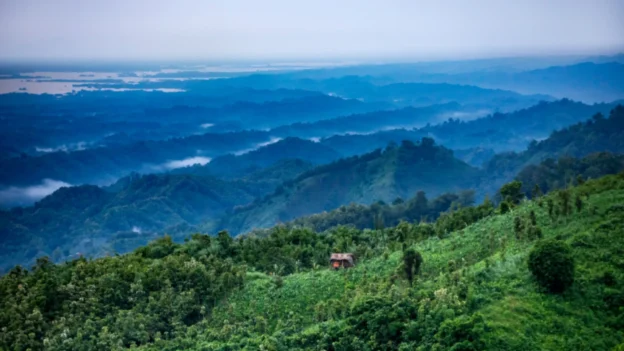
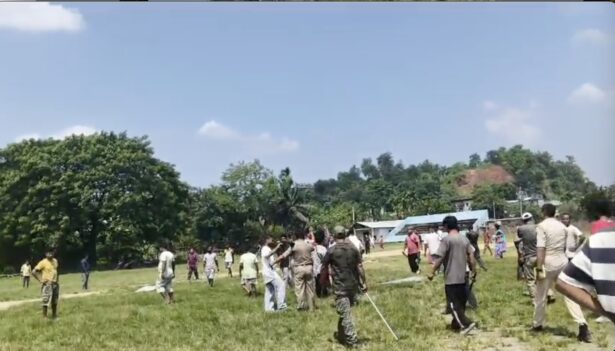
The massive mobilization was driven by growing resentment and fear among villagers over alleged harassment and territorial encroachment involving Karbi groups and Assam police personnel near disputed agricultural lands located along the West Jaintia Hills-Karbi Anglong sector. Farmers from Lapangap claim that they are increasingly being prevented from cultivating ancestral farmland that has sustained generations of local families.
For the villagers, the issue is not merely about maps, administrative boundaries or political negotiations. It is fundamentally tied to survival. Agriculture remains the primary source of livelihood in the area, and fears surrounding access to farmland have triggered serious anxieties ahead of the new cultivation season.
Several villagers recounted painful experiences from October 2025, when they allegedly had to harvest paddy crops under extreme pressure and fear of violence. According to residents, the continued presence of an Assam police camp at Lum Pynthror — an area they insist falls within Meghalaya — has become a symbol of what they describe as continued intimidation and occupation. The controversial “GPS line” reportedly drawn by Assam authorities has further intensified mistrust and confusion among local residents.
The villagers also expressed frustration over what they perceive as the inadequate response of Meghalaya’s own security apparatus. Some protesters alleged that while Assam police personnel actively assist Karbi settlers in the disputed zone, Meghalaya farmers feel abandoned and powerless within their own territory. During discussions with government officials, community leaders reportedly described the situation as one where locals feel like “slaves in their own land.”
The tensions were further aggravated after a peace meeting held on May 5, 2026, in Khanduli reportedly failed to produce any meaningful breakthrough. Although the Karbi side had sought time to consult community members, villagers from Lapangap claimed that no tangible progress followed, forcing them to carry their grievances directly to the state capital.
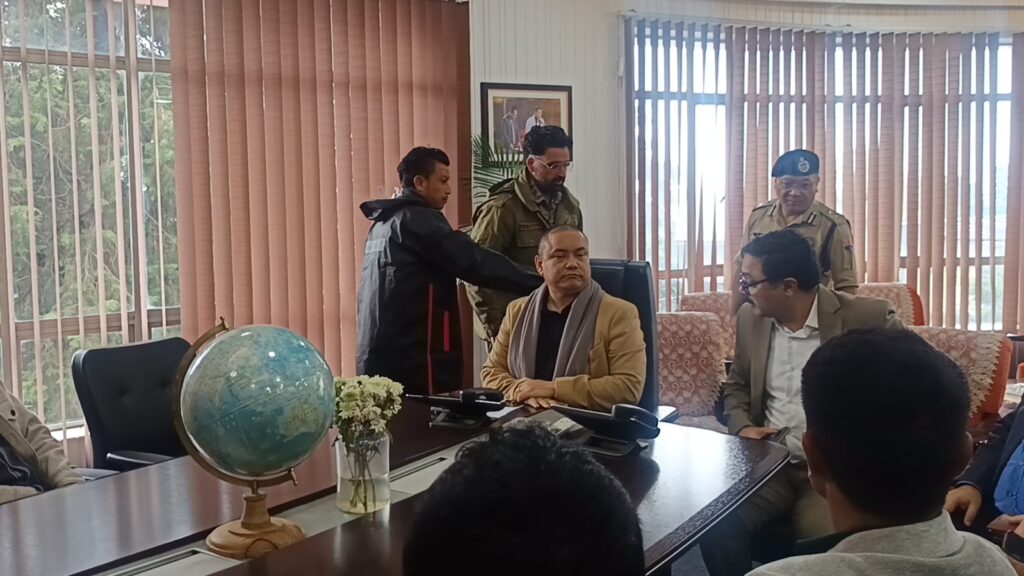
Faced with mounting public pressure and growing unrest in Shillong, the Meghalaya government was ultimately compelled to respond swiftly. Deputy Chief Minister Sniawbhalang Dhar, who oversees Border Area Development, convened an emergency meeting involving the Chief Secretary, Director General of Police and the Deputy Commissioner of West Jaintia Hills.
The government acknowledged that while the larger border settlement process between Meghalaya and Assam remains a complicated and long-term political issue, the immediate safety of farmers could not be ignored. In response, Deputy Commissioner Abhinav Kumar Singh addressed protesters outside the Secretariat and assured them that SF-10 Special Forces personnel would be deployed to vulnerable border outposts to ensure the safety of farmers and facilitate normal agricultural activities.
Authorities also promised that senior officials, including the Deputy Commissioner and Superintendent of Police, would personally visit the affected areas to monitor the situation and oversee security arrangements on the ground.
While the protesters eventually agreed to temporarily suspend their agitation following these assurances, the underlying tensions remain far from resolved. Village elders and supporting organizations, including the KSU, JSU, JNC and HFU, have warned that if harassment continues or if government assurances fail to materialize, they are prepared to intensify their protests in the coming weeks.
The Lapangap episode has once again exposed how unresolved border disputes in the Northeast continue to evolve into deeply emotional and politically sensitive conflicts involving land, identity, security and dignity. For communities living along these contested boundaries, the issue is no longer seen merely as an interstate administrative dispute, but as a daily struggle over livelihood, belonging and survival.