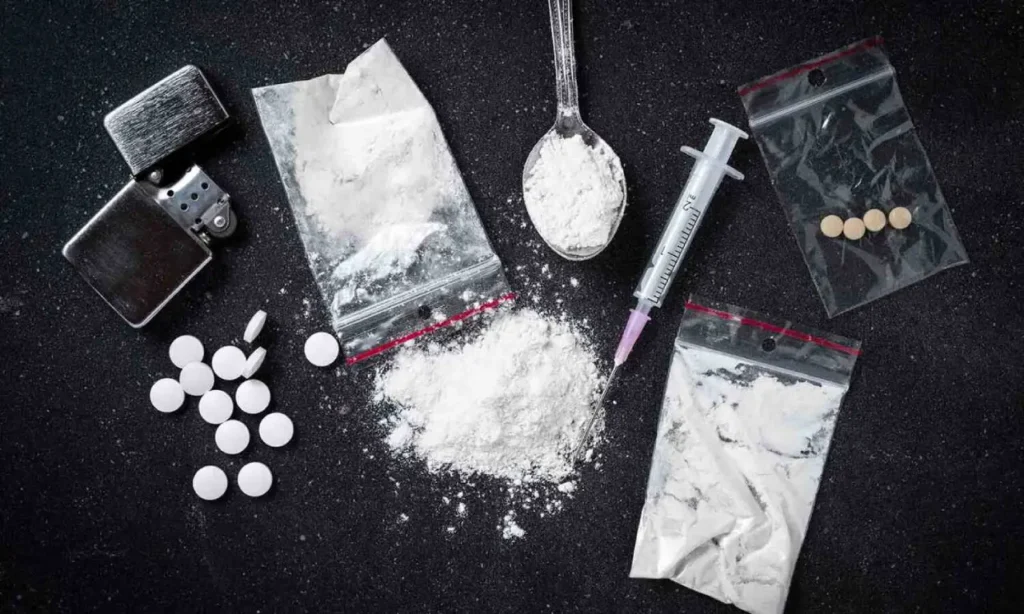
On 17 May in New Delhi, the Narcotics Control Bureau (NCB) arrested Thachintuang, a Myanmar national from Chin State and the kingpin of one of the biggest transnational drug trafficking networks along the India–Myanmar border. Chintuang was the second major Myanmar-based drug supplier caught by the NCB in 2026. In another operation between 24–25 April this year in Manipur’s Churachandpur district, Indian Drug Law Enforcement Agencies (DLEAs) seized heroin worth ₹11 crore. The consignment, possibly from Myanmar, was intended for distribution in illicit drug markets in other regions of India.
Similarly, in recent years, the DLEAs have identified and destroyed clandestine laboratories involved in the manufacture of other narcotic products such as methamphetamine and mephedrone and their precursors, with key hotspots identified in Maharashtra, Gujarat, Punjab, Manipur, Nagaland, Mizoram, the Delhi-NCR region, Madhya Pradesh and Rajasthan.
Several such arrests and seizures point towards North East India (NEI) as one of the critical trans-shipment points. This triggers several questions, of which the most important is how much narcotics is actually entering India through the NEI region, particularly in the Manipur and Mizoram sectors of the India–Myanmar border, where such large-scale seizures have been reported. This is particularly important in enabling policymakers and the DLEAs to initiate and execute prevention and intervention strategies.
The understanding of the DLEAs is that whatever narcotics is seized in the NEI states originates in Myanmar, except for the Active Pharmaceutical Ingredients (APIs) and raw materials used for processing, which originate in India. This is because Myanmar is surplus in finished narcotics. Owing to the absence of border fencing, the civil war in Myanmar, a low investment-to-profitability ratio, the low-volume, high-value nature of narcotic products, and increasing demand, the market for narcotics production and smuggling is growing.
According to UNODC reports, poppy cultivation in Myanmar regions bordering India (particularly Chin State, which borders the Indian states of Manipur and Mizoram) is not a new phenomenon. These satellite imagery-based and ground-truthing reports help us understand how much area is under poppy cultivation and, by default, the approximate quantities of heroin that should enter India each year. UNODC reports suggest that the area under poppy cultivation is growing every year.
Since heroin yield depends mainly on laboratory efficiency, a Drug Enforcement Administration (DEA) laboratory efficiency study in Colombia estimated that 8 kg of oven-dry opium was needed to produce 1 kg of 100% pure heroin (8:1). This ratio varies by region: 7:1 in Afghanistan and 10:1 in the rest of the world, including Myanmar. These figures provide an estimate of both pure heroin and heroin of unknown purity production.
According to the UNODC report of 2025, Chin State, Myanmar (bordering the Indian states of Manipur and Mizoram), had 832 ha and 1,040 ha under poppy cultivation in 2024 and 2025 respectively. The average opium production in Myanmar was 20.5–23.5 kg per hectare and, therefore, on average, Chin State produced 18 MT and 20 MT of oven-dry opium in 2024 and 2025 respectively. Thus, 1 ha could yield approximately 2–2.3 kg of heroin. Even using conservative estimates, Chin State had the potential to produce 1.65–1.9 MT of heroin in 2024 and 2.1–2.3 MT in 2025.
The entire poppy season and associated activities such as lancing, exudation, scraping, and processing into morphine, brown sugar and heroin usually take one year (September to August), but can take more than a year in Chin State. This is because post-harvest activities are complex due to several variables, including terrain, the availability of raw materials for processing opium and skilled labour, and frequent conflicts involving the Myanmar Armed Forces and other armed groups. Therefore, whatever opium was produced in 2024 would likely be processed and pushed into the market only in 2026. This year, we can expect the entry of 1.65–1.9 MT of heroin.
For several other narcotic products, there is difficulty in quantifying the approximate amount entering India annually because of the lack of data on manufacturing and/or processing units across the border. For such products, one can apply the ‘iceberg effect’ in narcotics trafficking, whereby, based on available narcotics seizure statistics and literature, there is an informal consensus among DLEAs that there is a 1:10 ratio of “drugs seized” to “drugs escaped” (undetected trafficking) in the illicit drug market. This means that for every unit of drugs seized, approximately ten units pass through undetected.
For example, in 2024, about 849.45 kg of ATS drugs was seized in Mizoram. Using the iceberg effect, approximately 8,494.5 kg of ATS drugs must have evaded detection in the Mizoram sector, and the same or even higher quantity might enter the NEI sector in the ensuing years. Therefore, based on available data for 2024, we can only arrive at approximate quantities that may have slipped through and those that might enter in future.
The need of the hour is to obtain and publish as much information as possible on narcotics and seizures. As per the International Narcotics Control Board (INCB), control is exercised over 145 narcotic drugs, mainly natural products such as opium and its derivatives, synthetic drugs such as methadone and pethidine, as well as cannabis and coca leaf.
This list of seizures (NCB Report 2024) across India included approximately 25-plus different substances, which is not exhaustive when compared to the 145 types of narcotic drugs under control. This is not to suggest that all 145 controlled substances are present and being abused in India, but one should not discount the possibility of abuse involving such a spectrum of substances.
The geopolitics and geoeconomics behind illicit narcotics are becoming more complicated than before. Following the return of the Taliban in Afghanistan, the area under poppy cultivation declined by 95%, indicating that farmers were adhering to the ban announced in April 2022.
Consequently, global supply dynamics shifted, with Myanmar in the Golden Triangle overtaking Afghanistan as the world’s leading opium producer.
In addition, the all-out war by the USA against narcotics—including fentanyl, heroin and crystal methamphetamine—through operations targeting factories along the borders with Canada and Mexico that processed APIs into fentanyl, has forced narcotics operators to seek alternative markets for supplying APIs, and India will be one of them.
UNODC does not conduct a dedicated, standalone annual “Opium Survey” for India because India is a legal producer of opium for the pharmaceutical industry, whereas the UNODC’s primary crop-monitoring programme focuses on illicit cultivation.
Therefore, one of the essential components of narcotics prevention and enforcement is the availability of adequate data on narcotics diversity, quality and quantity, especially as much has happened, including ethnic conflict, over allegations relating to an illicit narcotics ecosystem in the Manipur and Mizoram sectors along the India–Myanmar border.
All this suggests that we need a much stronger database containing substance-wise and state- and Union Territory-wise data on all 145-plus categories of substances and APIs, their movements, factories, and the mapping of seizures, finances, peddlers, etc. Such data will help us understand, interpret and develop substance-specific policies against any form of abuse, and design and execute effective prevention and intervention strategies in the NEI region, which has become one of the major trans-shipment hubs for illicit narcotics.