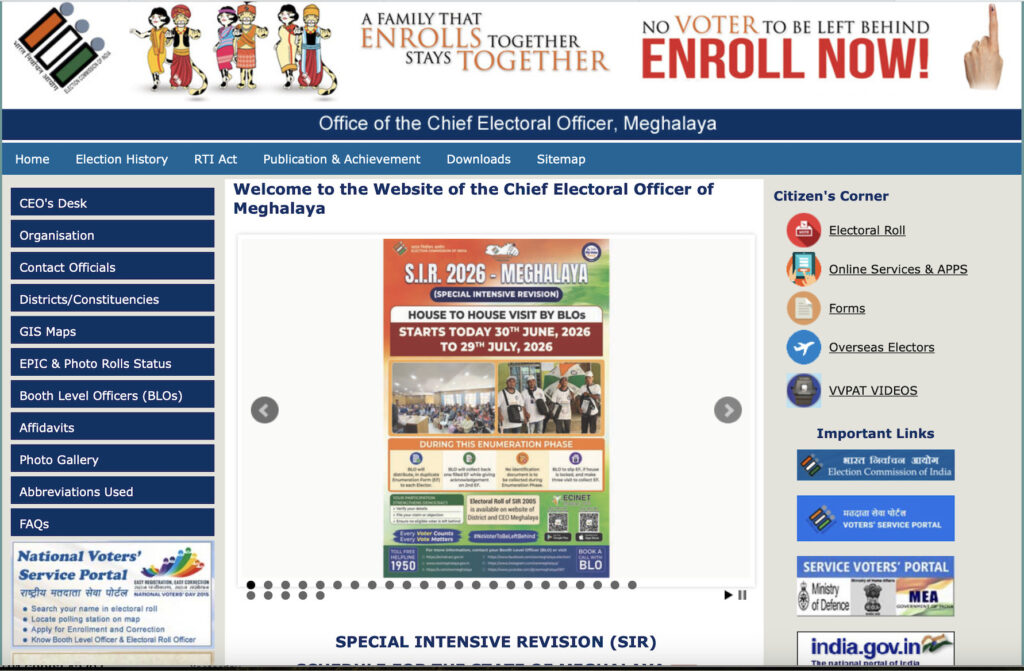
The Office of the Chief Electoral Officer (CEO), Meghalaya, under the leadership of Dr BDR Tiwari, has officially launched the Special Intensive Revision (SIR) 2026. Being carried out in strict accordance with the timeline and programme announced by the Election Commission of India (ECI), the primary objective of this intensive exercise is to ensure a flawless electoral roll, where no eligible citizen is left out and no ineligible person is included.
To accomplish this significant task, the state has deployed a robust network of trained electoral officials. A total of 3,551 Booth Level Officers (BLOs) have been deployed across Meghalaya, all of whom have undergone specialised training for the revision exercise. Supporting and supervising this extensive network are 60 Electoral Registration Officers (EROs), 166 Assistant Electoral Registration Officers (AEROs), and 410 BLO Supervisors, all of whom have been carefully appointed and trained to facilitate the smooth conduct of the exercise.
Meghalaya currently has a total electorate of 23,49,645 electors, translating to an average of 662 electors assigned to each Booth Level Officer. The extensive house-to-house verification campaign officially commenced on 30 June 2026, with BLOs visiting households to distribute Enumeration Forms (EFs) and verify electoral details. The exercise recorded an encouraging start, with 1,19,129 Enumeration Forms distributed on the very first day, achieving an initial coverage of 5.07 per cent of the state’s total electorate.
A district-wise analysis of the launch reveals that the Garo Hills region emerged as the clear frontrunner during the initial phase of the exercise. South West Garo Hills recorded the highest coverage in the state, successfully distributing Enumeration Forms to 20.49 per cent of its electors on the first day. North Garo Hills followed with a 10.25 per centcoverage rate, while South Garo Hills registered 6.67 per cent, and West Garo Hills recorded 6.50 per cent coverage.
In comparison, East Khasi Hills, which has the largest electorate in Meghalaya, handled the highest volume of physical Enumeration Forms. As of 3.00 pm on 1 July 2026, election officials in the district had distributed 28,006 Enumeration Forms, accounting for 4.43 per cent of its total electorate.
The house-to-house verification and distribution phase will continue until 29 July 2026. The procedure has been designed to be simple and accessible. Booth Level Officers will distribute the Enumeration Form in duplicate to each elector. After the form has been completed, the BLO will collect one copy while issuing a formal acknowledgement on the second copy retained by the elector.
To minimise inconvenience to citizens, no supporting documents are required during the initial enumeration stage. In cases where a house is found locked, the BLO will leave an Enumeration Form slip at the premises and is required to make up to three follow-up visits to collect the completed form.
As an alternative to physical submission, electors may also complete and submit their Enumeration Forms online during the revision period. Online self-enumeration can be carried out through the ECINET mobile application, available on both the Google Play Store and the Apple App Store. Electors may also access the official ECINET portal online or use the Voter Services Portal.
To assist electors, the 2005 legacy electoral roll, which was prepared during Meghalaya’s last Special Intensive Revision more than two decades ago, has been made available online. Citizens can access this legacy roll through the official website of the Chief Electoral Officer, Meghalaya, the websites of the respective district administrations, the ECINET mobile application, or the Voter Services Portal. The 2005 legacy roll is also available offline with the respective Booth Level Officers for verification.
Electors whose names appear in the 2005 legacy electoral roll are strongly advised to note down their relevant particulars before filling out the new Enumeration Form. These include their name, relative’s name, state, district, Assembly Constituency number, Part number, and Serial number, to ensure accurate completion of the form.
For citizens who migrated to Meghalaya from other states after 2005, their details will naturally not appear in the Meghalaya legacy roll. Such electors should instead search the Voter Services Portal or the ECINET application to retrieve their details from the last intensive revision roll of their respective state of origin, prepared between 2002 and 2005, and record the corresponding electoral particulars.
Although no supporting documents are required to be attached to either the physical or online Enumeration Form, a recent passport-size photograph must be affixed to the physical form or uploaded while completing the online submission.
Where an elector’s name does not appear in the 2005 legacy electoral roll, but the names of their parents or grandparents are included, the applicant may furnish the electoral details of those parents or grandparents for verification purposes.
For any further information or logistical assistance, electors are encouraged to contact their respective Booth Level Officers. The names and contact details of the designated BLOs have been prominently displayed at every polling station. In addition, citizens can book appointments or request a direct call from their assigned BLO through the ECINET mobile application, which also features a QR code for quick and convenient download.
The Office of the Chief Electoral Officer has appealed to all eligible electors across Meghalaya to cooperate fully with the visiting officials, complete their Enumeration Forms carefully, and return them within the prescribed timeline to help ensure an accurate, comprehensive and fully updated electoral roll for the state.